
The Milkmaid of Montfermeil (Novels of Paul de Kock Volume XX)
Paul de Kock
THE CLASSIC COLLECTION · 1904
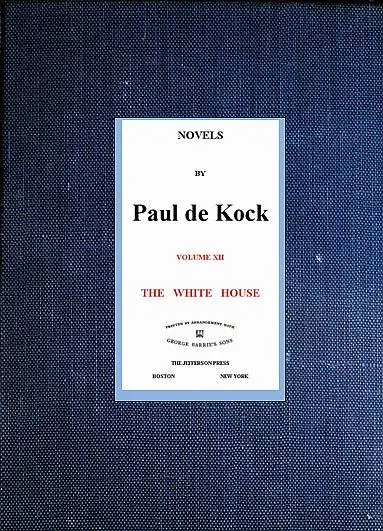
"The White House" by Paul de Kock is a novel written in the early 19th century. Set against the backdrop of Parisian society, the story revolves around the life of a government clerk named Robineau. The plot explores themes of social status, romance, and the comedic misadventures of its characters through their interactions at a lavish reception hosted by the affluent Baron de Marcey. The opening of the novel introduces us to Robineau as he navigates his mundane life as a clerk while yearning for social advancement and romance. He encounters two wealthy acquaintances in the Palais-Royal garden, Alfred and Edouard, who invite him to a grand reception at the baron's residence. Despite his self-deprecating humor and jealousy over his friends' wealth, Robineau struggles with his own lack of fortunes, especially as he prepares for the social event amid thoughts of his love interest, a milliner named Fifine. The introduction sets the stage for Robineau's hopes and aspirations, depicting a blend of lighthearted banter and the underlying social commentary of the era.
Introduction adapted from the source catalogue; source summaries may be automatically generated.
Free to read · English · 152,580 words · No account needed
MAKE TIME FOR A GOOD BOOK
On by default. Untick to stop anonymous reading totals. Each page counts after 10 seconds in view. How this works.
Anonymous counting is on unless you have switched it off.
Edouard said no more; in spite of himself vague suspicions assailed his mind. To dissipate them he glanced at the girl, whose every feature was so instinct with innocence. After several minutes passed thus, he realized that he ought to return to the château, for he wished that his absence should not be noticed, or, at all events, to conceal the fact that he had been to Chadrat. So he rose and said to Isaure:
"I must leave you now."
"Already, monsieur?" said the girl ingenuously.
"What!" cried Edouard; "may I hope that my presence has given you some
pleasure?"
"As I have told you, monsieur, I very seldom have an opportunity to talk with anyone here in the mountains."
"Oh! to be sure," said Edouard more coldly; "and that is the only
reason?"
He interrupted himself, thinking:
"Well! one would suppose that I expected this girl to be in love with me already?--I preach at Alfred, and I am no better than he is."
"I will go down the mountain with you," said Isaure; "it is time for me to go home--my poor Vaillant must be tired."
She ran at once to collect her herd, and drove it toward the valley, skipping about and laughing heartily at every antic of her goats. Edouard followed her, saying to himself:
"Her heart is calm and undisturbed; this frank gayety, this sweet unrestraint show that her mind is not burdened with thoughts of love. Poor child! for her own good, I pray that she may never know that passion, which causes more sorrow than pleasure!"
Edouard sighed; something whispered to him that he would be very glad to make that sorrow and that pleasure known to Isaure.
They reached the cottage, Isaure opened her door, and her dog ran out and leaped upon her; then he looked at Edouard and walked around him, but showed no temper.
"I believe that he recognizes you already," said the girl.
Edouard walked up to Vaillant and patted him a moment; the dog made no objection, but kept his eyes fixed on his mistress, as if to ask her whether the young man was a friend of hers.
"Good!" said Edouard, "I see that we shall be very good friends before long.--Adieu, charming Isaure! until to-morrow morning."
"Until to-morrow, Monsieur--Pardon me, but I do not know your name."
"My name is Edouard."
"Very well; until to-morrow, Monsieur Edouard, as you will not rest a moment under my roof to-day."
As she spoke, the girl curtsied gracefully to Edouard, then entered the house singing. The young man retraced his steps to La Roche-Noire, dreaming of the little goatherd.
Your reading position is saved on this browser. Take it to another device with a library code. Reading pages adapt to text, rather than matching a printed edition.
Paul de Kock

Paul de Kock

Paul de Kock

Paul de Kock
BEHIND THE BOOK
This eBook is for the use of anyone anywhere in the United States and most other parts of the world at no cost and with almost no restrictions whatsoever. You may copy it, give it away or re-use it under the terms of the Project Gutenberg License included with this eBook or online at www.gutenberg.org. If you are not located in the United States, you will have to check the laws of the country where you are located before using this eBook. Read the source licence.
The original source file, including credits and licence, is retained by this library. Request an original-format copy at no charge. Please include the book title and Project Gutenberg identifier #40712.
KEEP YOUR CURIOSITY GOING
Coulson Kernahan

Maurice Baring
Frances Wright
Cécile Tormay

Frederic Jesup Stimson

W. H. P. (William Henry Pope) Jarvis