
The Milkmaid of Montfermeil (Novels of Paul de Kock Volume XX)
Paul de Kock
THE CLASSIC COLLECTION · 1904
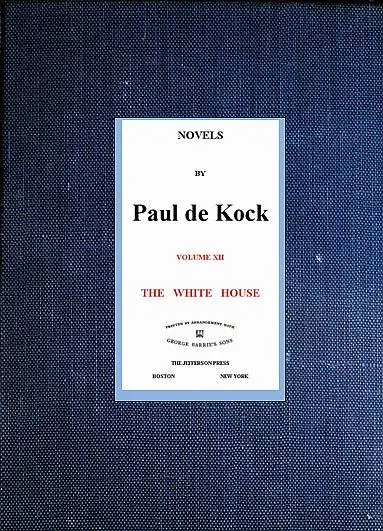
"The White House" by Paul de Kock is a novel written in the early 19th century. Set against the backdrop of Parisian society, the story revolves around the life of a government clerk named Robineau. The plot explores themes of social status, romance, and the comedic misadventures of its characters through their interactions at a lavish reception hosted by the affluent Baron de Marcey. The opening of the novel introduces us to Robineau as he navigates his mundane life as a clerk while yearning for social advancement and romance. He encounters two wealthy acquaintances in the Palais-Royal garden, Alfred and Edouard, who invite him to a grand reception at the baron's residence. Despite his self-deprecating humor and jealousy over his friends' wealth, Robineau struggles with his own lack of fortunes, especially as he prepares for the social event amid thoughts of his love interest, a milliner named Fifine. The introduction sets the stage for Robineau's hopes and aspirations, depicting a blend of lighthearted banter and the underlying social commentary of the era.
Introduction adapted from the source catalogue; source summaries may be automatically generated.
Free to read · English · 152,580 words · No account needed
MAKE TIME FOR A GOOD BOOK
On by default. Untick to stop anonymous reading totals. Each page counts after 10 seconds in view. How this works.
Anonymous counting is on unless you have switched it off.
"No, you have drunk quite enough."
"Never mind, bourgeois; when we’re celebrating your arrival, we won’t hold back and look at the others; and everybody coming here to-night to dance, too!"
"I don’t want them to come to dance to-night; let them come some other
time."
"But you invited all the good people who gave you such a fine concert," said Alfred, "and you must receive them. You have chosen to play the seigneur, so you must submit to the consequences.--Now let us inspect the château."
"I am going to guide my master," said Cunette.
"You’d do better by going to bed, drunkard!"
"I know my duties, monseigneur."
Robineau and his friends left the bedroom. Monsieur Cunette, who was exceedingly pig-headed in his cups, and who considered that the concierge should be present at the inspection of the château, followed his master, supporting himself against the walls.
They walked through long, venerable galleries, lighted by great ogive windows, through which the light found its way with difficulty, however, because the glass was coated with dust. They entered enormous rooms, all decorated in the same general style as Robineau’s bedroom, where the eye could hardly reach the ceiling.
"This château must have been in existence in the time of King Pepin,"
said Edouard.
"It is all superb," said Robineau, who gazed in admiration at every landscape painted over the doors and mirrors.
"Say rather that it must have been very beautiful two centuries
ago!--But now!"
"Mirrors are still mirrors, my dear Alfred."
"Very good! but the gilding is no longer gilding, and the paintings look
like old fans!"
"For a baron, you seem rather indifferent to the value of what is venerable. I am certain that Monsieur Edouard appreciates the beauties of this château better than you do."
"To my mind," said Edouard, "there is a touch of romance, of vagueness
about it."
"Isn’t there? It’s magnificent! There’s room enough to lodge a
regiment!"
"There’s just as many rooms on the second floor, master," mumbled Monsieur Cunette, standing at the door of the room in which the young men were. "It’s the same thing over again, except perhaps the ceilings are a little lower and there ain’t such pretty pictures as there is here."
"In that case it is unnecessary for us to inspect the second floor."
"Ah! messieurs, this gallery opens on a terrace from which we can see
the whole neighborhood."
"The terrace is in rather bad condition."
"What are those slits in the wall?"
"They are loop-holes," said Edouard; "and there are machicoulis, I believe, in those sally-ports."
Your reading position is saved on this browser. Take it to another device with a library code. Reading pages adapt to text, rather than matching a printed edition.
Paul de Kock

Paul de Kock

Paul de Kock

Paul de Kock
BEHIND THE BOOK
This eBook is for the use of anyone anywhere in the United States and most other parts of the world at no cost and with almost no restrictions whatsoever. You may copy it, give it away or re-use it under the terms of the Project Gutenberg License included with this eBook or online at www.gutenberg.org. If you are not located in the United States, you will have to check the laws of the country where you are located before using this eBook. Read the source licence.
The original source file, including credits and licence, is retained by this library. Request an original-format copy at no charge. Please include the book title and Project Gutenberg identifier #40712.
KEEP YOUR CURIOSITY GOING
Coulson Kernahan

Maurice Baring
Frances Wright
Cécile Tormay

Frederic Jesup Stimson

W. H. P. (William Henry Pope) Jarvis