
Lucia in London
E. F. (Edward Frederic) Benson
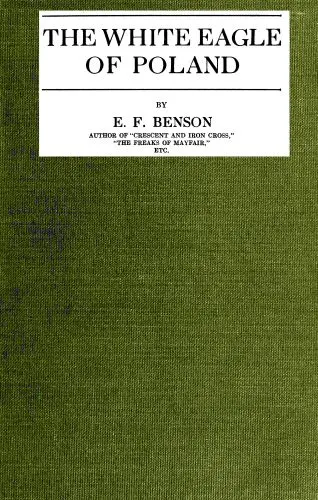
THE CLASSIC COLLECTION · 1919
"The White Eagle of Poland" by E. F. Benson is a historical account likely written in the early 20th century, specifically around the time of World War I. The book focuses on the intricate political and social dynamics surrounding the reconstruction of an independent Polish state after the war against the Central Powers. It discusses the significance of Poland's independence as crucial to the geopolitical balance in Europe and highlights the aspirations of Polish patriots to reunify the nation. At the start of this work, the author presents a preface that outlines the two main parts of the book. The first part discusses the historical context of Poland’s partitions and the influence of international politics on its sovereignty, emphasizing the necessity of a strong Polish state as a buffer to German expansionist policies. The opening content reflects on the European view of Poland prior to the war, acknowledging the lack of awareness about its geographical and cultural significance and introduces the notion that the resolution of Poland’s plight is a critical factor for global peace and stability.
Introduction adapted from the source catalogue; source summaries may be automatically generated.
Free to read · English · 47,452 words · No account needed
MAKE TIME FOR A GOOD BOOK
On by default. Untick to stop anonymous reading totals. Each page counts after 10 seconds in view. How this works.
Anonymous counting is on unless you have switched it off.
A further point to be noted about this proclamation is that it contains no hint that the provinces of the ancient republic now part of the Russian Empire, such as Lithuania, should be included in the reunited Poland to which the Grand Duke alluded, or that Russia contemplated in the faintest degree placing within the frontiers of the new autonomous state those territories which for the last hundred years she had incorporated into herself, and which were in fact ethnographically non-Polish, since the bulk of their inhabitants were White Russians or Little Russians. The National Democrats, and their allied groups also, who for years had worked for the unity and independence of Poland, at that date made no such claim, though their policy to-day includes the reunion with Poland of these provinces, but they accepted the Grand Duke’s manifesto as meaning that Russia intended to reunite with the Kingdom of Poland, Prussian Poland and Austrian Poland, and to place the whole with self-government, under the sceptre of the Tsar. Had Russia advanced into Germany and Austria, and made good her advance, so that in conjunction with France and England she could have dictated a peace, it is pretty clear that this was what she meant to do, and she probably would have been obliged to do it, since the Grand Duke’s proclamation as regards Poland was presently endorsed by all the Allies.
Now Russia never had the opportunity of fully vindicating her good faith with regard to the proclamation, for while she was in a state of war, and must needs strain every nerve to the vigorous prosecution of that, it would have been unreasonable to expect her to devote energies to the accomplishment of her promise, and within a year her armies, as we have noticed, had retreated from the Kingdom of Poland and Galicia altogether, leaving the enemy in possession. But during that year the Russian Government, distrusting perhaps the effect of the Grand Duke’s proclamation, did not endorse it by any practical measure, but on the other hand preserved and pursued a policy which was distinctly anti-Polish. Notices on the railways and in other public places written in Polish were suppressed, and the Russian advance through Galicia was followed by the importation of civil servants from Russia to replace Poles. As a guarantee of good faith, the Government might at least have begun placing Poles in official positions hitherto held by Russians, but nothing of the sort was done. Up till August, 1915, when the Germans were at the gates of Warsaw, the Russian Government made no official announcement about Polish independence, nor did they take any practical steps to warrant sincerity. All that the Russian Government did with regard to the fulfilment of the Grand Duke’s proclamation during that period was to nominate a Russo-Polish Commission in May, 1915, with the object of elaborating a project of Polish autonomy. There were six Poles on this commission, including M. Dmowski and Count Wielopolski, and six Russian representatives under the Presidency of the Prime Minister Goremykin. They could not come to any agreement, and the Polish members thereupon drew up and presented to the Government their own proposals. These dealt with two points: (i) immediate changes in the administration of the Kingdom of Poland, (ii) a constitution for Poland which recognised her as a separate state, under the Russian sceptre. This project was never even considered by the Russian Government, and, as was only natural, the sincerity of the Grand Duke’s proclamation came to be seriously questioned. But it is most significant that at the moment of Germany’s advance into Poland, Goremykin, then Minister of the Interior in Russia, announced to the Duma the granting of autonomy to Poland. The object of this was perfectly clear: now, when the enemy was in possession, the Government at last confirmed the Grand Duke’s promises in order to prevent the Poles from embracing the cause of the Central Empires and furnishing recruits for their armies. The confirmation, in fact, of the original proclamation, unrealisable, since the German armies were in occupation, was made in the same spirit as the proclamation itself. We may then, I think, take it for granted that no independent Polish state, to include all the territories of ancient Poland, was ever for a moment contemplated by Russia, nor demanded by Polish Nationalists, and that, as far as practical steps can supply a criterion of motive, the proclamation of the Grand Duke was little more than a defensive measure against Polish disloyalty in the face of the enemy.
Your reading position is saved on this browser. Take it to another device with a library code. Reading pages adapt to text, rather than matching a printed edition.
E. F. (Edward Frederic) Benson

E. F. (Edward Frederic) Benson

E. F. (Edward Frederic) Benson

E. F. (Edward Frederic) Benson
BEHIND THE BOOK
This eBook is for the use of anyone anywhere in the United States and most other parts of the world at no cost and with almost no restrictions whatsoever. You may copy it, give it away or re-use it under the terms of the Project Gutenberg License included with this eBook or online at www.gutenberg.org. If you are not located in the United States, you will have to check the laws of the country where you are located before using this eBook. Read the source licence.
The original source file, including credits and licence, is retained by this library. Request an original-format copy at no charge. Please include the book title and Project Gutenberg identifier #58914.
KEEP YOUR CURIOSITY GOING
Cécile Tormay

Moritz Busch
John L. Ransom
Frances Wright
Cécile Tormay

Mabel Potter Daggett