
Lucia in London
E. F. (Edward Frederic) Benson
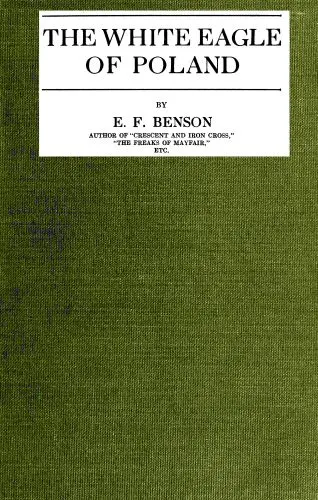
THE CLASSIC COLLECTION · 1919
"The White Eagle of Poland" by E. F. Benson is a historical account likely written in the early 20th century, specifically around the time of World War I. The book focuses on the intricate political and social dynamics surrounding the reconstruction of an independent Polish state after the war against the Central Powers. It discusses the significance of Poland's independence as crucial to the geopolitical balance in Europe and highlights the aspirations of Polish patriots to reunify the nation. At the start of this work, the author presents a preface that outlines the two main parts of the book. The first part discusses the historical context of Poland’s partitions and the influence of international politics on its sovereignty, emphasizing the necessity of a strong Polish state as a buffer to German expansionist policies. The opening content reflects on the European view of Poland prior to the war, acknowledging the lack of awareness about its geographical and cultural significance and introduces the notion that the resolution of Poland’s plight is a critical factor for global peace and stability.
Introduction adapted from the source catalogue; source summaries may be automatically generated.
Free to read · English · 47,452 words · No account needed
MAKE TIME FOR A GOOD BOOK
On by default. Untick to stop anonymous reading totals. Each page counts after 10 seconds in view. How this works.
Anonymous counting is on unless you have switched it off.
[6] A typical instance of this is the way in which she treated the cloth industry. Cloth made in the country for consumption in the country had to be taken to Vienna, paying an import duty on the way, to be stamped there and taken back, after paying another duty, to Galicia. Production was thus rendered impossible, and the factories were closed.
[7] In Russia similarly they have played Germany’s game, both by aiding and abetting the Bolsheviks while they were Germany’s tools, and by persistently making bad blood between the Poles there and the Russians.
[8] According to the Constitution there should have been 55 members
elected, but I have not been able to ascertain who the remaining three
are.
[9] These figures, however, include the populations of all Lithuania, Minsk and Volhynia, which are slightly greater than those in the programme.
[10] “Pre-War statistics of Poland and Lithuania,” G. Drage, p. 8. This estimate, if we compare it with others, gives the highest percentage of Poles.
[11] These are Vilna (205,000), Bialystock (90,000), Grodno (60,000), Brest-Litovsk (60,000), Schaulen (22,000), Slonim (22,000). These figures are derived from a recent German source.
[12] This has now been done, for at a meeting at Versailles on June 3, 1918, the Prime Ministers of Great Britain, France, and Italy, declared that a united and independent Poland, with access to the sea, was one of the conditions of a solid and just peace.
[13] It was at the battle of Grünwald (1410) that the Polish armies, under Ladislas Jagello, completely defeated the Teutonic knights.
[14] Galicia was little better off than Poland, and the same commandeering of supplies has gone on there ever since; as late as December, 1917, a Polish deputy, Stapinski, called attention to it in the Reichsrat.
[15] Yiddish, it may be explained, is not Hebrew at all, as is popularly supposed, though it is printed in Hebrew characters. It is really a Swabian dialect, and 70 per cent. of the words in it are German. Its more scientific name is Judaeo-Germanic.
[16] In certain districts, notably that of Kielce, there was a considerable amount of forced labour, for men were badly wanted to work in the unexploited mines there. Similarly we find that an appeal was made to the Pope in November, 1916, asking whether such compulsion was not an act of “intolerable tyranny.” After a considerable delay His Holiness replied that “as a neutral” he could not interfere in such internal questions. But in spite of such instances we shall probably be right to conclude that Germany did not make forced levies for labour to any considerable extent.
Your reading position is saved on this browser. Take it to another device with a library code. Reading pages adapt to text, rather than matching a printed edition.
E. F. (Edward Frederic) Benson

E. F. (Edward Frederic) Benson

E. F. (Edward Frederic) Benson

E. F. (Edward Frederic) Benson
BEHIND THE BOOK
This eBook is for the use of anyone anywhere in the United States and most other parts of the world at no cost and with almost no restrictions whatsoever. You may copy it, give it away or re-use it under the terms of the Project Gutenberg License included with this eBook or online at www.gutenberg.org. If you are not located in the United States, you will have to check the laws of the country where you are located before using this eBook. Read the source licence.
The original source file, including credits and licence, is retained by this library. Request an original-format copy at no charge. Please include the book title and Project Gutenberg identifier #58914.
KEEP YOUR CURIOSITY GOING
Cécile Tormay

Moritz Busch
John L. Ransom
Frances Wright
Cécile Tormay

Mabel Potter Daggett