
The Wonderful Year
William John Locke
THE CLASSIC COLLECTION · 1900
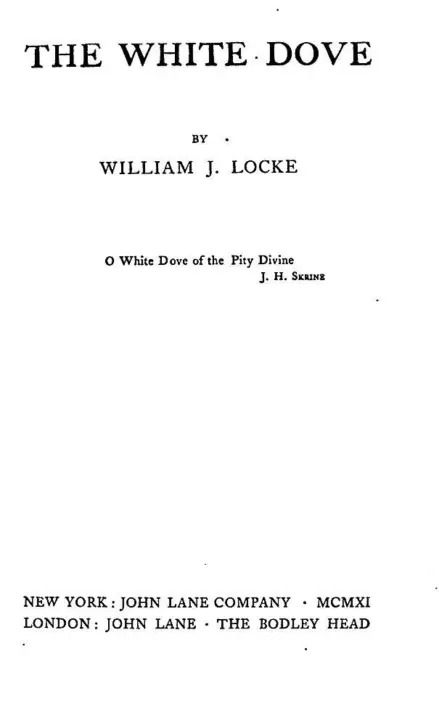
"The White Dove" by William John Locke is a novel written in the late 19th century. The story revolves around Sylvester Lanyon, a dedicated doctor who grapples with the memories of his deceased wife while navigating his relationships with those around him, particularly Ella Defries, a vibrant young woman who challenges his somber outlook on life. The novel explores themes of love, loss, and the complexities of human connection against the backdrop of a slow-paced, reflective life. The beginning of the novel introduces Sylvester in a thoughtful exchange with Ella, revealing their contrasting perspectives on life. While Ella advocates for embracing life's joys despite its struggles, Sylvester appears more guarded and introspective, weighed down by memories of loss. As their conversation unfolds, it becomes clear that Sylvester is on the cusp of significant change, having just sold his medical practice to pursue newfound ambitions in London. This pivotal moment sets the stage for the exploration of his character's internal conflict, laying the groundwork for the unfolding drama of relationships, societal expectations, and personal revelations throughout the story.
Introduction adapted from the source catalogue; source summaries may be automatically generated.
Free to read · English · 72,842 words · No account needed
MAKE TIME FOR A GOOD BOOK
On by default. Untick to stop anonymous reading totals. Each page counts after 10 seconds in view. How this works.
Anonymous counting is on unless you have switched it off.
“The Colony's a fraud, and she knows it's a fraud,” she said, in the vernacular of her class. “And yet she pins her immortal soul to it. Why doesn't she marry the man and be done with it? But no--she won't do that. She's making herself ill because the Colony isn't likely to come off, which is distinctly good business, and what on earth she can find to interest her in the rubbishy scheme, goodness only knows. If she only painted, or wrote poetry, or out-Wagnered Wagner in immortal tunelessness, one could perhaps understand. But she's no more artistic than you are.”
“I know I'm a Philistine,” smiled Sylvester, at the tribute of the artless lady. “Is that why you 've come to me?”
“Oh, you know what I mean,” returned Lady Milmo. “Now can't you put some sense into her, or get that dear Mr. Lanyon to do so? It's my impression she isn't in love with him one little bit.”
“Then, for Heaven's sake, my dear Lady Milmo,” said Sylvester, earnestly, “do all you can to impress that fact upon him!”
“I should be glad if the engagement were broken off,” said Lady Milmo,
reflectively.
“So would all the true friends of Ella Defries,” replied Sylvester.
Lady Milmo arched her eyebrows. She looked at him for a moment
quizzically.
“Is that purely a disinterested remark, Dr. Lanyon?”
“I would not marry one single woman that is now living on this earth,”
said Sylvester.
“Why, whatever have we poor creatures done to you? There are some men, I know, who look upon women as a disease, but I'm sure you 're not one.”
Sylvester scanned his finger nails,--a trick he had caught from his
father.
“One marriage is enough for a man, Lady Milmo,” he said in a low voice.
Lady Milmo was conscious of an indiscretion. She escaped adroitly and led the talk back to Roderick.
“I think we'd better get this silly affair of Ella's broken off, don't you?” she said at parting.
“If you could manage it, my father and myself would be exceedingly grateful to you,” he replied.
Lady Milmo was driving away, her kind head filled with schemes for Ella's extrication, when, at the block at Oxford Circus, she caught sight of a news-vendor wearing as an apron the coloured bill of an early edition of an evening paper. Across it in enormous capitals ran the startling legend, “Sudden Death of Sir Decimus Bland.”
“The best thing the pompous old idiot has ever done in his life!” said
Lady Milmo.
Your reading position is saved on this browser. Take it to another device with a library code. Reading pages adapt to text, rather than matching a printed edition.
William John Locke

William John Locke

William John Locke

William John Locke
BEHIND THE BOOK
This eBook is for the use of anyone anywhere in the United States and most other parts of the world at no cost and with almost no restrictions whatsoever. You may copy it, give it away or re-use it under the terms of the Project Gutenberg License included with this eBook or online at www.gutenberg.org. If you are not located in the United States, you will have to check the laws of the country where you are located before using this eBook. Read the source licence.
The original source file, including credits and licence, is retained by this library. Request an original-format copy at no charge. Please include the book title and Project Gutenberg identifier #56013.
KEEP YOUR CURIOSITY GOING
Coulson Kernahan

Maurice Baring
Frances Wright
Cécile Tormay

Frederic Jesup Stimson

W. H. P. (William Henry Pope) Jarvis