
The Wonderful Year
William John Locke
THE CLASSIC COLLECTION · 1900
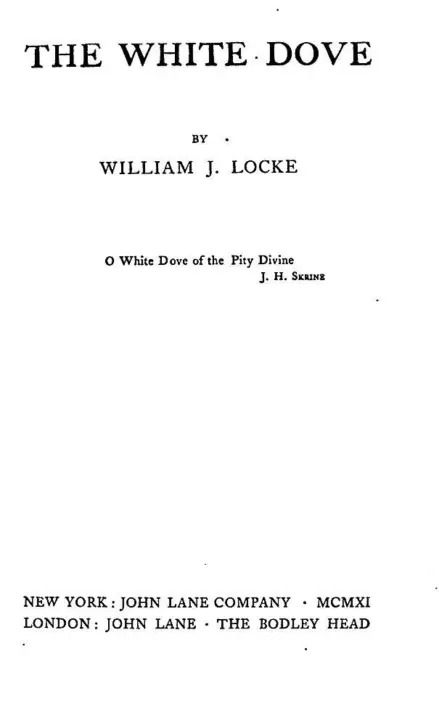
"The White Dove" by William John Locke is a novel written in the late 19th century. The story revolves around Sylvester Lanyon, a dedicated doctor who grapples with the memories of his deceased wife while navigating his relationships with those around him, particularly Ella Defries, a vibrant young woman who challenges his somber outlook on life. The novel explores themes of love, loss, and the complexities of human connection against the backdrop of a slow-paced, reflective life. The beginning of the novel introduces Sylvester in a thoughtful exchange with Ella, revealing their contrasting perspectives on life. While Ella advocates for embracing life's joys despite its struggles, Sylvester appears more guarded and introspective, weighed down by memories of loss. As their conversation unfolds, it becomes clear that Sylvester is on the cusp of significant change, having just sold his medical practice to pursue newfound ambitions in London. This pivotal moment sets the stage for the exploration of his character's internal conflict, laying the groundwork for the unfolding drama of relationships, societal expectations, and personal revelations throughout the story.
Introduction adapted from the source catalogue; source summaries may be automatically generated.
Free to read · English · 72,842 words · No account needed
MAKE TIME FOR A GOOD BOOK
On by default. Untick to stop anonymous reading totals. Each page counts after 10 seconds in view. How this works.
Anonymous counting is on unless you have switched it off.
He reached Matthew Lanyon's office in a seraphic temper, which a quarter of an hour's wait did not ruffle. When Mr. Lanyon's client had departed, he was shown into the office, where Matthew was seated at his desk.
“I thought you would come,” said Matthew, without further greeting. “Sit
down.”
“You are not looking at all well, my dear friend,” said Usher. “You should really take care of yourself. I always say it is wrong for a man to let his business affairs get the upper hand with him.”
It was true. Matthew had been ailing considerably of late, and his doctor had urged him to do a number of impossible things,--to go for a sea voyage, to reduce his practice, to take a partner. He was killing himself. He must stop, or human science wouldn't answer for the consequences.
“Human science can wait till she's asked,” the old man had replied with a certain humour. The past year had aged him considerably. His hair was greyer, his figure slightly bent, his face and hands thinner, his brow more care worn. Characteristically he had told Sylvester of none of his ailments, and during the weekends Sylvester had spent at Woodlands, he had made special efforts to appear bright and strong. When Sylvester, anxiously informed by his aunt, questioned him, he had laughed in his cheery way, but with a touch of petulance, and asked how he, a man of science, could attribute any importance to Agatha's silly whimsies.
He was not the man to be fond of pity, even from those dearest to him; a fortiori, he found Usher's sympathy particularly obnoxious.
“I'm exceedingly well,” he said somewhat irritably. “Better than I have been for months.”
“Perhaps the pleasant news has cheered you,” said Usher. “There is nothing like the happiness of others to make the heart young again. I am always rejoiced at the happiness of others. It is my nature.”
He said it with such an air of dull simplicity, uttering each vocable with weighty deliberation, that a smile flickered around Matthew's lips. “I really think you believe it.”
“I never disguise my sentiments. Falsehood is abhorrent to me.”
“Rubbish!” said Matthew, curtly. “I'm busy. I can only give you ten minutes. What have you come for?”
“To share your happiness in the engagement of our dear children,--my
son, your ward.”
“I am not pleased at all. Even you ought to know that.”
“Not pleased?”
“No. A marriage like that is an impossibility.”
Usher opened his eyes in reproachful astonishment.
“Why?”
“How can I let my ward marry a man like Roderick?”
“My son is a fine fellow,” said Usher.
Your reading position is saved on this browser. Take it to another device with a library code. Reading pages adapt to text, rather than matching a printed edition.
William John Locke

William John Locke

William John Locke

William John Locke
BEHIND THE BOOK
This eBook is for the use of anyone anywhere in the United States and most other parts of the world at no cost and with almost no restrictions whatsoever. You may copy it, give it away or re-use it under the terms of the Project Gutenberg License included with this eBook or online at www.gutenberg.org. If you are not located in the United States, you will have to check the laws of the country where you are located before using this eBook. Read the source licence.
The original source file, including credits and licence, is retained by this library. Request an original-format copy at no charge. Please include the book title and Project Gutenberg identifier #56013.
KEEP YOUR CURIOSITY GOING
Coulson Kernahan

Maurice Baring
Frances Wright
Cécile Tormay

Frederic Jesup Stimson

W. H. P. (William Henry Pope) Jarvis