
The Wonderful Year
William John Locke
THE CLASSIC COLLECTION · 1900
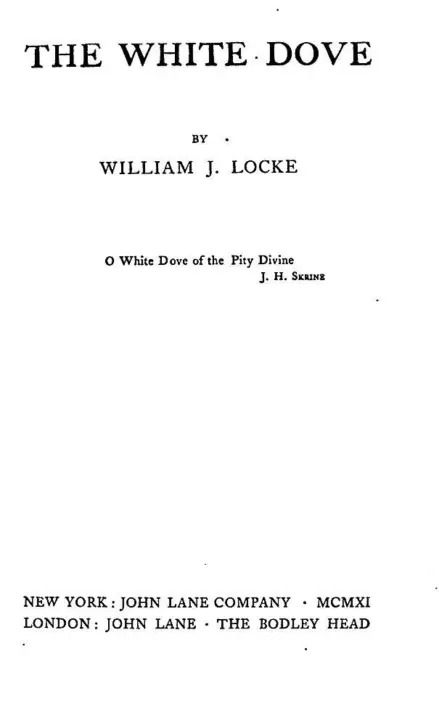
"The White Dove" by William John Locke is a novel written in the late 19th century. The story revolves around Sylvester Lanyon, a dedicated doctor who grapples with the memories of his deceased wife while navigating his relationships with those around him, particularly Ella Defries, a vibrant young woman who challenges his somber outlook on life. The novel explores themes of love, loss, and the complexities of human connection against the backdrop of a slow-paced, reflective life. The beginning of the novel introduces Sylvester in a thoughtful exchange with Ella, revealing their contrasting perspectives on life. While Ella advocates for embracing life's joys despite its struggles, Sylvester appears more guarded and introspective, weighed down by memories of loss. As their conversation unfolds, it becomes clear that Sylvester is on the cusp of significant change, having just sold his medical practice to pursue newfound ambitions in London. This pivotal moment sets the stage for the exploration of his character's internal conflict, laying the groundwork for the unfolding drama of relationships, societal expectations, and personal revelations throughout the story.
Introduction adapted from the source catalogue; source summaries may be automatically generated.
Free to read · English · 72,842 words · No account needed
MAKE TIME FOR A GOOD BOOK
On by default. Untick to stop anonymous reading totals. Each page counts after 10 seconds in view. How this works.
Anonymous counting is on unless you have switched it off.
“The prime of life, my dear sir,” he would say, “the heyday of existence! Up to sixty a man gathers his experience and tears his fingers dreadfully. After sixty he can sit down quietly and enjoy it and let his fingers heal.”
There was a pause in the talk, and the three sat, as they often did, content to be together, looking into the fire and thinking their own thoughts. Perhaps the girl's were the happiest. The room had darkened, and the firelight played on their faces gathered round the hearth. Suddenly Sylvester spoke.
“I was talking to Ella about my plans, father, before you came in.”
“A very sensible person to talk to,” said Matthew.
“I've burned my ships. I have sold the practice and am going to join
Frodsham in London.”
“I'm very glad indeed to hear it,” said the old man; “you should have done it years ago.”
His voice was suave and even, but the keen eye of the physician detected a trembling of the fingers resting on the broad leathern arm of the chair.
“I don't at all like to leave you,” said Sylvester, feeling guilty. Matthew waved away the reluctance.
“Nonsense, my boy. I'm not a cripple that requires to be taken care of. Grown up men can't be for ever hanging on to--I was going to say, to each other's apron strings. London is your place. Perhaps after a time, when I am dead and gone,--a man must die some day, you know,--you'll like to come back to the old house and devote yourself entirely to research and be independent of two guinea fees and that kind of thing. That would be nice, wouldn't it, Ella?”
The girl's heart throbbed at the share implied, but a tenderer feeling
quieted it at once.
“It would be impossible without you, Uncle Matthew,” she said.
He rose with a laugh. “None of us are indispensable, not even the most futile. I'm going to dress. You'll dine here, of course, Syl? And, Ella, tell them to get up some of the '84' Pommery to drink good luck to Syl.”
He walked out of the room with the brisk air of a man thoroughly pleased with life; but outside, in the passage, his face grew sad, and he mounted the stairs to his dressing-room very slowly, holding on to the balusters.
The younger folks remained for a while longer in the library. Sylvester bent forward and broke a great lump of coal with the poker.
“I'm not fit to black his boots, you know, My companionship means much more to him than Dorothy's does to me, and he gives it up without a murmur.”
Your reading position is saved on this browser. Take it to another device with a library code. Reading pages adapt to text, rather than matching a printed edition.
William John Locke

William John Locke

William John Locke

William John Locke
BEHIND THE BOOK
This eBook is for the use of anyone anywhere in the United States and most other parts of the world at no cost and with almost no restrictions whatsoever. You may copy it, give it away or re-use it under the terms of the Project Gutenberg License included with this eBook or online at www.gutenberg.org. If you are not located in the United States, you will have to check the laws of the country where you are located before using this eBook. Read the source licence.
The original source file, including credits and licence, is retained by this library. Request an original-format copy at no charge. Please include the book title and Project Gutenberg identifier #56013.
KEEP YOUR CURIOSITY GOING
Coulson Kernahan

Maurice Baring
Frances Wright
Cécile Tormay

Frederic Jesup Stimson

W. H. P. (William Henry Pope) Jarvis