
The Wonderful Year
William John Locke
THE CLASSIC COLLECTION · 1900
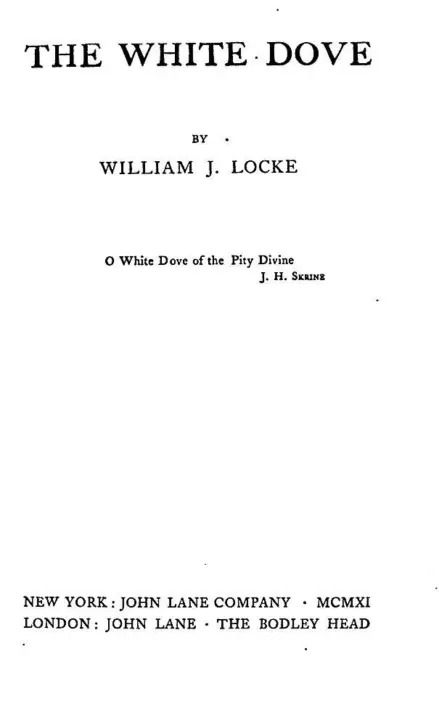
"The White Dove" by William John Locke is a novel written in the late 19th century. The story revolves around Sylvester Lanyon, a dedicated doctor who grapples with the memories of his deceased wife while navigating his relationships with those around him, particularly Ella Defries, a vibrant young woman who challenges his somber outlook on life. The novel explores themes of love, loss, and the complexities of human connection against the backdrop of a slow-paced, reflective life. The beginning of the novel introduces Sylvester in a thoughtful exchange with Ella, revealing their contrasting perspectives on life. While Ella advocates for embracing life's joys despite its struggles, Sylvester appears more guarded and introspective, weighed down by memories of loss. As their conversation unfolds, it becomes clear that Sylvester is on the cusp of significant change, having just sold his medical practice to pursue newfound ambitions in London. This pivotal moment sets the stage for the exploration of his character's internal conflict, laying the groundwork for the unfolding drama of relationships, societal expectations, and personal revelations throughout the story.
Introduction adapted from the source catalogue; source summaries may be automatically generated.
Free to read · English · 72,842 words · No account needed
MAKE TIME FOR A GOOD BOOK
On by default. Untick to stop anonymous reading totals. Each page counts after 10 seconds in view. How this works.
Anonymous counting is on unless you have switched it off.
Roderick laughed with good-humoured indulgence, showing a set of white,
even teeth.
“The same old intransigeant,” said he. “Well, go your ways. I'll convert you to the Colony yet, and make you a director! Auf wiedersehen!”
Sylvester shook hands with him in his glum style and strolled on towards the Marble Arch, glad to be winning homewards again away from the froth of fashion and the jargon of art. He smiled once on his way. It was at the idea of his father, shrewd-headed abhorrer of cranks, putting his hands in his pockets for the Walden Art Colony. Not while there was a lazy miscreant with wife and children in Ayresford, he thought. How could a man of the world like Roderick imagine him to be such a fool?
But Roderick, with his cheery air of confidence, followed the southward
stream of people.
“How do, Usher?” said a young man, passing by.
Roderick stopped him. “My dearest boy, I haven't been able to see you to shake you by the hand. The play's immense, colossal. You've marked a new era,--the Marlowe of our time.”
“Very good of you to say so,” murmured the dramatic author.
“It is my most esteemed privilege,” said Roderick, and waving an adieu with his well-gloved hand, he went on his way to Lady Milmo.
At the corner he looked about for a moment, and not seeing her sat down and waited. He gazed on the soft blue sky and stroked his pointed beard, letting his thoughts wander whither they would.
“I am so sorry, Mr. Usher,” said a voice. He started to, his feet; Lady Milmo and Ella were before him.
“A thousand pardons. I was gathering the wool of sweet and bitter fancy! Oh, no, you are not late, indeed not. Won't you sit? It is somewhat deserted here, but it is more rural than further up; we can talk more freely.”
“I am sure you can talk interestingly anywhere,” said Lady Milmo.
She was a small elderly lady dressed somewhat youthfully. She wore a little rouge, a trifle of black along the eyelashes, and a coquettish straw hat with pink roses and an osprey feather. She seemed thoroughly contented with herself and her surroundings.
“One gets into the habit of talking in the key of one's environment,” said Roderick, reflectively. “Don't you think so, Miss Defries?”
“It is the fault of this social life of ours,” replied Ella. “There are so many affectations and insincerities around us that we are afraid to be genuine.”
“It is a great charm of Lady Milmo and yourself that with you one is
bound to be genuine.”
Your reading position is saved on this browser. Take it to another device with a library code. Reading pages adapt to text, rather than matching a printed edition.
William John Locke

William John Locke

William John Locke

William John Locke
BEHIND THE BOOK
This eBook is for the use of anyone anywhere in the United States and most other parts of the world at no cost and with almost no restrictions whatsoever. You may copy it, give it away or re-use it under the terms of the Project Gutenberg License included with this eBook or online at www.gutenberg.org. If you are not located in the United States, you will have to check the laws of the country where you are located before using this eBook. Read the source licence.
The original source file, including credits and licence, is retained by this library. Request an original-format copy at no charge. Please include the book title and Project Gutenberg identifier #56013.
KEEP YOUR CURIOSITY GOING
Coulson Kernahan

Maurice Baring
Frances Wright
Cécile Tormay

Frederic Jesup Stimson

W. H. P. (William Henry Pope) Jarvis