
The Wonderful Year
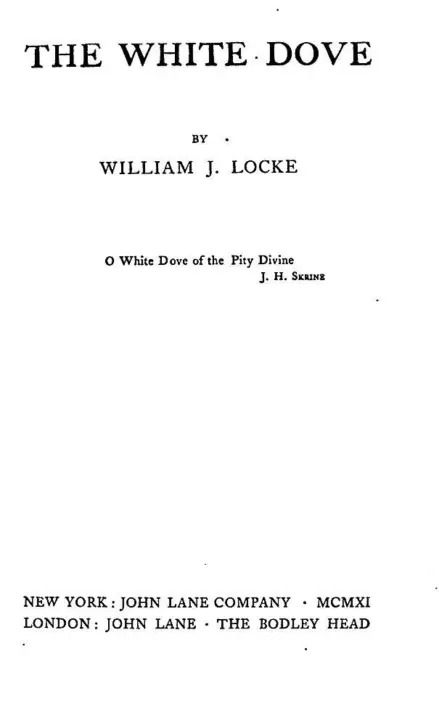
William John Locke
THE CLASSIC COLLECTION · 1900
"The White Dove" by William John Locke is a novel written in the late 19th century. The story revolves around Sylvester Lanyon, a dedicated doctor who grapples with the memories of his deceased wife while navigating his relationships with those around him, particularly Ella Defries, a vibrant young woman who challenges his somber outlook on life. The novel explores themes of love, loss, and the complexities of human connection against the backdrop of a slow-paced, reflective life. The beginning of the novel introduces Sylvester in a thoughtful exchange with Ella, revealing their contrasting perspectives on life. While Ella advocates for embracing life's joys despite its struggles, Sylvester appears more guarded and introspective, weighed down by memories of loss. As their conversation unfolds, it becomes clear that Sylvester is on the cusp of significant change, having just sold his medical practice to pursue newfound ambitions in London. This pivotal moment sets the stage for the exploration of his character's internal conflict, laying the groundwork for the unfolding drama of relationships, societal expectations, and personal revelations throughout the story.
Introduction adapted from the source catalogue; source summaries may be automatically generated.
Free to read · English · 72,842 words · No account needed
MAKE TIME FOR A GOOD BOOK
On by default. Untick to stop anonymous reading totals. Each page counts after 10 seconds in view. How this works.
Anonymous counting is on unless you have switched it off.
“What I can't understand,” said Sylvester, “is why he did not announce his coming,--why he should suddenly turn up at that ungodly hour. There are plenty of day trains.”
He appealed unconsciously to his father, who made no reply. But a little later, when Miss Lanyon and Ella had left the room, Matthew said, suddenly breaking a short silence,--
“I was expecting him.”
“Why didn't you tell me?” asked Sylvester, involuntarily.
“He was in some trouble apparently, and asked to see me alone this
morning on business.”
“I wonder what it could have been?”
“I wonder,” said the old man, drily.
Sylvester flushed, as if at a rebuke. Knowing his father, he was aware of indiscretion. Matthew had always maintained the most impenetrable reserve as regards his business affairs; the son had been trained from childhood to look upon them as sacrosanct, and to question was an indecency.
“I beg your pardon, father,” he said deferentially.
“I mentioned the fact, for obvious reasons,” said Matthew.
“Quite so,” said Sylvester, and then hesitating and finally blurting it out, as if he were ashamed of it, he added,--
“I know you are a father confessor to every poor devil in trouble.”
The old man looked at his son and his kind eyes grew a little moist. Any tribute of faith and love from Sylvester touched him deeply. But he laughed and said characteristically,--
“There are some people who'll tell you anything, if you 're only soft-headed enough to listen to them.” Then he nodded towards the window, and waved his hand,--
“There is one, anyhow, who doesn't want a confessor.”
It was Ella, standing in the clear March sunshine of the garden, looking in through the French window, and holding up a bunch of fresh-gathered violets. With a word of adieu to his father, Sylvester went out and joined her. She pinned the flowers in his buttonhole and for ten pleasant minutes they walked along the trim-kept paths.
“You were not angry with me last night?” he asked.
She murmured very meekly,--“If I were, I should not be here with you
now.”
“I never thought I should--ever do such a thing again,” he said awkwardly. “I couldn't help it. It has made a different man of me.”
She drew herself up quite proudly and looked him straight in the eyes. They were brave, clear eyes, and so were the man's that met them.
“Are you in earnest?” she asked.
“Am I the man not to be in earnest?” he answered.
The doctor's page, running across the strip of lawn to them, broke the spell with the time-honoured morning announcement,--
Your reading position is saved on this browser. Take it to another device with a library code. Reading pages adapt to text, rather than matching a printed edition.
William John Locke

William John Locke

William John Locke

William John Locke
BEHIND THE BOOK
This eBook is for the use of anyone anywhere in the United States and most other parts of the world at no cost and with almost no restrictions whatsoever. You may copy it, give it away or re-use it under the terms of the Project Gutenberg License included with this eBook or online at www.gutenberg.org. If you are not located in the United States, you will have to check the laws of the country where you are located before using this eBook. Read the source licence.
The original source file, including credits and licence, is retained by this library. Request an original-format copy at no charge. Please include the book title and Project Gutenberg identifier #56013.
KEEP YOUR CURIOSITY GOING
Coulson Kernahan

Maurice Baring
Frances Wright
Cécile Tormay

Frederic Jesup Stimson

W. H. P. (William Henry Pope) Jarvis