
The Wonderful Year
William John Locke
THE CLASSIC COLLECTION · 1900
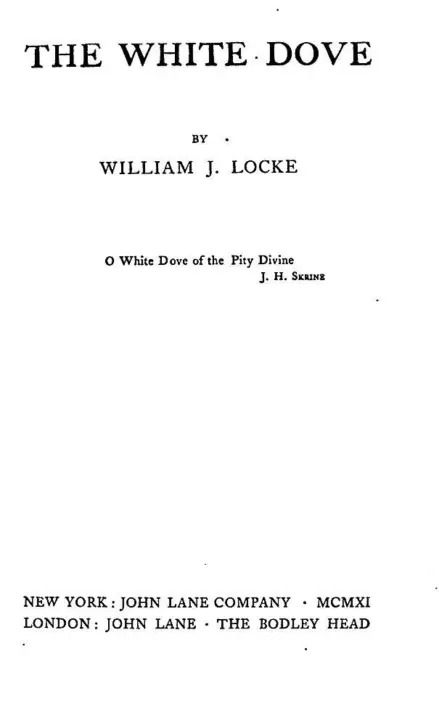
"The White Dove" by William John Locke is a novel written in the late 19th century. The story revolves around Sylvester Lanyon, a dedicated doctor who grapples with the memories of his deceased wife while navigating his relationships with those around him, particularly Ella Defries, a vibrant young woman who challenges his somber outlook on life. The novel explores themes of love, loss, and the complexities of human connection against the backdrop of a slow-paced, reflective life. The beginning of the novel introduces Sylvester in a thoughtful exchange with Ella, revealing their contrasting perspectives on life. While Ella advocates for embracing life's joys despite its struggles, Sylvester appears more guarded and introspective, weighed down by memories of loss. As their conversation unfolds, it becomes clear that Sylvester is on the cusp of significant change, having just sold his medical practice to pursue newfound ambitions in London. This pivotal moment sets the stage for the exploration of his character's internal conflict, laying the groundwork for the unfolding drama of relationships, societal expectations, and personal revelations throughout the story.
Introduction adapted from the source catalogue; source summaries may be automatically generated.
Free to read · English · 72,842 words · No account needed
MAKE TIME FOR A GOOD BOOK
On by default. Untick to stop anonymous reading totals. Each page counts after 10 seconds in view. How this works.
Anonymous counting is on unless you have switched it off.
“Constance? I did not think you knew--till the other night. And then I
hoped against hope.”
“Did you know? How long? I only learned it after her death--Leroux's last illness. My God! does all the country-side know?”
“No, Syl. I alone.”
He sought his son's hand on the coverlet, and then continued in the calm, assured tone that Sylvester knew had given strength and comfort to so many. The voice had grown suddenly strong.
“She came to me herself, and told me, a soul-stricken woman,--just after. She loved the man, Syl, and had always loved him. Circumstances estranged them, they thought for ever. And then--she was a brave woman, Syl--she fancied she could make a good man's life happy,--yours. But the mistake was cleared up, and he returned. She loved him,--my boy, we can't kill love,--but she was proud of her honour and scorned running from temptation; relied on her strength too far, until one day, only one day, Syl, it failed her, in a whirl of madness. She came to me to ask what she should do. I have never seen such frantic grief in a human soul. And a good many have brought their troubles to me,” he added with one of his rare smiles.
“That is true,” said Sylvester. And a sudden impulse made him add, “God
bless you!”
For the thought, of a soul in pain flying instinctively to the sympathy of those kind eyes brought a gush of tenderness. He saw him again as the wise counsellor, the generous friend, the child-hearted lover of all things, great and small.
“And you told her--?” he queried in a low voice, deeply moved.
“A greater judge than I set the precedent. She was the truest wife to
you thereafter.”
“Tell me, father,” said Sylvester, huskily, “when was it? Dorothy?”
“Your own flesh and blood,” said the old man, gripping his hand. “My poor boy, how you must have suffered!”
He lay back again, prostrated by his sustained effort of speech, and closed his eyes. Sylvester leaned forward, half reclining on the bed, still holding his father's hand. And as he sat there silent, a veil seemed to be drawn from before his vision.
“She--Constance must have suffered,” he said at last.
Matthew opened his eyes and met his son's gaze wistfully.
“Don't we all? If the stainless like you suffer, what of us poor sinners who struggle towards the light! Think of the agony of that pure and delicate soul who bore you, my son. Pray for all poor souls, Syl.”
Your reading position is saved on this browser. Take it to another device with a library code. Reading pages adapt to text, rather than matching a printed edition.
William John Locke

William John Locke

William John Locke

William John Locke
BEHIND THE BOOK
This eBook is for the use of anyone anywhere in the United States and most other parts of the world at no cost and with almost no restrictions whatsoever. You may copy it, give it away or re-use it under the terms of the Project Gutenberg License included with this eBook or online at www.gutenberg.org. If you are not located in the United States, you will have to check the laws of the country where you are located before using this eBook. Read the source licence.
The original source file, including credits and licence, is retained by this library. Request an original-format copy at no charge. Please include the book title and Project Gutenberg identifier #56013.
KEEP YOUR CURIOSITY GOING
Coulson Kernahan

Maurice Baring
Frances Wright
Cécile Tormay

Frederic Jesup Stimson

W. H. P. (William Henry Pope) Jarvis