
The Wonderful Year
William John Locke
THE CLASSIC COLLECTION · 1900
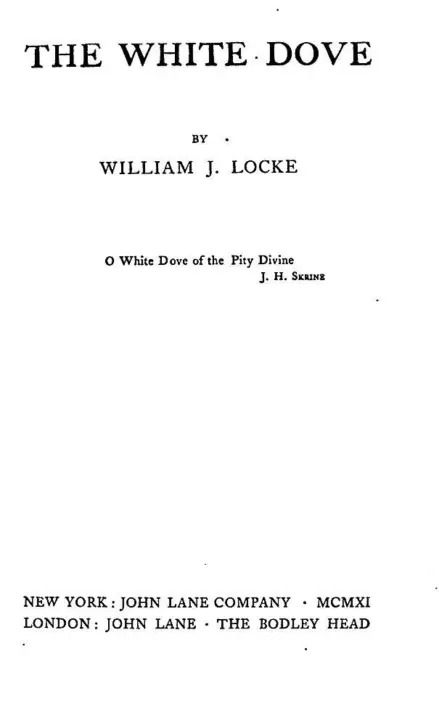
"The White Dove" by William John Locke is a novel written in the late 19th century. The story revolves around Sylvester Lanyon, a dedicated doctor who grapples with the memories of his deceased wife while navigating his relationships with those around him, particularly Ella Defries, a vibrant young woman who challenges his somber outlook on life. The novel explores themes of love, loss, and the complexities of human connection against the backdrop of a slow-paced, reflective life. The beginning of the novel introduces Sylvester in a thoughtful exchange with Ella, revealing their contrasting perspectives on life. While Ella advocates for embracing life's joys despite its struggles, Sylvester appears more guarded and introspective, weighed down by memories of loss. As their conversation unfolds, it becomes clear that Sylvester is on the cusp of significant change, having just sold his medical practice to pursue newfound ambitions in London. This pivotal moment sets the stage for the exploration of his character's internal conflict, laying the groundwork for the unfolding drama of relationships, societal expectations, and personal revelations throughout the story.
Introduction adapted from the source catalogue; source summaries may be automatically generated.
Free to read · English · 72,842 words · No account needed
MAKE TIME FOR A GOOD BOOK
On by default. Untick to stop anonymous reading totals. Each page counts after 10 seconds in view. How this works.
Anonymous counting is on unless you have switched it off.
Matthew started in his chair, and his face wore an expression of great
anxiety.
“Impossible!” he said almost angrily.
“I only quote Roderick's explicit statement. And I fancy for once in a
way he wasn't lying.”
Then he saw his father white and aged, his kind lips quivering, his breath coming fast. In concern he rose, bent over him.
“Why, you 're ill--” he began.
But Matthew pushed him away gently.
“Nonsense, my boy. It's only one of those confounded pains about my heart. There, it's all gone now. Don't worry. It's this hot room. I think I'll go out for a stroll.”
“You had better lie down,” said the physician.
“Yes, and stick out my tongue and chew that thermometer of yours! No, thank you. There!” He rose to his feet, and held himself erect. “I'm as strong as a horse.”
“I don't like your going out,” said Sylvester.
The other looked at his watch. “I must, for a bit,” he said. “Go up and talk to your aunt for an hour before dinner. She's dying to hear all the gossip.”
It was useless to try to restrain him. He had an imperious will to which Sylvester had yielded all his life. So the son went upstairs, and the father put on his overcoat and walked at a brisk pace through the dark December evening to the house of his enemy.
Mr. Usher put down the “Financial News” and rose from his chair as
Matthew entered the room.
“My dear friend, how great a surprise! You have come for a reconciliation. It is a Christian thing. I too am a Christian, Matthew.”
“I have come to ask you a question,” said Matthew, ignoring the other's proffered hand. “Roderick denies that he receives any allowance from you. Is that true?”
“I am too poor to make my son an allowance,” replied Usher.
“You know what I mean,” replied Matthew, sternly. “I pay £100 a quarter into your banking account for you to remit, as from yourself, to Roderick. Does he get it?”
Ushers eyes shifted from Matthew's glance. He shuffled a step towards the fireplace before replying.
“You outrage a father's feelings, Matthew. I live for my son. You
yourself have a son.”
Matthew strode up to him and laid a hand on his collar.
“Confound it, sir, answer my question! Roderick states that he hasn't received a penny from you for years. Have you kept all these sums back from him? By God! you shall speak.”
Involuntarily he shook him in his angry grasp. Usher was scared.
“No violence, Matthew.”
Matthew released him with a contemptuous exclamation.
Your reading position is saved on this browser. Take it to another device with a library code. Reading pages adapt to text, rather than matching a printed edition.
William John Locke

William John Locke

William John Locke

William John Locke
BEHIND THE BOOK
This eBook is for the use of anyone anywhere in the United States and most other parts of the world at no cost and with almost no restrictions whatsoever. You may copy it, give it away or re-use it under the terms of the Project Gutenberg License included with this eBook or online at www.gutenberg.org. If you are not located in the United States, you will have to check the laws of the country where you are located before using this eBook. Read the source licence.
The original source file, including credits and licence, is retained by this library. Request an original-format copy at no charge. Please include the book title and Project Gutenberg identifier #56013.
KEEP YOUR CURIOSITY GOING
Coulson Kernahan

Maurice Baring
Frances Wright
Cécile Tormay

Frederic Jesup Stimson

W. H. P. (William Henry Pope) Jarvis