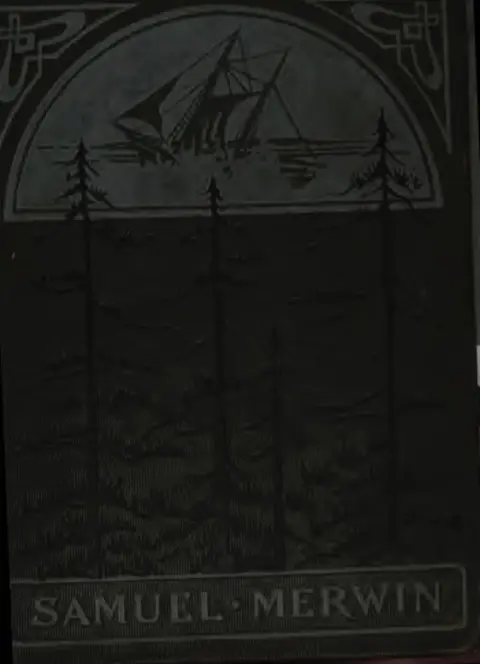
His Little World: The Story of Hunch Badeau
Samuel Merwin
THE CLASSIC COLLECTION · 1903
"The Whip Hand: A Tale of the Pine Country" by Samuel Merwin is a novel written in the early 20th century. The story introduces themes of adventure and struggle against nature, as it begins with a dramatic sea rescue involving a group of young men from a surf-boat braving the stormy waters of Lake Michigan to save the crew of a distressed steamer. The narrative is anchored by the character Jack Halloran, who embodies youthful determination and camaraderie, as he leads his crew in what seems like a noble yet perilous endeavor. The opening of the novel sets an intense scene, characterized by a thick storm that creates an atmosphere of urgency and peril. As the young men rally around the surf-boat in a daring rescue mission, we see Halloran commanding the group's efforts, showing both his leadership and enthusiasm for the fight against the elements. Meanwhile, onshore, a festive gathering of students and townsfolk lends a contrasting sense of community and support as they wait for the boat's return. However, the backdrop of impending tragedy looms, hinted at by the storm and the shipwreck in progress, establishing the stakes for the characters as they engage in a struggle that mixes both physical challenge and the spirit of youth.
Introduction adapted from the source catalogue; source summaries may be automatically generated.
Free to read · English · 61,307 words · No account needed
MAKE TIME FOR A GOOD BOOK
On by default. Untick to stop anonymous reading totals. Each page counts after 10 seconds in view. How this works.
Anonymous counting is on unless you have switched it off.
“What do we care for them?”
“No, I mustn't. We had really better go in.” And in she went, with Halloran, crestfallen, following.
After an insufferable evening he tried again to see her, and again it was accomplished only by maneuvering.
“Margaret,” he said, when he had drawn her into the corner of the emptying room, “tell me what it means. What's the matter?”
She looked at him and slowly shook her head. “Nothing,” she replied;
“nothing at all.”
“Did you get my letters?”
She nodded.
“I didn't know--you didn't answer. Why didn't you write, Margaret?”
No answer.
“Won't you tell me? I've come a long way to ask you.”
“I--why, I just couldn't.”
“Didn't you have anything to say to me?”
“No, I don't believe I did.”
“And have you nothing to say to me now?”
A long, long silence. Then this from Miss Davies:
“Oh, please don't now. It's very late--and I'm tired.”
“But when am I to see you?” he broke out impatiently.
“Oh, there will be plenty of time. But not to-night--please. You aren't going away before morning.”
“I am here only for a day or so. I--I am down East on--on business.” He had quailed again. “I just stopped off here.”
“Oh, you just happened to come?”
“No, I meant to come--I had to, I couldn't stay away. It's a long time since I've seen you, Margaret.
“I know. You called in Evanston, didn't you? Mrs. Bigelow wrote me that you had taken George. How is he doing?”
“Well. But when can I talk with you--alone somewhere? I can't say anything when you seem so hurried.”
“Why--to-morrow, perhaps.”
“To-morrow morning?”
“No, not the morning. I'm going to climb the Terrace.”
“Why not drop that and come with me?”
“I can't. I promised Mr. Green. He's getting up a party. You--you might come along.” He shook his head. There was another pause. “Margaret,” he said then, “who is Mr. Green?”
“He's a Boston man.”
“Is he--is he----?”
Some one was looking for Miss Davies. “She's in the card-room, I think,”
said a voice.
“Here I am. I'll be there directly.”
“Wait, Margaret. Do you plan to get back for lunch?”
“Yes--I don't think we're going to take any with us.”
“Then I'll order a carriage for two o'clock, and we'll drive.”
“Well----”
“Of course”--and every word he uttered sounded like “Mr. Green--Mr. Green”--“of course, if you'd rather not------”
“Oh, no--thank you very much. I'd enjoy going. At two, did you say?”
Your reading position is saved on this browser. Take it to another device with a library code. Reading pages adapt to text, rather than matching a printed edition.
Samuel Merwin
Samuel Merwin
Samuel Merwin
Samuel Merwin
BEHIND THE BOOK
This eBook is for the use of anyone anywhere in the United States and most other parts of the world at no cost and with almost no restrictions whatsoever. You may copy it, give it away or re-use it under the terms of the Project Gutenberg License included with this eBook or online at www.gutenberg.org. If you are not located in the United States, you will have to check the laws of the country where you are located before using this eBook. Read the source licence.
The original source file, including credits and licence, is retained by this library. Request an original-format copy at no charge. Please include the book title and Project Gutenberg identifier #54102.
KEEP YOUR CURIOSITY GOING
Coulson Kernahan

Maurice Baring
Frances Wright
Cécile Tormay

Frederic Jesup Stimson

W. H. P. (William Henry Pope) Jarvis