THE CLASSIC COLLECTION✦South Australia and Western AustraliaCLASSIC FREE BOOKS
South Australia and Western Australia
Anthony Trollope
THE CLASSIC COLLECTION · 1859
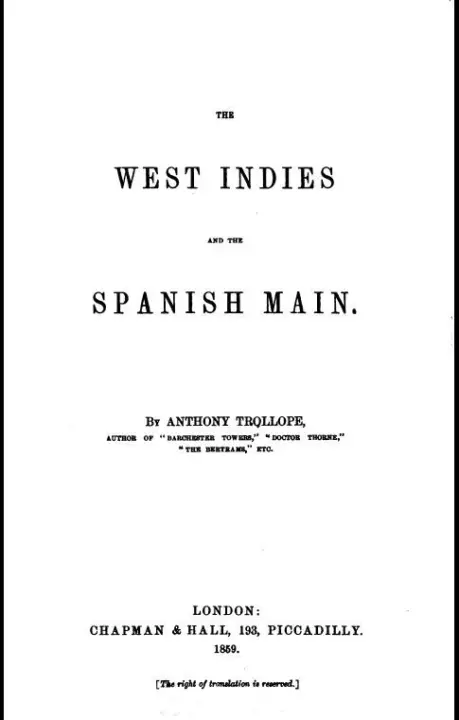
"The West Indies and the Spanish Main" by Anthony Trollope is a travel narrative written in the mid-19th century. This work explores the author's journey through various Caribbean destinations, including Jamaica and Cuba, offering insights into their cultures, landscapes, and social dynamics. The narrative blends personal observation with historical context, providing a vivid description of life in the West Indies and highlighting the author's experiences and reflections throughout his travels. The opening of the narrative begins with the author aboard a ship caught in a stagnant situation, grappling with heat and discomfort while preparing to write his account of the journey. He reflects on his maritime hardships, including a lack of provisions and an inefficient crew, while humorously lamenting his decision to take a less conventional route to reach Cien Fuegos. As he details his interactions with the ship’s crew and his personal circumstances, Trollope establishes a tone that blends self-deprecating humor and keen observation of human nature, setting the stage for the explorations of the cultural landscapes he will encounter in the West Indies.
Introduction adapted from the source catalogue; source summaries may be automatically generated.
Free to read · English · 118,992 words · No account needed
MAKE TIME FOR A GOOD BOOK
On by default. Untick to stop anonymous reading totals. Each page counts after 10 seconds in view. How this works.
Anonymous counting is on unless you have switched it off.
Of many of his sister colonies a Barbadian can speak with temper. When Jamaica is mentioned philanthropic compassion lights up his face, and he tells you how much he feels for the poor wretches there who call themselves planters. St. Lucia also he pities, and Grenada; and of St. Vincent he has some hope. Their little efforts he says are praiseworthy; only, alas! they are so little! He does not think much of Antigua; and turns up his nose at Nevis and St. Kitts, which in a small way are doing a fair stroke of business. The French islands he does not love, but that is probably patriotism: as the French islands are successful sugar growers such patriotism is natural. But do not speak to him of Trinadad; that subject is very sore. And as for Guiana--! One knows what to expect if one holds a red rag up to a bull. Praise Guiana sugar-making in Bridgetown, and you will be holding up a red rag to a dozen bulls, no one of which will refuse the challenge. And thus you may always know a Bim.
When I have met four or five together, I have not dared to try this experiment, for they are wrathy men, and have rough sides to their tongues; but I have so encountered two at a time.
"Yes," I have said; "the superiority of Barbados cannot be doubted. We all grant that. But which colony is second in the race?"
"It is impossible to say," said A. "They are none of them well
circumstanced."
"None of them have got any labour," said B.
"They can't make returns," said A.
"Just look at their clearances," said B; "and then look at ours."
"Jamaica sugar is paying now," I remarked.
"Jamaica, sir, has been destroyed root and branch," said A, well pleased; for they delight to talk of Jamaica. "And no one can lament it more than I do," said B. "Jamaica is a fine island, only utterly ruined."
"Magnificent! such scenery!" I replied.
"But it can't make sugar," said B.
"What of Trinidad?" I asked.
"Trinidad, sir, is a fine wild island; and perhaps some day we may
get our coal there."
"But Demerara makes a little sugar," I ventured to remark.
"It makes deuced little money, I know," said A.
"Every inch of it is mortgaged," said B.
"But their steam-engines," said I.
"Look at their clearances," said A.
"They have none," said B.
"At any rate, they have got beyond windmills," I remarked, with
considerable courage.
"Because they have got no wind," said A.
"A low bank of mud below the sea-level," said B.
"But a fine country for sugar," said I.
Your reading position is saved on this browser. Take it to another device with a library code. Reading pages adapt to text, rather than matching a printed edition.
Anthony Trollope

Anthony Trollope

Anthony Trollope

Anthony Trollope
BEHIND THE BOOK
This eBook is for the use of anyone anywhere in the United States and most other parts of the world at no cost and with almost no restrictions whatsoever. You may copy it, give it away or re-use it under the terms of the Project Gutenberg License included with this eBook or online at www.gutenberg.org. If you are not located in the United States, you will have to check the laws of the country where you are located before using this eBook. Read the source licence.
The original source file, including credits and licence, is retained by this library. Request an original-format copy at no charge. Please include the book title and Project Gutenberg identifier #55100.
KEEP YOUR CURIOSITY GOING
Wilfrid Scawen Blunt
Wilfrid Scawen Blunt

E. W. (Edgar Watson) Howe
Francis Greenleaf Allinson & Anne C. E. (Anne Crosby Emery) Allinson
Cyrenus Cole

John Martineau