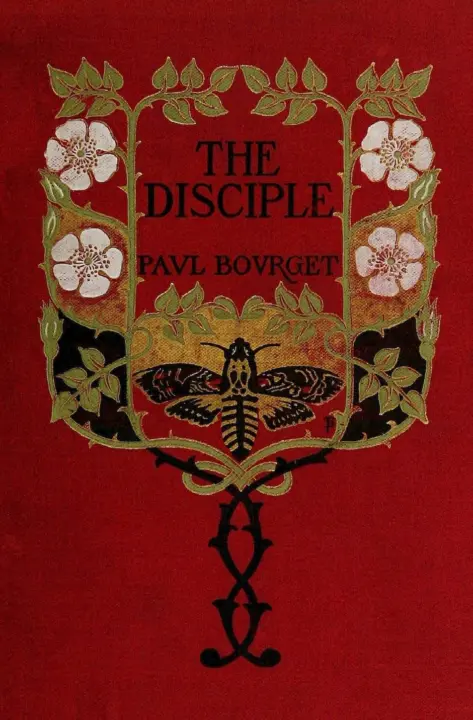
The disciple
Paul Bourget
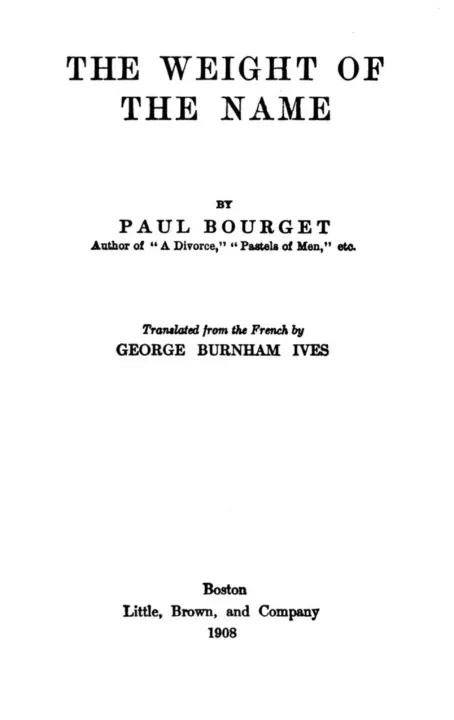
THE CLASSIC COLLECTION · 1908
"The Weight of the Name" by Paul Bourget is a novel written in the early 20th century. The narrative follows Landri de Claviers-Grandchamp, a young nobleman torn between his aristocratic upbringing and his passionate love for a widow named Valentine Olier. The book explores themes of love, class hierarchy, and personal identity against the backdrop of French society. At the start of the novel, Landri arrives at a clandestine meeting with Valentine, a woman he has loved silently for three years, despite their complex social circumstances. He grapples with his feelings and the pressure of his noble lineage while expressing his intent to propose to her. Valentine, though moved, reveals her own insecurities about their differing social statuses, ultimately refusing his proposal due to the potential implications of marrying a man of his name. This opening sets the stage for a deeper exploration of the characters' emotional struggles and societal expectations, hinting at the larger conflicts that will unfold as their relationship develops.
Introduction adapted from the source catalogue; source summaries may be automatically generated.
Free to read · English · 96,970 words · No account needed
MAKE TIME FOR A GOOD BOOK
On by default. Untick to stop anonymous reading totals. Each page counts after 10 seconds in view. How this works.
Anonymous counting is on unless you have switched it off.
"To be your wife. Yes," she said; and this time her blue eyes beneath their half-closed lids gazed steadfastly at Landri. Her delicate mouth closed in a fold of decision. Her whole fragile person was as if stiffened in a tension which proved to the lover the force of the emotion that she held in check. She repeated: "Yes, I refuse. I could find many pretexts to give you which, to others, would be good reasons, and which should be so to me. I have a child. I might say to you: 'I do not want him to have a stepfather.' That would not be true. You would be to him, I am sure, as you said, a second father. I might dwell upon my loss, which is so recent, in order to postpone my reply until later. Later, the reason which makes me decline the offer of your name would be the same, for it is just that name, it is what it represents, which forbids me to abandon myself to a liking of which you have had too many proofs. I shall soon be twenty-eight, my friend. I am no longer exactly a young woman. I have reflected much on marriage. I know that if people marry to love each other, they marry also to live and remain together, to have a home, to be a family. For that it is essential that there should not be, between the husband and wife, one of those unalterable differences of birth and environment, which make it impossible that her people should ever be really related to his.--Your name? It is not only very old, it is illustrious. It is blended with the whole history of France. There was a Maréchal de Claviers-Grandchamp who was a comrade of Bayard, a Cardinal de Claviers-Grandchamp who was a friend of Bossuet. Claviers-Grandchamps have been ambassadors, governors of provinces, commanders of the Saint-Esprit, peers of France. Your house has contracted alliances with ten other houses of the French or European aristocracy. You are cousins of English dukes, of German and Italian princes. You are a grand seigneur, and I a bourgeoise, a very petty bourgeoise.--Do not you interrupt me, either," she said, placing her slender hand on the young man's arm and arresting thus his protest; "it is better that I should say it all at once. In all this I am moved neither by humility nor by pride. I have never understood either of those sentiments, when there is question of facts so impossible to deny or to modify as our situation. I am a bourgeoise, I say again. That means that my people lived in straitened circumstances at first, then modestly. I consider myself rich with the thirty thousand francs a year that they saved for me, in how many years! It is a fortune in our world, in yours it would be ruin. When I walk in that quarter, before those ancient hôtels which are still to be found there, on the afternoon of a grand reception, I see their courtyards, the coupés and automobiles waiting, the footmen in livery, all that luxury of existence which you no longer notice, it is so natural to you,--and do you know what my feeling always is? That if it were necessary for me to live there, and in such fashion, I should be too much out of my element, too overpowered! These are trifles. I mention them to you because they represent a whole type of customs, an entire social code. Do not say that you will not impose those customs on your wife, that you will liberate her from that code. You could not do it. To-day, as a bachelor, and because you are an officer, you have been able to simplify your life a great deal. But your wife would not be merely the companion of Monsieur de Claviers-Grandchamp, a simple lieutenant of dragoons, stationed at Saint-Mihiel, she would be also the daughter-in-law of the Marquis de Claviers-Grandchamp, who lives in a veritable palace in Paris, and who has a historic château in the Oise. He is a widower. He would require, and he would have a right to require, his daughter-in-law, with him and for him, to do the honors of those princely residences. And besides, he would begin by not accepting me. You have talked so much to me about him! I know him so well, without having seen him. Not for nothing do you call him the 'Émigré.' So many times you have exerted yourself to prove to me that he is not a man of our time; that he has the pride, the religious veneration of his race and of old France. And such a man would consent that his heir, the only survivor of his four sons, should take for his wife the widow of an officer who was the son of a physician, herself the daughter of a provincial notary, who, before she became Madame Olier, bore the name of Mademoiselle Barral? Never! To marry me, my friend, would be first of all to quarrel with your father, and, more or less, with all your relations and your whole social circle. What do you care? you will say. When two people love, they suffice for each other. That is true and it is not true. You would suffer death and torture that I should be humiliated, even in trifles, that I should not have the rank due to your wife, being your wife. I should suffer to see you suffer, and perhaps--I do not make myself out any better than I am--on my own account. People are so ingenious in all societies in wounding those whom they look upon as intruders. If we should have children, would they feel that they were really the brothers and sisters of my boy, of a poor little Olier, they who would be Claviers-Grandchamps? And if--But what's the use of enumerating the miseries comprised in that cruel, wise, profoundly significant word--mésalliance. No. I will not be your wife, my friend, and the day will come when you will thank me for having defended you against yourself, for having defended us--dare I say it?--But not effectively, for I could not prevent your saying words which are destined to break off forever, for a long time at all events, relations so pleasant as ours.--So pleasant!" she repeated. And then, with something very like a sob: "Oh! why, why did you speak so to me again?"
Your reading position is saved on this browser. Take it to another device with a library code. Reading pages adapt to text, rather than matching a printed edition.
Paul Bourget
Paul Bourget
Paul Bourget
Paul Bourget
BEHIND THE BOOK
This eBook is for the use of anyone anywhere in the United States and most other parts of the world at no cost and with almost no restrictions whatsoever. You may copy it, give it away or re-use it under the terms of the Project Gutenberg License included with this eBook or online at www.gutenberg.org. If you are not located in the United States, you will have to check the laws of the country where you are located before using this eBook. Read the source licence.
The original source file, including credits and licence, is retained by this library. Request an original-format copy at no charge. Please include the book title and Project Gutenberg identifier #68859.
KEEP YOUR CURIOSITY GOING
Coulson Kernahan

Maurice Baring
Frances Wright
Cécile Tormay

Frederic Jesup Stimson

W. H. P. (William Henry Pope) Jarvis