
The disciple
Paul Bourget
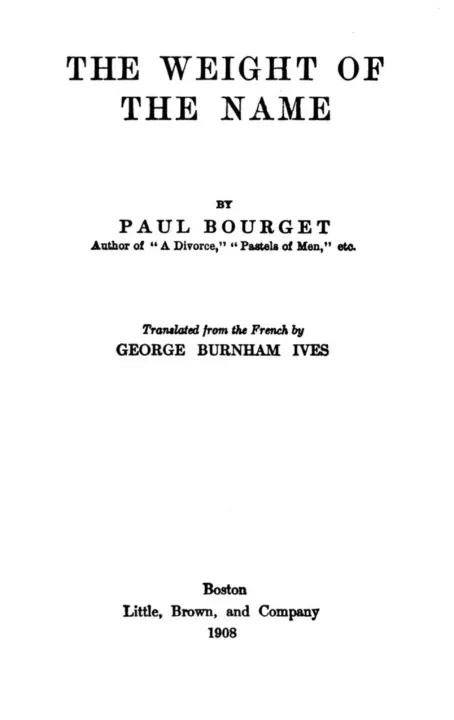
THE CLASSIC COLLECTION · 1908
"The Weight of the Name" by Paul Bourget is a novel written in the early 20th century. The narrative follows Landri de Claviers-Grandchamp, a young nobleman torn between his aristocratic upbringing and his passionate love for a widow named Valentine Olier. The book explores themes of love, class hierarchy, and personal identity against the backdrop of French society. At the start of the novel, Landri arrives at a clandestine meeting with Valentine, a woman he has loved silently for three years, despite their complex social circumstances. He grapples with his feelings and the pressure of his noble lineage while expressing his intent to propose to her. Valentine, though moved, reveals her own insecurities about their differing social statuses, ultimately refusing his proposal due to the potential implications of marrying a man of his name. This opening sets the stage for a deeper exploration of the characters' emotional struggles and societal expectations, hinting at the larger conflicts that will unfold as their relationship develops.
Introduction adapted from the source catalogue; source summaries may be automatically generated.
Free to read · English · 96,970 words · No account needed
MAKE TIME FOR A GOOD BOOK
On by default. Untick to stop anonymous reading totals. Each page counts after 10 seconds in view. How this works.
Anonymous counting is on unless you have switched it off.
She had assumed, as she said these few words, a very gentle but very firm expression. Her voice had dwelt with especial force on the word "friend," which she repeated thrice. It was a reminder of a very hazardous and very fragile engagement. Thousands of such engagements have been entered into, since passionate men, like Landri, are able to respect those whom they love, and since women secretly enamored, like Valentine, dream of reconciling the emotions of a forbidden affection with the strict requirements of virtue. The rare thing is not that one suggests and the other accepts the romantic compact of friendship without other development, but that the compact is adhered to. Absolute, almost naïve sincerity on the part of both contracting parties is essential, a sincerity which excludes all trickery on his part, all coquetry on hers. There must also be a voluntary separation of their lives, which does not permit too frequent meetings. He who says sincerity does not always say truth. One may maintain sincerely a radically false situation, may obstinately abide by it through mute rebellions, through secret and long-protracted suffering, through hidden anguish, like that the memory of which quivered in the young man's reply:--
"A friend!" What bitterness those soft syllables assumed in passing through those suddenly contracted lips! "I knew that, at the outset of our conversation, you would shelter yourself behind my promise. I knew that you would anticipate the sentences that I wish to say to you, and that you would not allow me to say them. God is my witness, and you, too, madame, are my witness, that I have done everything to maintain the absolute reserve which you imposed as a condition upon the relations between us.--Let me speak, I deserve that you should let me speak!" he implored, at a gesture from Valentine, who had half risen. He put such mournful ardor into that entreaty, that she resumed her seat, without further attempt to arrest an avowal which her woman's tact had foreseen only too plainly during these last days. Accustomed as she was to control herself, her constantly increasing pallor, her more and more rapid breathing, disclosed the agitation aroused in her by the voice of him whom she had pretended to look upon only as a friend, and who continued: "Yes, I deserve it. I have been so honest, so loyal in my determination to obey you! Anything, even that silence, was less painful to me than to lose you altogether. And then, I had given you such good reason! I have reproached myself so bitterly for that madness of a few minutes, three years ago! That I had confessed to you what I ought always to have hidden from you, since you were not free, crushed me with such profound remorse! Every day at Saint-Mihiel I pass the wall of the garden where that scene took place. Never without seeing you again, in my thoughts, as I saw you after that mad declaration, abruptly leaving me and going back to the house, without looking back. And what weeks those were that followed, when we met almost every day, and I did not exist for your glance! 'She will never, never forgive me,' I said to myself, and the thought tore my heart. I was sincere when I determined to exchange into another regiment, to leave Saint-Mihiel; sincere when I tried, before my departure, which I believed to be final, to speak with you once more. I felt that I must explain my action to you, must make you understand that no degrading thought of seduction had entered my mind, that I must have been demented, that I had never for one second ceased to have such unbounded esteem and respect for you! Ah! I shall be very old, very cold-blooded, when I am able to recall without tears--see, they are coming to my eyes now!--your face on that day, your eyes, the tone in which you said to me: 'I have forgotten everything. Give me your word that that moment of aberration shall never return, and I will see you as before. I do not wish your life to be turned topsy-turvy because of me.'--While you were speaking, I was saying to myself--that hour is so vivid to me!--I was saying to myself: 'To breathe the air that she breathes, to see her go to and fro, to continue to hear her voice, there is no price I will not pay.' And you marked out the programme of our relations in the future. You said that the world did not place much credit in a disinterested friendship between a man and a woman, but that you did believe in such a thing provided that both were really loyal. I could repeat, syllable for syllable, every word that you said that afternoon. I listened while you said them, with an utterly indescribable sensation, of assuagement and exaltation as well, through my whole being. It was as if I had seen your very soul think and feel. Yes, I solemnly promised you then that, if you would admit me once more to your intimacy, I would be that friend that you gave me leave to be, and nothing more. That promise I have the right to say again that I have kept. I declare that I would continue to keep it if the circumstances had remained the same. But they have changed. Ah! madame, if one could read another's heart, I would beseech you to look into mine. You would see there that at the news of the misfortune which befell you, I had no selfish reflection concerning that change. I thought only of your grief, your solitude, your orphan child. So long as the catastrophe was recent, I was ashamed even to glimpse a new horizon before me--before us. But I cannot prevent life from being life. At twenty-seven a woman is entitled to reconstruct her life without offending in any wise the memory of him who is no more. On my part, I am not breaking my plighted word when I say: 'Madame, the worship, the adoration that I had for you three years ago, and that you justly forbade me to express to you then, I still entertain. My silence regarding my sentiments since that time is a guarantee of their depth. I break it to-day, when you can listen to me without having the protestation of the most fervent, the most respectful, the most submissive of passions cause you remorse. What I said to you in the garden I say again to-day, adding to it an entreaty which you will not deny. I love you. Let me devote to you what I have left of youth, my whole life. Allow me to be a support in your solitude, a consolation in your melancholy, a second father to your son. Be my wife and I will bless this long trial, which justifies me in repeating to you what I felt on the first day that I met you,--but how could you have failed to suspect it?--I love you, and I never have loved, I never shall love, anybody but you.'"
Your reading position is saved on this browser. Take it to another device with a library code. Reading pages adapt to text, rather than matching a printed edition.
Paul Bourget
Paul Bourget
Paul Bourget
Paul Bourget
BEHIND THE BOOK
This eBook is for the use of anyone anywhere in the United States and most other parts of the world at no cost and with almost no restrictions whatsoever. You may copy it, give it away or re-use it under the terms of the Project Gutenberg License included with this eBook or online at www.gutenberg.org. If you are not located in the United States, you will have to check the laws of the country where you are located before using this eBook. Read the source licence.
The original source file, including credits and licence, is retained by this library. Request an original-format copy at no charge. Please include the book title and Project Gutenberg identifier #68859.
KEEP YOUR CURIOSITY GOING
Coulson Kernahan

Maurice Baring
Frances Wright
Cécile Tormay

Frederic Jesup Stimson

W. H. P. (William Henry Pope) Jarvis