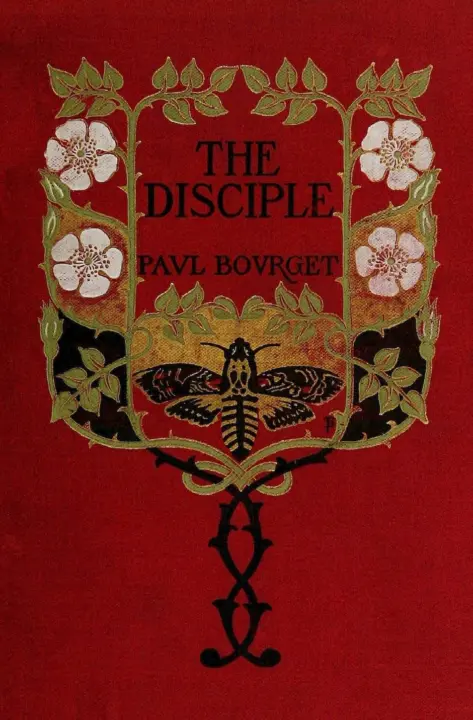
The disciple
Paul Bourget
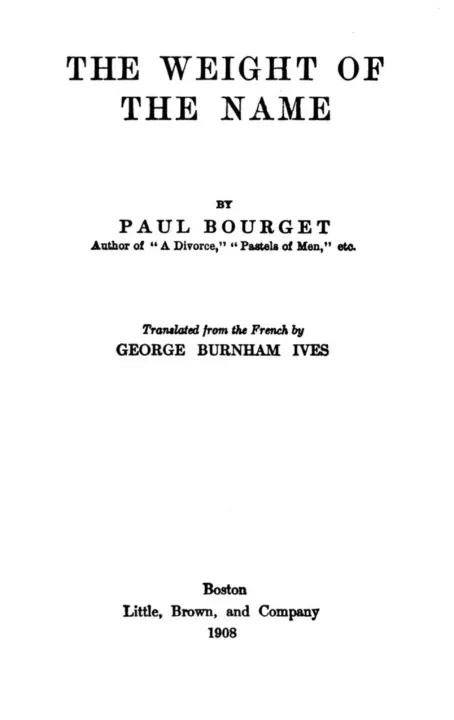
THE CLASSIC COLLECTION · 1908
"The Weight of the Name" by Paul Bourget is a novel written in the early 20th century. The narrative follows Landri de Claviers-Grandchamp, a young nobleman torn between his aristocratic upbringing and his passionate love for a widow named Valentine Olier. The book explores themes of love, class hierarchy, and personal identity against the backdrop of French society. At the start of the novel, Landri arrives at a clandestine meeting with Valentine, a woman he has loved silently for three years, despite their complex social circumstances. He grapples with his feelings and the pressure of his noble lineage while expressing his intent to propose to her. Valentine, though moved, reveals her own insecurities about their differing social statuses, ultimately refusing his proposal due to the potential implications of marrying a man of his name. This opening sets the stage for a deeper exploration of the characters' emotional struggles and societal expectations, hinting at the larger conflicts that will unfold as their relationship develops.
Introduction adapted from the source catalogue; source summaries may be automatically generated.
Free to read · English · 96,970 words · No account needed
MAKE TIME FOR A GOOD BOOK
On by default. Untick to stop anonymous reading totals. Each page counts after 10 seconds in view. How this works.
Anonymous counting is on unless you have switched it off.
"Unless what?" demanded Landri, as the other paused. "Finish your
sentence."
"Unless we accept the offer he made me on behalf of his partners--that is evidently the coup they have prepared. 'We have calculated,' he said, still with his perfect courtesy, 'the risks of a public sale. We may gain by it, we may lose. Certain pieces which we can place advantageously at once may escape us. We prefer to make you a proposition to buy the whole in one lump. We will give you four millions cash for the lot, that is, for all the articles enumerated in the pièce justificative No. 44, in the appendix of the book on the "History of the House of Grandchamp." Both you and we will do a good stroke of business. You too avoid the possible loss of an auction. You have your debts paid and more than two millions in cash to put you on your feet again. As for us, our profit is assured. We have with us two Americans who will give fifteen hundred thousand francs for the tapestries alone. You have a fortnight to decide.'--I repeat what he said, word for word.--A fortnight! It was six days ago that I had the interview with this Altona, and I haven't yet found the courage to inform Monsieur le Marquis! And you expect me not to feel as if my brain was going."
"I am the one to tell him," cried the young man, "and instantly. You have lost six days, Chaffin, six days out of fourteen! You have failed seriously in your duty. Let us go to him."
"And tell him what?" queried the secretary, placing himself before the door toward which Landri had already taken a step.
"Why, the facts, just as they are."
"And with what result? With the result that he'll refuse to believe you, against all the evidence, and say: 'Touch Grandchamp!--they'll not dare!'--Or else he'll use the week in looking for money, enough to pay the Altona gang. It may be that he'll find it, for, after all, the tapestries and furniture and pictures and bronzes are here, and we know they're worth at least four millions, as the other man offers that. Well, then, Monsieur le Marquis finds the money. At what price? He borrows at twenty, thirty, perhaps fifty per cent. And in a year we're just where we are now, with this difference, that our two millions due on those notes will have become two millions three hundred thousand, to say nothing of getting four or five hundred thousand francs more to continue during that year a sort of life that must at any price be changed. You hear, Landri--it must! You have reproached me for neglecting my duty. It is true that I haven't been able to say to your father those horrible words: you must. Consider that all this wreck of his vast fortune is due to the fact that he would never consent to say to himself those two little words: I must. You ask me where that fortune has gone. Why, in living at the rate of five hundred thousand francs a year, when he and Madame la Marquise had four hundred thousand--as you said just now--when they married. With a pencil and paper and two columns, one of income, one of outgo, I will show you the whole thing in a nutshell. The marquis was determined to keep up the same establishment at Grandchamp that his father did with almost twice his income, and his grandfather with three times as much. Madame your aunt and madame your great-aunt carried the rest with them to the Nançays and the Vardes. Monsieur le Marquis is always cursing the Civil Code, and he is quite right. But it is the Civil Code, and it's stronger than we are and than he is. He has kept up the château as if he were your grandfather and great-grandfather. Do you know what that means? In the first place, a hundred thousand francs for the park, gardens and conservatories, plus sixty thousand for the hounds, forty thousand for the shooting, thirty-five thousand for the stables. We have got to two hundred and thirty-five thousand at once. And so with the rest. The table? We have forty people at dinner to-night, and the marquis would consider himself disgraced if his chef were not cited as one of the best in Paris! The servants? You know how many there are, and you know too that Monsieur le Marquis never dreams of parting with an old retainer without giving him a pension. We had a discussion only yesterday about young Mauchaussée. Twelve hundred francs to the father, and a house; twelve hundred francs to the son. There are more than thirty others taken care of in the same way. That makes forty thousand francs. And there are demands all day to which Monsieur le Marquis makes but one reply: 'Give.' And we give--for brotherhoods and sisterhoods, for hospitals and churches, for schools, and for the elections. Without counting the private alms, which don't pass through my hands. A hundred thousand francs put in Monsieur de Lautrec's hand, without a receipt, just when we are so straightened, to settle a gambling debt! I have the proof of it. I spoke to Monsieur le Marquis about it. I had the courage.--'If we don't help one another,' was his reply, 'who will help us?'--That he should do such things the first or second year, in '66 and '67, even down to the war, was natural. But when he saw the income of the property decreasing, the mortgages growing bigger, the unpaid bills piling up, that he did not try to stop is extraordinary. But it's the fact. I understand it so well. Every economy was a degradation of the house of Grandchamp, and degradation of a concrete sort, which he could have seen with his eyes and touched with his hands. Economies, do I say? There were the hedges trimmed every three years,--but in the interval? the avenues not so well kept,--but after the rains?--Fewer flowers in the beds, fewer horses in the stable, stag-hunting with fewer dogs and fewer whippers-in! His heart was nearly broken. He went back the next year. The debt increased. It whirled him off in its eddies. And then, he has always hoped; yesterday, it was a fortunate investment,--Monsieur Jaubourg had put him on the track of a good thing. He gained a hundred and twenty thousand francs. A drop of water in the desert! Day, before yesterday, one of your cousins. Monsieur de Nançay, died and left him a hundred thousand francs. Another drop of water. These unexpected windfalls misled him with a mirage which harmonized only too well with his hereditary instinct. It would be easier for him to break off his habits altogether, than to change--that is the conclusion at which I have arrived. On that account, Landri, I look upon this offer of Altona's as providential, you understand. Monsieur le Marquis must accept it. Grandchamp once emptied of its furnishings, which are sacred reliques to him, he will never want to come here again. No more gardens à la française. At all events we will reduce the cost of keeping them. No more stag-hunting, no more open house. With what is left he will still have enough to live very handsomely. We will let the shooting, the château perhaps. Then we will begin to redeem the mortgages. The house of Claviers-Grandchamp will be shorn of its splendor for a few years. But it will live up to its motto: E tenebris inclarescent. It will not go down forever."
Your reading position is saved on this browser. Take it to another device with a library code. Reading pages adapt to text, rather than matching a printed edition.
Paul Bourget
Paul Bourget
Paul Bourget
Paul Bourget
BEHIND THE BOOK
This eBook is for the use of anyone anywhere in the United States and most other parts of the world at no cost and with almost no restrictions whatsoever. You may copy it, give it away or re-use it under the terms of the Project Gutenberg License included with this eBook or online at www.gutenberg.org. If you are not located in the United States, you will have to check the laws of the country where you are located before using this eBook. Read the source licence.
The original source file, including credits and licence, is retained by this library. Request an original-format copy at no charge. Please include the book title and Project Gutenberg identifier #68859.
KEEP YOUR CURIOSITY GOING
Coulson Kernahan

Maurice Baring
Frances Wright
Cécile Tormay

Frederic Jesup Stimson

W. H. P. (William Henry Pope) Jarvis