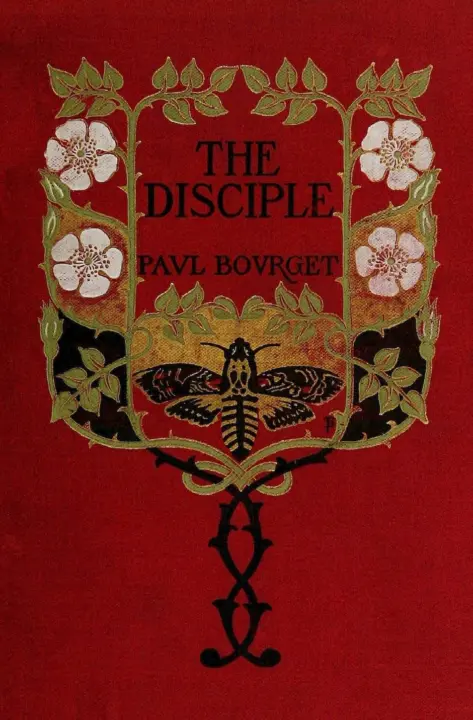
The disciple
Paul Bourget
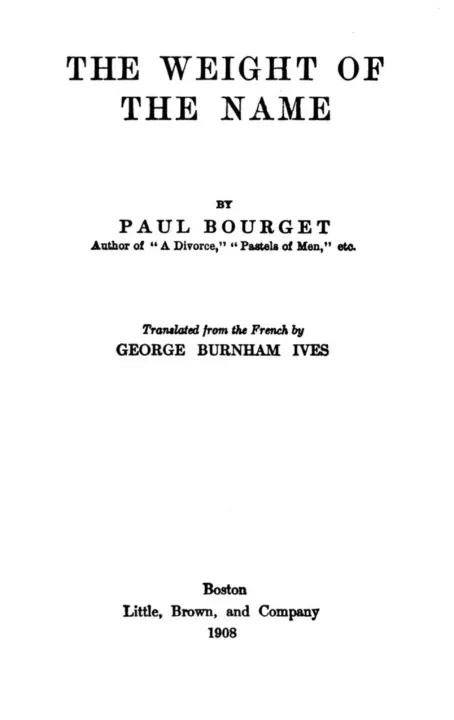
THE CLASSIC COLLECTION · 1908
"The Weight of the Name" by Paul Bourget is a novel written in the early 20th century. The narrative follows Landri de Claviers-Grandchamp, a young nobleman torn between his aristocratic upbringing and his passionate love for a widow named Valentine Olier. The book explores themes of love, class hierarchy, and personal identity against the backdrop of French society. At the start of the novel, Landri arrives at a clandestine meeting with Valentine, a woman he has loved silently for three years, despite their complex social circumstances. He grapples with his feelings and the pressure of his noble lineage while expressing his intent to propose to her. Valentine, though moved, reveals her own insecurities about their differing social statuses, ultimately refusing his proposal due to the potential implications of marrying a man of his name. This opening sets the stage for a deeper exploration of the characters' emotional struggles and societal expectations, hinting at the larger conflicts that will unfold as their relationship develops.
Introduction adapted from the source catalogue; source summaries may be automatically generated.
Free to read · English · 96,970 words · No account needed
MAKE TIME FOR A GOOD BOOK
On by default. Untick to stop anonymous reading totals. Each page counts after 10 seconds in view. How this works.
Anonymous counting is on unless you have switched it off.
"Do you think that I have not gone through such rebellions? Do you think that I, too, when my father spoke to me as I am speaking to you, did not ask myself if he were not a man of another century, who did not understand his epoch and who wished to involve me in his error? Do you think that I was not attracted by action, by actions of all sorts, by war, diplomacy, the tribune? that I never heard the voice of the tempter whispering: 'One does not serve the government, one serves France?' How many of my friends listened to that voice! I do not judge them. I could not do it, and I do not repent. This is why. Listen. What I am going to say will seem to you a long way from the starting-point of our conversation. But I do not lose sight of it.--No, I could not do it, because by dint of studying her, I realized that this France, offspring of the Revolution, had other workmen than me to employ, in its barracks, its public offices, its assemblies, and that we were very little able to serve her elsewhere. You have told me sometimes that I had the heart of an 'émigré.' It is true. But who saved France from dismemberment in 1815, if not the 'émigrés,' and Louis XVIII, first of all. Had there been no 'émigrés,' had not the King, supported by that handful of loyal subjects, made himself felt during twenty years in the councils of the coalition, the country would have been partitioned. What did they preserve for it, for that country which was so cruelly hostile to them?--A principle. Who will measure the strength of principles, of social truths, maintained by a group of men, by a single man sometimes, if he is called the King? Ah, well! the disease of France, offspring of the Revolution, does not lie in facts, nor in men, but in lack of principles, or in false principles, which is worse. I am not unjust to her, to this France I speak of. She has worked hard during these hundred years. She is working hard. And what endurance, what a sturdy will, what impetuosity! With all these is she bankrupt in all her aspirations--yes or no? Yes or no, does this country hold in Europe an inferior place to that she held in the worst days of the old monarchy? She is no older than England, however, her great rival in the Middle Ages! Has she progressed in social tranquillity? Has she found stability, that test of all political doctrines, as the regular beating of the pulse is the test of health? The fact is that the Revolution tried to base society on the individual, and that nature insists that it be based on the family. When I understood that great law, I understood the nobility. I understood then that our prejudices were profound social truths, elaborated by that result of experience during long ages which is called custom, and transformed into instinct. It is a profound social truth that there is no increase in the strength of a country unless the efforts of successive generations are combined, unless the living consider themselves as enjoying the usufruct only, between their dead and their descendants. But that is the law of primogeniture and entails! Another profound social truth: families must be deeply rooted in order to endure; they must have territorial interests, they must be amalgamated with the soil. But that means patrimonial domains, which are left undivided that they may not be sold!--Another profound social truth: there must be diverse environments, in order that there may be morals, and there are no environments unless there are classes, and distinct classes. But that means the three estates! Another profound social truth: every individual is simply the sum of those who have preceded him, a single moment in a long lineage. By marrying him to another individual at the same stage of development of her family, there is the chance of obtaining a superior creature, of solidifying acquired characteristics. But that means race!--All these truths the old France put in practice, and they were incarnate in the great Houses! The great Houses! On the instant that I realized their importance and that they were a working-out of the very laws of the family, the rôle of the noble in the presence of the Revolution was made clear to me: to maintain his House first of all. If we had all acted on that theory, what a reserve force France would have had for the hour of the inevitable crisis! However, there are still enough of us who fulfilled that duty, each as he could, especially in the provinces, and in that sturdy rural aristocracy which you will find in existence to-day, as in '71. But, even if I were alone of my kind, I should be no less assured of my duty. If we are fated never to be wanted again, let us at least make a noble end. Decenter mori. An aristocrat should either remain an aristocrat or die. I have remained one. The misfortunes of the time have not allowed me to add a page to the history of the Claviers-Grandchamps, but I have written that history, and I have maintained our house in its place. I have sounded the splendor of the name, as our ancestors said. What more can I say, Landri? Your father has continued his father, who had continued his. They all ask you by my mouth: 'Will you continue us?'"
Your reading position is saved on this browser. Take it to another device with a library code. Reading pages adapt to text, rather than matching a printed edition.
Paul Bourget
Paul Bourget
Paul Bourget
Paul Bourget
BEHIND THE BOOK
This eBook is for the use of anyone anywhere in the United States and most other parts of the world at no cost and with almost no restrictions whatsoever. You may copy it, give it away or re-use it under the terms of the Project Gutenberg License included with this eBook or online at www.gutenberg.org. If you are not located in the United States, you will have to check the laws of the country where you are located before using this eBook. Read the source licence.
The original source file, including credits and licence, is retained by this library. Request an original-format copy at no charge. Please include the book title and Project Gutenberg identifier #68859.
KEEP YOUR CURIOSITY GOING
Coulson Kernahan

Maurice Baring
Frances Wright
Cécile Tormay

Frederic Jesup Stimson

W. H. P. (William Henry Pope) Jarvis