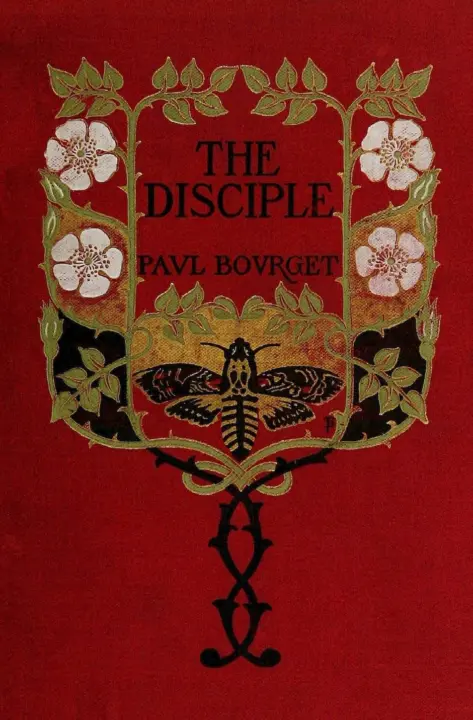
The disciple
Paul Bourget
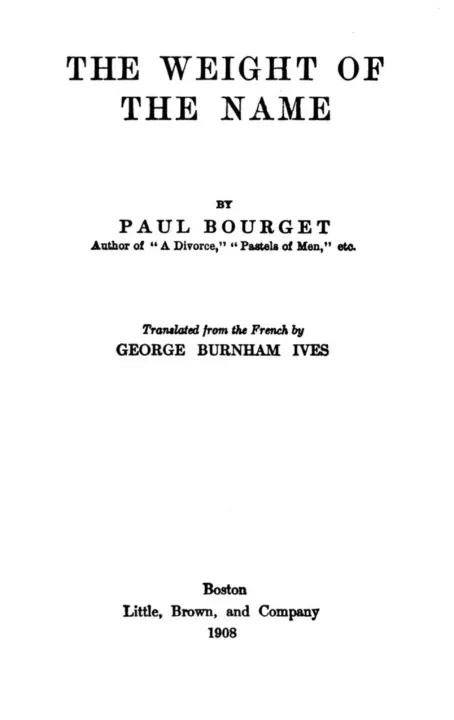
THE CLASSIC COLLECTION · 1908
"The Weight of the Name" by Paul Bourget is a novel written in the early 20th century. The narrative follows Landri de Claviers-Grandchamp, a young nobleman torn between his aristocratic upbringing and his passionate love for a widow named Valentine Olier. The book explores themes of love, class hierarchy, and personal identity against the backdrop of French society. At the start of the novel, Landri arrives at a clandestine meeting with Valentine, a woman he has loved silently for three years, despite their complex social circumstances. He grapples with his feelings and the pressure of his noble lineage while expressing his intent to propose to her. Valentine, though moved, reveals her own insecurities about their differing social statuses, ultimately refusing his proposal due to the potential implications of marrying a man of his name. This opening sets the stage for a deeper exploration of the characters' emotional struggles and societal expectations, hinting at the larger conflicts that will unfold as their relationship develops.
Introduction adapted from the source catalogue; source summaries may be automatically generated.
Free to read · English · 96,970 words · No account needed
MAKE TIME FOR A GOOD BOOK
On by default. Untick to stop anonymous reading totals. Each page counts after 10 seconds in view. How this works.
Anonymous counting is on unless you have switched it off.
"I love him and admire him still," replied the young man in a tone of the utmost earnestness; "yes, I admire him. No one knows better than I his great qualities and what he might have been. What a soldier! He proved it during the war. What a diplomatist! What an administrator! What a Councillor of State! And he is nothing. Nothing, nothing, nothing! Why, it is the whole tragedy of my thoughts, the evidence of my father's magnificent gifts, paralyzed by his name, solely by his name! Since I have become observant, I have seen that he, intelligent, generous, straightforward as he is, makes no use of his energies, takes part in none of the activities of his time. And yet there is a contemporaneous France. He is in it, but not of it. It will have none of him, who will have none of it. He will have passed his youth, his maturity, his old age, in what? In taking part in a pompous parade of the ancien régime, what with his receptions at Paris and Grandchamp, his stag-hunting, and the playing the patron to an enormous and utterly unprofitable clientage, of low and high estate, who live on his luxury or his income. I felt the worthlessness of all that too soon; he will never feel it. He is deceived by a mirage. He is close to a time when the nobility was still an aristocracy. My grandfather was twenty-six years old in 1827, when he succeeded to my great-grandfather's peerage, and my great-grandfather was colonel of the dragoons of Claviers before '89. For there were dragoons of Claviers-Grandchamp as there were of Custine and Jarnac, Belzunce and Lanan. They are far away. But in my father's eyes all those things so entirely uprooted and done away with are still realities. He is in touch with them. He has known those who saw them. As a little boy he played on the knees of old ladies who had been at court at Versailles. One would say that that past fascinates him more and more as it recedes. To me it is death, and I desired to live. That was the motive that led me to enter the army. Indeed, I had no choice. All other careers were closed to the future Marquis de Claviers-Grandchamp.--These are the privileges you spoke of just now. I let you have your say.--Yes, closed. Foreign affairs? Closed. My father would have been welcomed by the Empire at least. To-day they no longer want us. The Council of State? Closed. The government? Closed. Can you imagine a nobleman as a prefect? They were under Napoleon and the Restoration. The liberal professions? Closed. Though a noble had the genius of a Trosseau, a Berryer, or a Séguin, no one would have him to treat a cold in the head, to try a case about a division fence, or to build a foot-bridge. Commerce? Closed. Manufacturing? Closed, or practically so. To succeed in it we nobles must have a superior talent of which I, for my part, have never been conscious. Politics? That is like all the rest. People blame nobles for not taking up a profession! They forget that they are excluded from almost all, and the others are made ten times more difficult by their birth. And you would have me not call them pariahs! I say again, I resolved not to be one. The army was left. I prepared at Saint-Cyr, not without a struggle. There at least I knew the pleasure of not being a creature apart, of feeling that I was a Frenchman like the others, of not being exiled from my time, from my generation, from my fatherland; the delight of the uniform, of touching elbows with comrades, of obeying my superiors and of commanding my inferiors. That uniform no one shall tear from me except with my life. In losing it I should lose all my reasons for living.--All, no, since I love you. I wanted to speak to you to-day to learn whether I shall keep you in the trial that is in store for me. It will have its painful sides!--Now that you know what the crisis is that I am on the point of passing through," he added, "will you still answer no as you did a moment ago? I have no pride and I ask you again, will you be my wife? Not the wife of the Comte de Claviers-Grandchamp, whose father and whose environment you dread, but of a soldier with whom that environment will have no more to do, whom his father will have spurned? If I should ever have superintended the taking of a church inventory, it will arouse in the mothers another sort of indignation than for a mésalliance, as you call it, and as I do not call it. If I have you, the wound will bleed, doubtless, but I shall have you. You and my profession, my profession and you, those are enough to make me very strong."
Your reading position is saved on this browser. Take it to another device with a library code. Reading pages adapt to text, rather than matching a printed edition.
Paul Bourget
Paul Bourget
Paul Bourget
Paul Bourget
BEHIND THE BOOK
This eBook is for the use of anyone anywhere in the United States and most other parts of the world at no cost and with almost no restrictions whatsoever. You may copy it, give it away or re-use it under the terms of the Project Gutenberg License included with this eBook or online at www.gutenberg.org. If you are not located in the United States, you will have to check the laws of the country where you are located before using this eBook. Read the source licence.
The original source file, including credits and licence, is retained by this library. Request an original-format copy at no charge. Please include the book title and Project Gutenberg identifier #68859.
KEEP YOUR CURIOSITY GOING
Coulson Kernahan

Maurice Baring
Frances Wright
Cécile Tormay

Frederic Jesup Stimson

W. H. P. (William Henry Pope) Jarvis