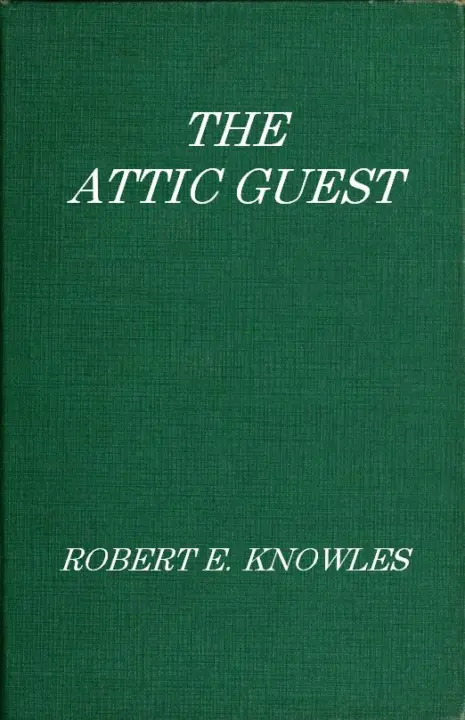
The Attic Guest: A Novel
Robert E. (Robert Edward) Knowles
THE CLASSIC COLLECTION · 1908
"The Web of Time" by Robert E. Knowles is a novel written in the early 20th century. The book appears to explore themes of struggle, family dynamics, and redemption, centering around the lives of the Simmons family as they confront personal and societal challenges in a small community. The opening introduces Harvey Simmons, a young boy grappling with the harsh realities of his father's alcoholism, and his mother, Annie, whose love for her family is overshadowed by her husband's destructive behavior. The beginning of the story paints a poignant picture of Annie Simmons anxiously waiting for her husband, revealing her conflicted feelings of love and fear due to his alcoholism. As she tries to create a semblance of normalcy for her children, the narrative highlights the toll that addiction takes on family life. The opening scene also foreshadows tragedy when a desperate encounter unfolds, leading to the death of a baby in a distressing and chaotic moment. As the story progresses, themes of hope and resilience intertwine, reflecting the challenges faced by the Simmons family as they navigate their circumstances.
Introduction adapted from the source catalogue; source summaries may be automatically generated.
Free to read · English · 104,439 words · No account needed
MAKE TIME FOR A GOOD BOOK
On by default. Untick to stop anonymous reading totals. Each page counts after 10 seconds in view. How this works.
Anonymous counting is on unless you have switched it off.
For many of his auditors were decidedly in the dark as to the source of this honour that had befallen him in ancient Spain.
"What kind of a animal was that, Tom, that tetched him on the head?" one bronzed toiler asked of his companion as he still gazed, bewildered rather, on the reclining Mr. Craig. "Did he say a elephant—sounded summat like that anyhow, didn’t it?"
"No, no," the other answered, a little impatiently; "what would elephants be doin’ at a public meetin’? He said ’twas a infantum—I heard him myself."
"What’s a infantum?" the first persisted earnestly.
"Oh—well. Well, it’s a kind of a baby—only it’s feminine," he explained learnedly. "An’ I think it’s got somethin’ to do wi’ the cholery—don’t talk, there’s Mr. Borland gettin’ up. Hurrah," he shouted, joining in the general chorus, and glad of this very opportune escape.
David began very haltingly. Yet he could not but feel the cordiality of his welcome; and his glance, at first rather furtive and shy, became more confident as he gradually felt the ground beneath his feet. "I ain’t much used to public speakin’," he started hesitatingly; "never made but one speech like this before. They were a little obstreperous when I began, but before I got through you could have—have heard a crowbar drop," he affirmed, to the delight of his audience. "I can’t sling it off like my friend Mr. Craig, here; mebbe it’s because I’ve not moved in them royal circles," he ventured as soberly as he could. "Though I think I’ve got him beat when it comes to rubbin’ noses with the quality. I’ve done a little in that line myself—when I was a little shaver, too. None o’ them royal folks ever patted me on the head—but I threw up all over Abe Lincoln once. Old Abe used to stop at my father’s in Peoria when he was ridin’ the circuit," David explained carefully; "an’ once he picked me up—I was jest a baby—an’ threw me up to the ceilin’; then I done the same when I came down—too soon after dinner, you see," he added, his words lost in the mirth that stormed about him. "But other ways, I ain’t what you’d call a successful man, I reckon," he went on, the quotation obvious. "I’ve always been kind o’ scared, ever since I was a young fellow, for fear I’d be too successful—that is, the way some folks reckon success. I knew a terrible successful man in Illinois one time—he was that successful that he got richer than any other man in the county. An’ he got so fond o’ bein’ successful that he nearly gave up eatin’—jest to be more successful. He got that fond of it that by and by he wouldn’t even spend the money for gettin’ his hair cut; he used to soak his head, in the winter, an’ then stand outside till it froze stiff—then he’d break it off. He was a terrible successful man, to his way o’ thinkin’," David went on gravely, the crowd rocking to and fro in a spasm of delight. "So I think, my friends, I’d better jest own up I’ve been a failure. An’ I thank you, more’n I can say, for wantin’ me to be your first mayor—but I’m goin’ to sit back quiet an’ give some better man the job. For one thing, I’m gettin’ to be an old man—an’ that’s a disease that don’t heal much. Besides, I’ll have enough to do to make a livin’. I won’t deny I used to wake up nights an’ think it’d be fine to be the first boss o’ the whole town; but I reckon it ain’t comin’ my way—it ain’t intended to be wove into my web, by the looks o’ things. But I thank you for—for your love," David blurted out, vainly searching for a better word. "An’ what kind o’ gives me a lump in my throat, is the way I see how the men that used to work for me is the loyalest to me now. That’s terrible rich pay—an’ I can stand here to-night an’ say, afore God an’ man, that I’ve tried to be more a friend than a boss. Your joys has been my joys, an’ your sorrows has been my sorrows," his voice quivering a little as he spoke the gracious words; "an’ I ain’t disgraced—if I did get beat in business. This here’s far sweeter to me now than if it’d come my way when I was livin’ in the big house, wadin’ round knee-deep in clover. It’s when a fellow’s down he loves to find out how many true friends he’s got; any old torn umbrella’s just as good as a five dollar one—till the rain’s peltin’ down on him—an’ then he knows the difference. So I can’t do nothin’ but thank you all, an’ tell you how glad you’ve made me. I’ll be all right," he concluded with heroic bearing, "I’ll get my bite an’ my sup, an’ I’ll go down to my rest in peace; an’ I’m richer—far richer than I ever thought. It’s friends that make a fellow rich; an’ I intend keepin’ them as long as I live—an’ after, too," he concluded, turning from his chair to add the words, electrical in their effect.
Your reading position is saved on this browser. Take it to another device with a library code. Reading pages adapt to text, rather than matching a printed edition.
Robert E. (Robert Edward) Knowles
Robert E. (Robert Edward) Knowles
BEHIND THE BOOK
This eBook is for the use of anyone anywhere in the United States and most other parts of the world at no cost and with almost no restrictions whatsoever. You may copy it, give it away or re-use it under the terms of the Project Gutenberg License included with this eBook or online at www.gutenberg.org. If you are not located in the United States, you will have to check the laws of the country where you are located before using this eBook. Read the source licence.
The original source file, including credits and licence, is retained by this library. Request an original-format copy at no charge. Please include the book title and Project Gutenberg identifier #51198.
KEEP YOUR CURIOSITY GOING
Coulson Kernahan

Maurice Baring
Frances Wright
Cécile Tormay

Frederic Jesup Stimson

W. H. P. (William Henry Pope) Jarvis