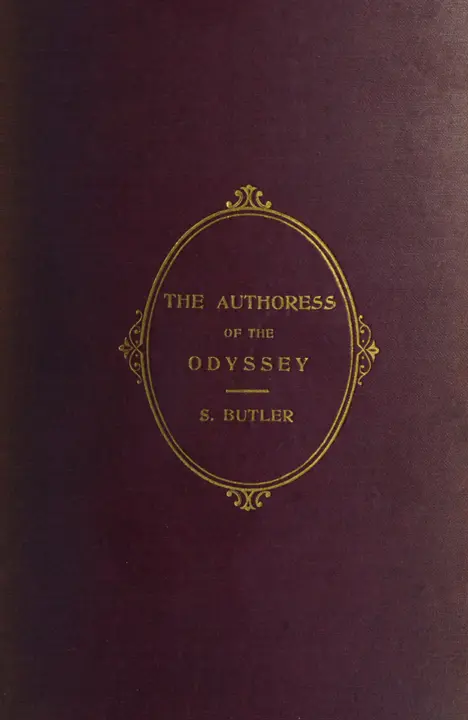
The Authoress of the Odyssey Where and when she wrote, who she was, the use she made of the Iliad, and how the poem grew under her hands
Samuel Butler
THE CLASSIC COLLECTION · 1900
"The Way of All Flesh" by Samuel Butler is a semi-autobiographical novel written between 1873 and 1884, though published posthumously in 1903. This scathing attack on Victorian hypocrisy follows four generations of the Pontifex family, centering on Ernest Pontifex's turbulent journey from oppressive childhood to troubled adulthood. Dominated by hypocritical parents and navigating theological crises, prison, a disastrous marriage, and eventual liberation, Ernest's story captured the anti-Victorian sentiment of its time, earning recognition as a landmark English novel.
Introduction adapted from the source catalogue; source summaries may be automatically generated.
Free to read · English · 163,842 words · No account needed
MAKE TIME FOR A GOOD BOOK
On by default. Untick to stop anonymous reading totals. Each page counts after 10 seconds in view. How this works.
Anonymous counting is on unless you have switched it off.
In the course of the evening they came into the drawing-room, and, as an especial treat, were to sing some of their hymns to me, instead of saying them, so that I might hear how nicely they sang. Ernest was to choose the first hymn, and he chose one about some people who were to come to the sunset tree. I am no botanist, and do not know what kind of tree a sunset tree is, but the words began, “Come, come, come; come to the sunset tree for the day is past and gone.” The tune was rather pretty and had taken Ernest’s fancy, for he was unusually fond of music and had a sweet little child’s voice which he liked using.
He was, however, very late in being able to sound a hard it “c” or “k,” and, instead of saying “Come,” he said “Tum tum, tum.”
“Ernest,” said Theobald, from the arm-chair in front of the fire, where he was sitting with his hands folded before him, “don’t you think it would be very nice if you were to say ‘come’ like other people, instead of ‘tum’?”
“I do say tum,” replied Ernest, meaning that he had said “come.”
Theobald was always in a bad temper on Sunday evening. Whether it is that they are as much bored with the day as their neighbours, or whether they are tired, or whatever the cause may be, clergymen are seldom at their best on Sunday evening; I had already seen signs that evening that my host was cross, and was a little nervous at hearing Ernest say so promptly “I do say tum,” when his papa had said he did not say it as he should.
Theobald noticed the fact that he was being contradicted in a moment. He got up from his arm-chair and went to the piano.
“No, Ernest, you don’t,” he said, “you say nothing of the kind, you say ‘tum,’ not ‘come.’ Now say ‘come’ after me, as I do.”
“Tum,” said Ernest, at once; “is that better?” I have no doubt he thought it was, but it was not.
“Now, Ernest, you are not taking pains: you are not trying as you ought to do. It is high time you learned to say ‘come,’ why, Joey can say ‘come,’ can’t you, Joey?”
“Yeth, I can,” replied Joey, and he said something which was not far
off “come.”
“There, Ernest, do you hear that? There’s no difficulty about it, nor shadow of difficulty. Now, take your own time, think about it, and say ‘come’ after me.”
The boy remained silent a few seconds and then said “tum” again.
Your reading position is saved on this browser. Take it to another device with a library code. Reading pages adapt to text, rather than matching a printed edition.
Samuel Butler
Samuel Butler
Samuel Butler
Samuel Butler
BEHIND THE BOOK
This eBook is for the use of anyone anywhere in the United States and most other parts of the world at no cost and with almost no restrictions whatsoever. You may copy it, give it away or re-use it under the terms of the Project Gutenberg License included with this eBook or online at www.gutenberg.org. If you are not located in the United States, you will have to check the laws of the country where you are located before using this eBook. Read the source licence.
The original source file, including credits and licence, is retained by this library. Request an original-format copy at no charge. Please include the book title and Project Gutenberg identifier #2084.
KEEP YOUR CURIOSITY GOING
Coulson Kernahan

Maurice Baring
Frances Wright
Cécile Tormay

Frederic Jesup Stimson

W. H. P. (William Henry Pope) Jarvis