
The Writing of News A Handbook with Chapters on Newspaper Correspondence and Copy Reading
Charles G. (Charles Griffith) Ross
THE CLASSIC COLLECTION · 1892
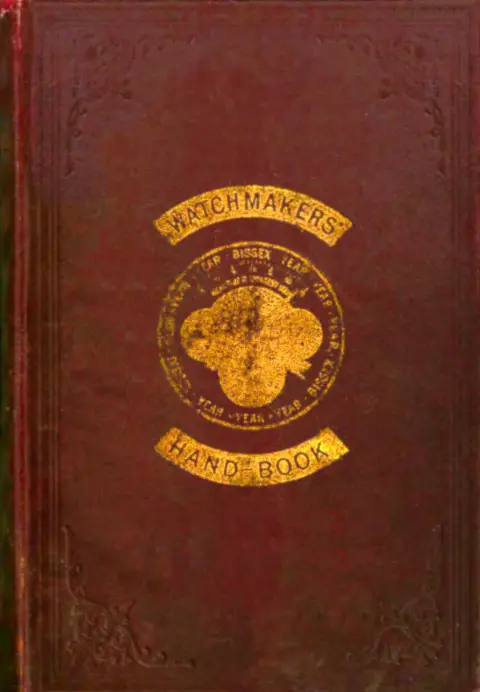
"The watchmakers'' hand book : intended as a workshop companion for those… by Claudius Saunier is a technical handbook written in the late 19th century. It is a comprehensive reference for watchmakers and allied mechanical trades, focusing on practical methods, materials, tools, measurement, repairs, and finishing techniques to support daily workshop work. The opening of the handbook presents a transcriber’s note on formatting, followed by period advertisements, the title page, and a preface explaining the American edition’s practical aims, expanded content, modernized tooling, integrated illustrations, and thorough indexing. An extensive index outlines the breadth of topics, after which Part I begins by arguing that arithmetic, geometry, and drawing are essential foundations for competent watch repair and construction despite interchangeable manufacturing. It then offers concise refreshers on calculation signs, powers and roots (including square-root extraction), proportions, and the elements of practical geometry (circles, angles, plane areas, and volumes). The text proceeds to basic drawing practice and conventions, tracing and transferring methods, and key instruments (rules, protractor, scales, sector, proportional compass, vernier, micrometer screw), before introducing core geometric constructions for perpendiculars, parallels, subdivisions, and angle replication—ending mid-topic on subdividing an angle.
Introduction adapted from the source catalogue; source summaries may be automatically generated.
Free to read · English · 142,736 words · No account needed
MAKE TIME FOR A GOOD BOOK
On by default. Untick to stop anonymous reading totals. Each page counts after 10 seconds in view. How this works.
Anonymous counting is on unless you have switched it off.
Gold resembles platinum, silver, iron, etc., in being capable of welding, that is to say, two pieces of the metal can be united without previous fusion. Indeed, by the application of great pressure it can be made to weld when cold.
It is insoluble except in aqua regia (a mixture of 1 part nitric acid and 4 parts hydrochloric acid), alkaline persulphides and selenic acid. Chlorine, phosphorus, and a few other substances can be made to combine with it by the acid of heat.
It is as a preservative, that is applied in layers termed “gilding,” that gold is principally used in watchwork, and some details will be found on this subject under “Gilding,” (articles =142=-=153=). Owing to its softness the metal is not used in a pure state, but usually alloyed with copper. The principal alloys in use in this country are:
22 parts (carats) gold, 2 parts (carats) copper, for coin and wedding
rings.
18 parts gold, 6 parts copper, for high-class jewelry and watch-cases.
15 parts gold, 9 parts copper, for ordinary jewelry.
12 parts gold, 12 parts copper; and 9 parts gold, 15 parts copper, for
common jewelry.
The alloys used for soldering gold will be described under “Solders”
(=126=).
Alloys of gold with silver and copper have been employed for making watch wheels; they wear well, and will take a beautiful polish, which is maintained for a longer time than in the case of brass wheels.
Chronometer balance-springs and the suspension-springs for astronomical clocks have also been made of gold-copper or gold-silver alloys rolled and hardened (=591=.) If carefully prepared, they maintain their elasticity unimpaired for a long period, and there is no liability to rust.
The dilatation for a given change of temperature is, however, greater than that of steel, so that a greater compensating effect becomes necessary, but this inconvenience is partially compensated for by its inoxidizability and the fact that it is not liable to become magnetic.
=114.= This metal in an unalloyed state is too soft for use in
horology; its principal use is for cases, and as a constituent of
solders.
Houriet made watch wheels of an alloy containing 2 parts silver to 1 part 18-carat gold, and he affirmed that this alloy became polished at the acting surfaces of the teeth. Jurgensen states that chronometer escape-wheels made of this alloy, carefully hammered, do not require oil at the points of their teeth.
Dumesnil proposed an alloy of 2 parts copper, 1 part silver, and 1 part zinc, all perfectly pure. Lecocq made chronometer balances in which the brass was replaced by pure silver deposited on the surface of the steel by electrolysis, thus avoiding the use of a fire. The compensation is said to have been very efficient.
Your reading position is saved on this browser. Take it to another device with a library code. Reading pages adapt to text, rather than matching a printed edition.
BEHIND THE BOOK
This eBook is for the use of anyone anywhere in the United States and most other parts of the world at no cost and with almost no restrictions whatsoever. You may copy it, give it away or re-use it under the terms of the Project Gutenberg License included with this eBook or online at www.gutenberg.org. If you are not located in the United States, you will have to check the laws of the country where you are located before using this eBook. Read the source licence.
The original source file, including credits and licence, is retained by this library. Request an original-format copy at no charge. Please include the book title and Project Gutenberg identifier #76850.
KEEP YOUR CURIOSITY GOING
Charles G. (Charles Griffith) Ross
Hannah Webster Foster

Emily Lawless
Edwin Hamlin Carr

Charles De Lano Hine
Andrew Ure