
The Writing of News A Handbook with Chapters on Newspaper Correspondence and Copy Reading
Charles G. (Charles Griffith) Ross
THE CLASSIC COLLECTION · 1892
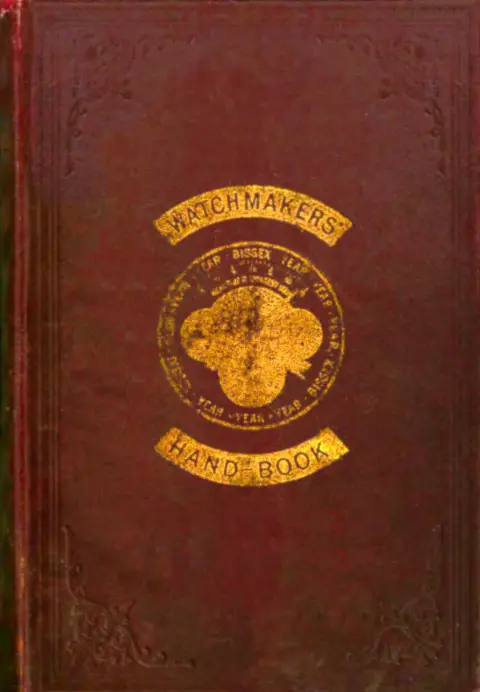
"The watchmakers'' hand book : intended as a workshop companion for those… by Claudius Saunier is a technical handbook written in the late 19th century. It is a comprehensive reference for watchmakers and allied mechanical trades, focusing on practical methods, materials, tools, measurement, repairs, and finishing techniques to support daily workshop work. The opening of the handbook presents a transcriber’s note on formatting, followed by period advertisements, the title page, and a preface explaining the American edition’s practical aims, expanded content, modernized tooling, integrated illustrations, and thorough indexing. An extensive index outlines the breadth of topics, after which Part I begins by arguing that arithmetic, geometry, and drawing are essential foundations for competent watch repair and construction despite interchangeable manufacturing. It then offers concise refreshers on calculation signs, powers and roots (including square-root extraction), proportions, and the elements of practical geometry (circles, angles, plane areas, and volumes). The text proceeds to basic drawing practice and conventions, tracing and transferring methods, and key instruments (rules, protractor, scales, sector, proportional compass, vernier, micrometer screw), before introducing core geometric constructions for perpendiculars, parallels, subdivisions, and angle replication—ending mid-topic on subdividing an angle.
Introduction adapted from the source catalogue; source summaries may be automatically generated.
Free to read · English · 142,736 words · No account needed
MAKE TIME FOR A GOOD BOOK
On by default. Untick to stop anonymous reading totals. Each page counts after 10 seconds in view. How this works.
Anonymous counting is on unless you have switched it off.
Preface.
Index.
Part I. Arithmetic, Geometry, Drawing, Etc.
Arithmetic.
Some Signs Employed in Calculations.
Powers and Roots.
Proportion.
Elements of Practical Geometry.
Geometrical Drawing.
Drawing Instruments.
Geometrical Drawings.
the Micrometrical Dividing Table.
Other Methods of Dividing Into Equal Parts.
to Subdivide a Circle.
Time.
Part II. Materials Employed in Horology.
Iron.
Cast Iron.
Steel.
General Observations.
Special Observations.
Determination of the Qualities of Steel.
Preparations of Steel.
Hardening.
Tempering.
to Whiten and Blue Steel.
Case-hardening.
Influence of Foreign Metals and Metalloids on the
Qualities of Iron and Steel.
Copper.
Zinc.
Brass.
Hammer Hardening of Brass.
to Anneal Brass.
Cast Brass.
Tin.
Bronze.
Sterro.
Lead.
Nickel.
German Silver.
Gold.
Silver.
Aluminium and Aluminium Bronze.
Mercury.
Platinum.
Palladium.
Characteristic Properties of Alloys.
Soldering.
Methods of Soldering.
Bronzing.
Gilding.
Acids and Salts.
Oil.
Alcohol.
Benzine, Etc.
Polishing Materials.
Preparation of Polishing Materials.
Smoothing.
Smoothing of Brass.
Smoothing of Steel.
Polishing.
to Polish Steel.
Cement, Wax, Resin, Etc.
Enamel.
Precious Stones.
Working in Precious Stones.
Part III. Health and Manipulation.
Preservation of Health.
the Sight.
the Body in General.
Use of the File and Graver.
to File Flat and Square With Both Hands at Once.
to File Flat With One Hand.
to Turn Cylindrical Pivots, Etc., and Square Shoulders.
Part IV. Tools and Appliances.
Workshop Fittings.
the Lathe.
the Foot Wheel.
the Bench.
Idlers.
Chucks.
the Slide Rest.
Gravers and Other Hand-turning Tools.
Drills.
Lathe Attachments.
Miscellaneous Small Tools.
Accessories and Miscellaneous Operations to Be Performed in the
Universal Head.
to Center an Object.
Uprighting and Drilling.
Production of Screw Threads. Screw Plates and Taps.
Taps.
Methods of Tapping Holes.
Rapid Mode of Making a Screw.
Screw-head Tools.
Tools For Cutting and Rounding-up the Teeth of Wheels.
Wheel-cutting Engine.
Cutters For Forming the Teeth of Brass Wheels.
Mill Cutters For Steel.
Tool For Making Cutters.
Tools For Correcting the Form of Teeth.
to Test the Accuracy of Certain Tools.
Part V. Repairing and Examining Watches.
Method.
External Examination of the Watch.
to Examine a Geneva Movement.
Accessories For Beginners.
Cleaning the Watch.
Putting the Watch Together.
to Examine English Or American Movements.
to Rapidly Time a Watch Or Clock.
Timing in Positions. Horizontal and Vertical.
Note on the Proportions of Balances.
Demagnetizing.
Part VI. Practical Recipes.
the Plate.
the Barrel. Including Arbor, Stopwork, Mainspring, Etc.
the Mainspring.
the Fusee.
Chain.
Wheels.
Pinions.
Set-hands Square.
Pivots.
Bushing Pivot Holes, Etc.
Depths.
on the Application of the Geometrical Laws of Depths to Practice.
Pallets.
Cylinder.
Balance Spring.
Dial Plate.
Metal Dials.
Hands.
Glasses.
Broaching.
Solid and Hollow Squares.
to Straighten a Rod, Plate Or Wheel.
American Watch Tool Co.
Chymistry District, WALTHAM, MASS.
Your reading position is saved on this browser. Take it to another device with a library code. Reading pages adapt to text, rather than matching a printed edition.
BEHIND THE BOOK
This eBook is for the use of anyone anywhere in the United States and most other parts of the world at no cost and with almost no restrictions whatsoever. You may copy it, give it away or re-use it under the terms of the Project Gutenberg License included with this eBook or online at www.gutenberg.org. If you are not located in the United States, you will have to check the laws of the country where you are located before using this eBook. Read the source licence.
The original source file, including credits and licence, is retained by this library. Request an original-format copy at no charge. Please include the book title and Project Gutenberg identifier #76850.
KEEP YOUR CURIOSITY GOING
Charles G. (Charles Griffith) Ross
Hannah Webster Foster

Emily Lawless
Edwin Hamlin Carr

Charles De Lano Hine
Andrew Ure