
Old Virginia and Her Neighbours, Vol. 2 (of 2)
John Fiske
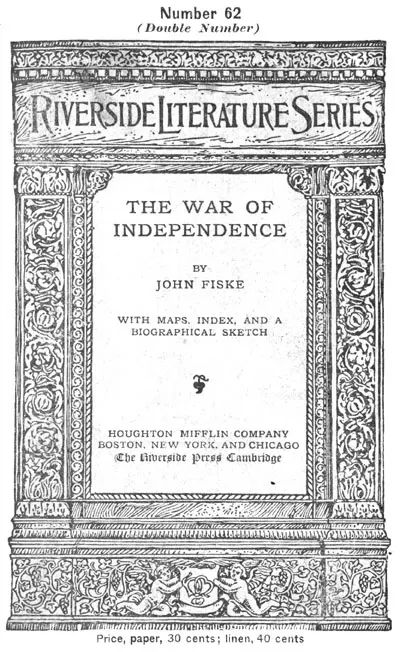
THE CLASSIC COLLECTION · 1889
"The War of Independence" by John Fiske is a historical account written in the late 19th century. This work offers a concise overview of the American Revolutionary War, emphasizing key events and the broader implications of the struggle for national independence. Fiske aims to clarify the complexities of this period, focusing on the causes and effects that defined the revolution rather than detailing every event. The opening of the narrative lays the groundwork for understanding the American Revolution by reflecting on celebrations commemorating important events leading up to the war. Fiske explains the importance of the period from the Declaration of Independence in 1776 to George Washington's inauguration in 1789, which marked the establishment of a new government. He highlights how approaching events, such as the undercurrents in colonial politics and the dissatisfaction with British rule, set the stage for rebellion, thus emphasizing the interconnectedness of historical occurrences leading to independence. Fiske's initial chapters are structured to draw readers into the historical context, informing them of the social, political, and economic conditions that precipitated the revolutionary fervor of the colonies.
Introduction adapted from the source catalogue; source summaries may be automatically generated.
Free to read · English · 50,938 words · No account needed
MAKE TIME FOR A GOOD BOOK
On by default. Untick to stop anonymous reading totals. Each page counts after 10 seconds in view. How this works.
Anonymous counting is on unless you have switched it off.
[Sidenote: Capture of Ticonderoga, May 10, 1775.]
[Sidenote: Washington appointed to command the army, June 15, 1775.]
[Sidenote: Charles Lee.]
The belligerent feeling in New England had now grown so strong as to show itself in an act of offensive warfare. On the 10th of May, just three weeks after Lexington, the fortresses at Ticonderoga and Crown Point, controlling the line of communication between New York and Canada, were surprised and captured by men from the Green Mountains and Connecticut valley under Ethan Allen and Seth Warner. The Congress, which met on that same day at Philadelphia, showed some reluctance in sanctioning an act so purely offensive; but in its choice of a president the spirit of defiance toward Great Britain was plainly shown. John Hancock, whom the British commander-in-chief was under stringent orders to arrest and send over to England to be tried for treason, was chosen to that eminent position on the 24th of May. This showed that the preponderance of sentiment in the country was in favour of supporting the New England colonies in the armed struggle into which they had drifted. This was still further shown two days later, when Congress in the name of the "United Colonies of America" assumed the direction of the rustic army of New England men engaged in the siege of Boston. As Congress was absolutely penniless and had no power to lay taxes, it proceeded to borrow £6000 for the purchase of gunpowder. It called for ten companies of riflemen from Virginia, Maryland, and Pennsylvania, to reinforce what was henceforth known as the Continental army; and on the 15th of June it appointed George Washington commander-in-chief. The choice of Washington was partly due to the general confidence in his ability and in his lofty character. In the French War he had won a military reputation higher than that of any other American, and he was already commander-in-chief of the forces of Virginia. But the choice was also partly due to sound political reasons. The Massachusetts leaders, especially Samuel Adams and his cousin John, were distrusted by some people as extremists and fire-eaters. They wished to bring about a declaration of independence, for they believed it to be the only possible cure for the evils of the time. The leaders in other colonies, upon which the hand of the British government had not borne so heavily, had not yet advanced quite so far as this. Most of them believed that the king could be brought to terms; they did not realize that he would never give way because it was politically as much a life and death struggle for him as for them. Washington was not yet clearly in favour of independence, nor was Jefferson, who a twelvemonth hence was to be engaged in writing the Declaration. It is doubtful if any of the leading men as yet agreed with the Adamses, except Dr. Franklin, who had just returned from England after his ten years' stay there, and knew very well how little hope was to be placed in conciliatory measures. The Adamses, therefore, like wise statesmen, were always on their guard lest circumstances should drive Massachusetts in the path of rebellion faster than the sister colonies were likely to keep pace with her. This was what the king above all things wished, and by the same token it was what they especially dreaded and sought to avoid. To appoint George Washington to the chief command was to go a long way toward irrevocably committing Virginia to the same cause with Massachusetts, and John Adams was foremost in urging the appointment. Its excellence was obvious to every one, and we hear of only two persons that were dissatisfied. One of these was John Hancock, who coveted military distinction and was vain enough to think himself fit for almost any position. The other was Charles Lee, a British officer who had served in America in the French War and afterward wandered about Europe as a soldier of fortune. He had returned to America in 1773 in the hope of playing a leading part here. He set himself up as an authority on military questions, and pretended to be a zealous lover of liberty. He was really an unprincipled charlatan for whom, the kindest thing that can be said is that perhaps he was slightly insane. He had hoped to be appointed to the chief command, and was disgusted when he found himself placed second among the four major-generals. The first major-general was Artemas Ward of Massachusetts; the third was Philip Schuyler of New York; the fourth was Israel Putnam of Connecticut. Eight brigadier-generals were appointed, among whom we may here mention Richard Montgomery of New York, William Heath of Massachusetts, John Sullivan of New Hampshire, and Nathanael Greene of Rhode Island. The adjutant-general, Horatio Gates, was an Englishman who had served in the French War, and since then had lived in Virginia.
Your reading position is saved on this browser. Take it to another device with a library code. Reading pages adapt to text, rather than matching a printed edition.
John Fiske

John Fiske

John Fiske

John Fiske
BEHIND THE BOOK
This eBook is for the use of anyone anywhere in the United States and most other parts of the world at no cost and with almost no restrictions whatsoever. You may copy it, give it away or re-use it under the terms of the Project Gutenberg License included with this eBook or online at www.gutenberg.org. If you are not located in the United States, you will have to check the laws of the country where you are located before using this eBook. Read the source licence.
The original source file, including credits and licence, is retained by this library. Request an original-format copy at no charge. Please include the book title and Project Gutenberg identifier #20803.
KEEP YOUR CURIOSITY GOING
Cécile Tormay

Moritz Busch
John L. Ransom
Frances Wright
Cécile Tormay

Mabel Potter Daggett