THE CLASSIC COLLECTION✦My diaries, being a personal narrative of events 1888-1914, Part 2 (1900-1914)CLASSIC FREE BOOKS
My diaries, being a personal narrative of events 1888-1914, Part 2 (1900-1914)
Wilfrid Scawen Blunt
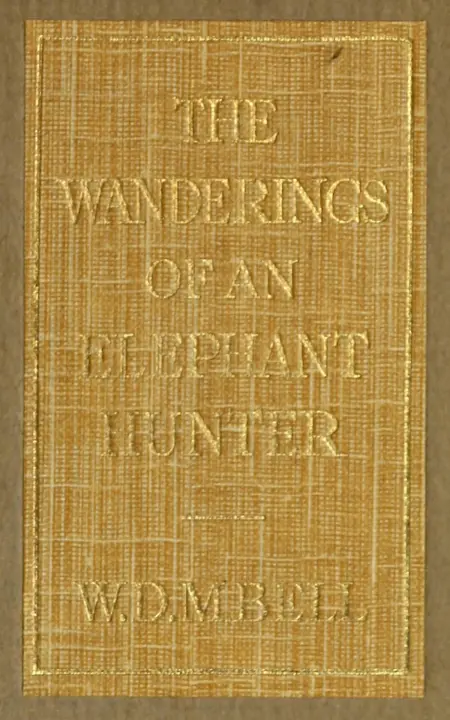
THE CLASSIC COLLECTION · 1923
"The Wanderings of an Elephant Hunter" by W. D. M. Bell is a memoir detailing the author's adventures as an elephant hunter, written in the early 20th century. The narrative centers around the intricacies of elephant hunting in Africa, exploring various techniques and the flora and fauna encountered in the wild. Through his experiences, Bell also delves into the relationship between humans and nature, particularly the impact of hunting on local ecosystems and communities. At the start of the memoir, Bell introduces the thrilling pursuit of solitary bull elephants, providing vivid descriptions of their immense size and behavior. He explains the methods involved in tracking these majestic creatures through dense bush, emphasizing the challenges hunters face in approaching them unnoticed. The opening chapters emphasize the excitement and unpredictability of hunting while laying a foundation for deeper explorations of Bell's encounters with local tribes and their cultural practices in relation to hunting and nature. As he shares his expertise, Bell hints at broader themes of coexistence and the clash of traditional beliefs with the realities of modern hunting.
Introduction adapted from the source catalogue; source summaries may be automatically generated.
Free to read · English · 71,572 words · No account needed
MAKE TIME FOR A GOOD BOOK
On by default. Untick to stop anonymous reading totals. Each page counts after 10 seconds in view. How this works.
Anonymous counting is on unless you have switched it off.
In the evening of the day upon which I had my consultation I was strolling about the village while my boys got food, prepared for another trip in the bush. Besides these preparations I noticed a lot of basket mending and sharpening of knives. One woman I questioned said she was coming with us on the morrow to get some elephant meat. I spoke to two or three others. They were all preparing to smoke and dry large quantities of meat, and they were all going with us. Great optimism prevailed everywhere. Even I began to feel that the turning in the lane was in sight. Late that night one of my trackers came to say that the medicine man wished me to stay in camp in the morning and not to proceed as I had intended. I asked the reason of this and he simply said that the medicine man was finding elephant for me and that when the sun was about so high (9 o’clock) I should hear some news.
Soon after daybreak natives from the village began to arrive in camp. All seemed in great spirit, and everyone came with knives, hatchets, baskets and skin bags of food. They sat about in groups laughing and joking among themselves. Breakfast finished, the boys got everything ready for the march. What beat me was that everyone—my people included—seemed certain they were going somewhere. About 9.30 a native glistening with sweat arrived. He had seen elephant. How many? Three! Big ones? Yes! Hurriedly telling the chief to keep his people well in the rear, off we set at a terrific pace straight through the bush until our guide stopped by a tree. There he had left his companion watching the elephants. Two or three hundred yards further on we came to their tracks. Everywhere were the welcome signs of their having fed as they went. But, strangest thing of all, not a single honey-guide appeared. Off again as hard as we could go, the tracks running on ahead clear and distinct, light grey patches on a burnt ground with the little grey footmarks of the native ahead of us. In an hour or so we spotted him in a tree, and as we drew near we caught the grey glint of elephant. Still no honey-guides; blessings on the medicine man! Wind right, bush fairly open, it only remained to see if they were warrantable. That they were large bulls we already knew from their tracks. Leaving the boys, I was soon close behind the big sterns as they wandered gently along. In a few seconds I had seen their ivory sufficiently to know that one was really good and the other two quite shootable beasts. Now for the brain shot. Of all thrills in the world give me the standing within 20 yds. of good elephant, waiting for a head to turn to send a tiny nickel bullet straight to the brain. From toenail to top of back they were all a good 11 ft. Stepping a few yards to the left and keeping parallel with them I saw that the way to bag the lot was to shoot the leader first, although he was not the biggest. Letting pass one or two chances at the middle and rearmost beasts, I finally got a bullet straight into the leader’s brain. The middle one turned towards the shot and the nearest turned away from it, so that they both presented chances at their brains: the former an easy broadside standing, the latter a behind the ear shot and running. So hard did this one come down on his tusks that one of them was loose in its socket and could be drawn straight out. Almost immediately one could hear a kind of rush coming through the bush. The chief and his people were arriving. There seemed to be hundreds of them. And the noise and rejoicings! I put guards on the medicine man’s beast. From first to last no honey-guide had appeared. The reader must judge for himself whether there was any magic in the affair or not. What I think happened was this: knowing that the medicine man was taking the affair in hand and that he had promised elephant, the natives believed that elephant would be killed. Believing that, they were willing to look industriously for them in the bush. Great numbers of them scattered through the bush had the effect of splitting up and scattering the honey-guides, besides increasing the chances of finding elephant. The fact that we did not hear a single bird must have been mere chance, I think. But you could not convince an African of that. Natural causes and their effects have not a place in his mind. I remember once an elephant I had hit in the heart shook his head violently in his death throes. I was astounded to see one of his tusks fly out and land twelve paces away. The boys were awe-stricken when they saw what had happened. After ten minutes’ silence they started whispering to each other and then my gun-bearer came to speak to me. He solemnly warned me with emotion in his voice never to go near another elephant. If I did it would certainly kill me after what had occurred. It was quite useless my pointing out that the discarded tusk was badly diseased, and that it would have probably fallen out in a short time anyhow. No! No! Bwana, it is medicine! said they.
Your reading position is saved on this browser. Take it to another device with a library code. Reading pages adapt to text, rather than matching a printed edition.
BEHIND THE BOOK
This eBook is for the use of anyone anywhere in the United States and most other parts of the world at no cost and with almost no restrictions whatsoever. You may copy it, give it away or re-use it under the terms of the Project Gutenberg License included with this eBook or online at www.gutenberg.org. If you are not located in the United States, you will have to check the laws of the country where you are located before using this eBook. Read the source licence.
The original source file, including credits and licence, is retained by this library. Request an original-format copy at no charge. Please include the book title and Project Gutenberg identifier #68044.
KEEP YOUR CURIOSITY GOING
Wilfrid Scawen Blunt
Wilfrid Scawen Blunt

E. W. (Edgar Watson) Howe
Francis Greenleaf Allinson & Anne C. E. (Anne Crosby Emery) Allinson
Cyrenus Cole

John Martineau