THE CLASSIC COLLECTION✦Heu-Heu, or The monsterCLASSIC FREE BOOKS
Heu-Heu, or The monster
H. Rider (Henry Rider) Haggard
THE CLASSIC COLLECTION · 1914
"The Wanderer's Necklace" by H. Rider Haggard is a historical novel set in the early 20th century that intertwines adventure with themes of love and fate. The narrative begins with a dedication and a note by the editor, introducing a story structured around the life of a character named Olaf, who reflects on pivotal moments from his past, specifically focusing on his relationships and the conflicts that arise in his world. As Olaf recounts his childhood and the complexities of his betrothal to Iduna, he becomes embroiled in a web of emotions and societal expectations that highlight the essence of love as well as the anguish of betrayal. The opening of the narrative vividly describes Olaf's formative experiences, including childhood memories of a house near water and his first encounter with his betrothed, Iduna, who captures his heart. As the tale unfolds, the tension between familial duty, personal desire, and the intrigue surrounding their budding love story is palpable. There are references to Olaf's relationships with his brother Ragnar and his foster-brother Steinar, along with foreboding hints from characters like Freydisa, which foreshadow future trials. The chapter concludes with Olaf embarking on a daring adventure that reveals both his courage and the fate that awaits him, setting the stage for the intertwining of past dreams and present realities that will define the course of his life.
Introduction adapted from the source catalogue; source summaries may be automatically generated.
Free to read · English · 95,744 words · No account needed
MAKE TIME FOR A GOOD BOOK
On by default. Untick to stop anonymous reading totals. Each page counts after 10 seconds in view. How this works.
Anonymous counting is on unless you have switched it off.
“I do not know what you would or would not have done,” she answered coldly. “I think that Constantine is right, and that you must be what is called a saint; and, if so, saints are best in heaven, especially when they know too much on earth. Give me that sword of yours.”
I drew the sword, saluted with it, and gave it to her.
“It is a heavy weapon,” she said. “Whence came it?”
“From the same grave as the necklace, Augusta.”
“Ah! the necklace that your dream-woman wore. Well, go to seek her in the land of dreams,” and she lifted the sword.
“Your pardon, Augusta, but you are about to strike with the blunt edge, which may wound but will not kill.”
She laughed a little, very nervously, and, turning the sword round in
her hand, said:
“Truly, you are the strangest of men! Ah! I thank you, now I have it right. Do you understand, Olaf, I mean, Sir Saint, what sort of a story I must tell of you after I have struck? Do you understand that not only are you about to die, but that infamy will be poured upon your name and that your body will be dragged through the streets and thrown to the dogs with the city offal? Answer, I say, answer!”
“I understand that you must cause these things to be done for your own sake, Augusta, and I do not complain. Lies matter nothing to me, who journey to the Land of Truth, where there are some whom I would meet again. Be advised by me. Strike here, where the neck joins the shoulder, holding the sword slantwise, for there even a woman’s blow will serve to sever the great artery.”
“I cannot. Kill yourself, Olaf.”
“A week ago I’d have fallen on the sword; but now, by the rule of our faith, in such a cause I may not. My blood must be upon your hands, for which I grieve, knowing that no other road is open to you. Augusta, if it is worth anything to you, take my full forgiveness for the deed, and with it my thanks for all the goodness you have shown to me, but most for your woman’s favour. In after years, perhaps, when death draws near to you also, if ever you remember Olaf, your faithful servant, you will understand much it is not fitting that I should say. Give me one moment to make my peace with Heaven as to certain kisses. Then strike hard and swiftly, and, as you strike, scream for your guards and women. Your wit will do the rest.”
Your reading position is saved on this browser. Take it to another device with a library code. Reading pages adapt to text, rather than matching a printed edition.
H. Rider (Henry Rider) Haggard
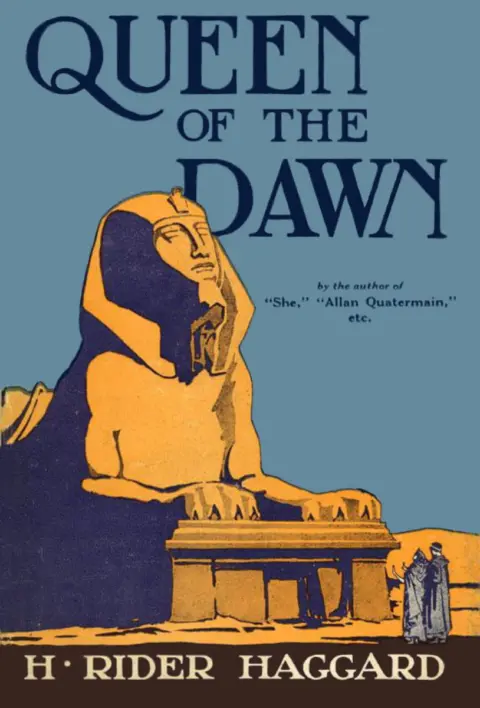
H. Rider (Henry Rider) Haggard
H. Rider (Henry Rider) Haggard
H. Rider (Henry Rider) Haggard
BEHIND THE BOOK
This eBook is for the use of anyone anywhere in the United States and most other parts of the world at no cost and with almost no restrictions whatsoever. You may copy it, give it away or re-use it under the terms of the Project Gutenberg License included with this eBook or online at www.gutenberg.org. If you are not located in the United States, you will have to check the laws of the country where you are located before using this eBook. Read the source licence.
The original source file, including credits and licence, is retained by this library. Request an original-format copy at no charge. Please include the book title and Project Gutenberg identifier #3097.
KEEP YOUR CURIOSITY GOING
Cécile Tormay

Moritz Busch
Coulson Kernahan
John L. Ransom

Maurice Baring
Frances Wright