READ · DISCOVER · ENJOYClassic literature · Always free
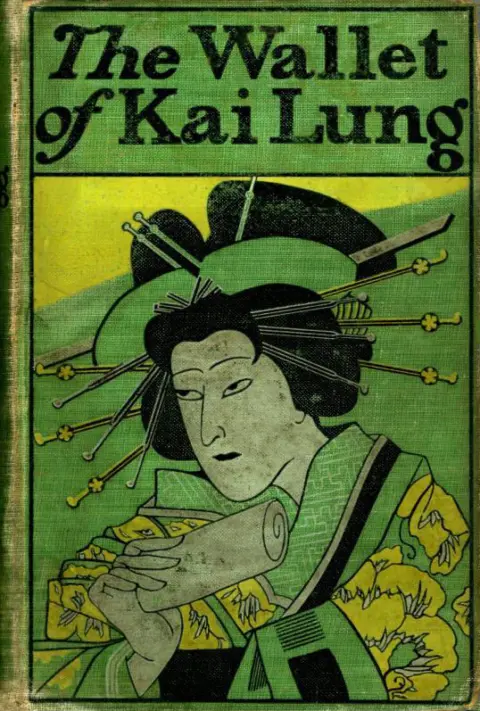
The Wallet of Kai Lung — digital edition cover

THE CLASSIC COLLECTION · 1900

The Wallet of Kai Lung

"The Wallet of Kai Lung" by Ernest Bramah is a collection of fantasy stories published in 1900. Set in ancient China, the tales follow Kai Lung, a wandering storyteller who captivates listeners with narratives of transformation, probation, vengeance, and destiny. Each story unfolds as Kai Lung shares these tales during his travels, weaving together accounts of mandarins, picture makers, and charitable souls navigating moral dilemmas and supernatural events. This pioneering work helped shape early fantasy literature with its unique blend of Eastern setting and imaginative storytelling.

Introduction adapted from the source catalogue; source summaries may be automatically generated.

Start reading ↓

Free to read · English · 79,520 words · No account needed

MAKE TIME FOR A GOOD BOOK

The Wallet of Kai Lung

On by default. Untick to stop anonymous reading totals. Each page counts after 10 seconds in view. How this works.

Anonymous counting is on unless you have switched it off.

The Wallet of Kai Lung

“‘Unless a more serious loss should be occasioned,’ replied the father coldly, ‘there is no necessity to adopt so extreme a course. The benevolent Mandarin in question existed at a remote period of the Thang dynasty, and the incident to which an allusion has been made arose in the following way: To the public court of the enlightened Poo-chow there came one day a youth of very inferior appearance and hesitating manner, who besought his explicit advice, saying: “The degraded and unprepossessing being before you, O select and venerable Mandarin, is by nature and attainments a person of the utmost timidity and fearfulness. From this cause life itself has become a detestable observance in his eyes, for those who should be his companions of both sexes hold him in undisguised contempt, making various unendurable allusions to the colour and nature of his internal organs whenever he would endeavour to join them. Instruct him, therefore, the manner in which this cowardice may be removed, and no service in return will be esteemed too great.” “There is a remedy,” replied the benevolent Mandarin, without any hesitation whatever, “which if properly carried out is efficacious beyond the possibility of failure. Certain component parts of your body are lacking, and before the desired result can be obtained these must be supplied from without. Of all courageous things the tiger is the most fearless, and in consequence it combines all those ingredients which you require; furthermore, as the teeth of the tiger are the instruments with which it accomplishes its vengeful purpose, there reside the essential principles of its inimitable courage. Let the person who seeks instruction in the matter, therefore, do as follows: taking the teeth of a full-grown tiger as soon as it is slain, and before the essences have time to return into the body, he shall grind them to a powder, and mixing the powder with a portion of rice, consume it. After seven days he must repeat the observance, and yet again a third time, after another similar lapse. Let him, then, return for further guidance; for the present the matter interests this person no further.” At these words the youth departed, filled with a new and inspired hope; for the wisdom of the sagacious Poo-chow was a matter which did not admit of any doubt whatever, and he had spoken with well-defined certainty of the success of the experiment. Nevertheless, after several days industriously spent in endeavouring to obtain by purchase the teeth of a newly-slain tiger, the details of the undertaking began to assume a new and entirely unforeseen aspect; for those whom he approached as being the most likely to possess what he required either became very immoderately and disagreeably amused at the nature of the request, or regarded it as a new and ill-judged form of ridicule, which they prepared to avenge by blows and by base remarks of the most personal variety. At length it became unavoidably obvious to the youth that if he was to obtain the articles in question it would first be necessary that he should become adept in the art of slaying tigers, for in no other way were the required conditions likely to be present. Although the prospect was one which did not greatly tend to allure him, yet he did not regard it with the utterly incapable emotions which would have been present on an earlier occasion; for the habit of continually guarding himself from the onslaughts of those who received his inquiry in an attitude of narrow-minded distrust had inspired him with a new-found valour, while his amiable and unrestrained manner of life increased his bodily vigour in every degree. First perfecting himself in the use of the bow and arrow, therefore, he betook himself to a wild and very extensive forest, and there concealed himself among the upper foliage of a tall tree standing by the side of a pool of water. On the second night of his watch, the youth perceived a large but somewhat ill-conditioned tiger approaching the pool for the purpose of quenching its thirst, whereupon he tremblingly fitted an arrow to his bowstring, and profiting by the instruction he had received, succeeded in piercing the creature to the heart. After fulfilling the observance laid upon him by the discriminating Poo-chow, the youth determined to remain in the forest, and sustain himself upon such food as fell to his weapons, until the time arrived when he should carry out the rite for the last time. At the end of seven days, so subtle had he become in all kinds of hunting, and so strengthened by the meat and herbs upon which he existed, that he disdained to avail himself of the shelter of a tree, but standing openly by the side of the water, he engaged the attention of the first tiger which came to drink, and discharged arrow after arrow into its body with unfailing power and precision. So entrancing, indeed, had the pursuit become that the next seven days lengthened out into the apparent period of as many moons, in such a leisurely manner did they rise and fall. On the appointed day, without waiting for the evening to arrive, the youth set out with the first appearance of light, and penetrated into the most inaccessible jungles, crying aloud words of taunt-laden challenge to all the beasts therein, and accusing the ancestors of their race of every imaginable variety of evil behaviour. Yet so great had become the renown of the one who stood forth, and so widely had the warning voice been passed from tree to tree, preparing all who dwelt in the forest against his anger, that not even the fiercest replied openly, though low growls and mutterings proceeded from every cave within a bow-shot’s distance around. Wearying quickly of such feeble and timorous demonstrations, the youth rushed into the cave from which the loudest murmurs proceeded, and there discovered a tiger of unnatural size, surrounded by the bones of innumerable ones whom it had devoured; for from time to time its ravages became so great and unbearable, that armies were raised in the neighbouring villages and sent to destroy it, but more than a few stragglers never returned. Plainly recognizing that a just and inevitable vengeance had overtaken it, the tiger made only a very inferior exhibition of resistance, and the youth, having first stunned it with a blow of his closed hand, seized it by the middle, and repeatedly dashed its head against the rocky sides of its retreat. He then performed for the third time the ceremony enjoined by the Mandarin, and having cast upon the cringing and despicable forms concealed in the surrounding woods and caves a look of dignified and ineffable contempt, set out upon his homeward journey, and in the space of three days’ time reached the town of the versatile Poo-chow. “Behold,” exclaimed that person, when, lifting up his eyes, he saw the youth approaching laden with the skins of the tigers and other spoils, “now at least the youths and maidens of your native village will no longer withdraw themselves from the company of so undoubtedly heroic a person.” “Illustrious Mandarin,” replied the other, casting both his weapons and his trophies before his inspired adviser’s feet, “what has this person to do with the little ones of either sex? Give him rather the foremost place in your ever-victorious company of bowmen, so that he may repay in part the undoubted debt under which he henceforth exists.” This proposal found favour with the pure-minded Poo-chow, so that in course of time the unassuming youth who had come supplicating his advice became the valiant commander of his army, and the one eventually chosen to present plighting gifts to his only daughter.’

Your reading position is saved on this browser. Take it to another device with a library code. Reading pages adapt to text, rather than matching a printed edition.

More from this author

BEHIND THE WORDS

About Ernest Bramah

Ernest Bramah (1868–1942). Explore The eyes of Max Carrados, Max Carrados, Kai Lung’s Golden Hours and other works in this collection. These books span classic fiction, mystery & detective, fantasy & fairy tales.

Explore this author’s books →

THE READERS’ VERDICT

How did this story stay with you?

Not rated yet
Your rating for The Wallet of Kai Lung

Be the first to share your verdict.

One rating per browser, which you can change or remove. A necessary browser identifier remembers your vote. How ratings work

A GOOD STORY DESERVES COMPANY

Pass this book along.

A great read is even better when it’s shared.

SEND A LITTLE INSPIRATION

Share this book

BEHIND THE BOOK

Edition & source details.

Title
The Wallet of Kai Lung
Author
Ernest Bramah
First publication (Open Library catalogue match)
1900
Digital edition publisher
Project Gutenberg
Gutenberg release date
1997-10-01
Language
English
Source edition imprint
Not stated in source catalogue
Source identifier
Project Gutenberg #1076
Contributors
No additional named contributors in source metadata

Public-domain source & licence

This eBook is for the use of anyone anywhere in the United States and most other parts of the world at no cost and with almost no restrictions whatsoever. You may copy it, give it away or re-use it under the terms of the Project Gutenberg License included with this eBook or online at www.gutenberg.org. If you are not located in the United States, you will have to check the laws of the country where you are located before using this eBook. Read the source licence.

Full source licence and obtaining an original copy

The original source file, including credits and licence, is retained by this library. Request an original-format copy at no charge. Please include the book title and Project Gutenberg identifier #1076.

the full Project Gutenberg License must appear
prominently whenever any copy of a Project Gutenberg work (any work
on which the phrase “Project Gutenberg” appears, or with which the
phrase “Project Gutenberg” is associated) is accessed, displayed,
performed, viewed, copied or distributed:

This eBook is for the use of anyone anywhere in the United States and most
other parts of the world at no cost and with almost no restrictions
whatsoever. You may copy it, give it away or re-use it under the terms
of the Project Gutenberg™ License included with this eBook or online
at www.gutenberg.org. If you
are not located in the United States, you will have to check the laws
of the country where you are located before using this eBook.

1.E.2. If an individual Project Gutenberg electronic work is
derived from texts not protected by U.S. copyright law (does not
contain a notice indicating that it is posted with permission of the
copyright holder), the work can be copied and distributed to anyone in
the United States without paying any fees or charges. If you are
redistributing or providing access to a work with the phrase “Project
Gutenberg” associated with or appearing on the work, you must comply
either with the requirements of paragraphs 1.E.1 through 1.E.7 or
obtain permission for the use of the work and the Project Gutenberg
trademark as set forth in paragraphs 1.E.8 or 1.E.9.

1.E.3. If an individual Project Gutenberg electronic work is posted
with the permission of the copyright holder, your use and distribution
must comply with both paragraphs 1.E.1 through 1.E.7 and any
additional terms imposed by the copyright holder. Additional terms
will be linked to the Project Gutenberg License for all works
posted with the permission of the copyright holder found at the
beginning of this work.

1.E.4. Do not unlink or detach or remove the full Project Gutenberg
License terms from this work, or any files containing a part of this
work or any other work associated with Project Gutenberg.

1.E.5. Do not copy, display, perform, distribute or redistribute this
electronic work, or any part of this electronic work, without
prominently displaying the sentence set forth in paragraph 1.E.1 with
active links or immediate access to the full terms of the Project
Gutenberg License.

1.E.6. You may convert to and distribute this work in any binary,
compressed, marked up, nonproprietary or proprietary form, including
any word processing or hypertext form. However, if you provide access
to or distribute copies of a Project Gutenberg work in a format
other than “Plain Vanilla ASCII” or other format used in the official
version posted on the official Project Gutenberg website
(www.gutenberg.org), you must, at no additional cost, fee or expense
to the user, provide a copy, a means of exporting a copy, or a means
of obtaining a copy upon request, of the work in its original “Plain
Vanilla ASCII” or other form. Any alternate format must include the
full Project Gutenberg License as specified in paragraph 1.E.1.

1.E.7. Do not charge a fee for access to, viewing, displaying,
performing, copying or distributing any Project Gutenberg works
unless you comply with paragraph 1.E.8 or 1.E.9.

1.E.8. You may charge a reasonable fee for copies of or providing
access to or distributing Project Gutenberg electronic works
provided that:

• You pay a royalty fee of 20% of the gross profits you derive from
the use of Project Gutenberg works calculated using the method
you already use to calculate your applicable taxes. The fee is owed
to the owner of the Project Gutenberg trademark, but he has
agreed to donate royalties under this paragraph to the Project
Gutenberg Literary Archive Foundation. Royalty payments must be paid
within 60 days following each date on which you prepare (or are
legally required to prepare) your periodic tax returns. Royalty
payments should be clearly marked as such and sent to the Project
Gutenberg Literary Archive Foundation at the address specified in
Section 4, “Information about donations to the Project Gutenberg
Literary Archive Foundation.”

• You provide a full refund of any money paid by a user who notifies
you in writing (or by e-mail) within 30 days of receipt that s/he
does not agree to the terms of the full Project Gutenberg™
License. You must require such a user to return or destroy all
copies of the works possessed in a physical medium and discontinue
all use of and all access to other copies of Project Gutenberg™
works.

• You provide, in accordance with paragraph 1.F.3, a full refund of
any money paid for a work or a replacement copy, if a defect in the
electronic work is discovered and reported to you within 90 days of
receipt of the work.

• You comply with all other terms of this agreement for free
distribution of Project Gutenberg™ works.


1.E.9. If you wish to charge a fee or distribute a Project
Gutenberg™ electronic work or group of works on different terms than
are set forth in this agreement, you must obtain permission in writing
from the Project Gutenberg Literary Archive Foundation, the manager of
the Project Gutenberg™ trademark. Contact the Foundation as set
forth in Section 3 below.

1.F.

1.F.1. Project Gutenberg volunteers and employees expend considerable
effort to identify, do copyright research on, transcribe and proofread
works not protected by U.S. copyright law in creating the Project
Gutenberg™ collection. Despite these efforts, Project Gutenberg™
electronic works, and the medium on which they may be stored, may
contain “Defects,” such as, but not limited to, incomplete, inaccurate
or corrupt data, transcription errors, a copyright or other
intellectual property infringement, a defective or damaged disk or
other medium, a computer virus, or computer codes that damage or
cannot be read by your equipment.

1.F.2. LIMITED WARRANTY, DISCLAIMER OF DAMAGES - Except for the “Right
of Replacement or Refund” described in paragraph 1.F.3, the Project
Gutenberg Literary Archive Foundation, the owner of the Project
Gutenberg™ trademark, and any other party distributing a Project
Gutenberg™ electronic work under this agreement, disclaim all
liability to you for damages, costs and expenses, including legal
fees. YOU AGREE THAT YOU HAVE NO REMEDIES FOR NEGLIGENCE, STRICT
LIABILITY, BREACH OF WARRANTY OR BREACH OF CONTRACT EXCEPT THOSE
PROVIDED IN PARAGRAPH 1.F.3. YOU AGREE THAT THE FOUNDATION, THE
TRADEMARK OWNER, AND ANY DISTRIBUTOR UNDER THIS AGREEMENT WILL NOT BE
LIABLE TO YOU FOR ACTUAL, DIRECT, INDIRECT, CONSEQUENTIAL, PUNITIVE OR
INCIDENTAL DAMAGES EVEN IF YOU GIVE NOTICE OF THE POSSIBILITY OF SUCH
DAMAGE.

1.F.3. LIMITED RIGHT OF REPLACEMENT OR REFUND - If you discover a
defect in this electronic work within 90 days of receiving it, you can
receive a refund of the money (if any) you paid for it by sending a
written explanation to the person you received the work from. If you
received the work on a physical medium, you must return the medium
with your written explanation. The person or entity that provided you
with the defective work may elect to provide a replacement copy in
lieu of a refund. If you received the work electronically, the person
or entity providing it to you may choose to give you a second
opportunity to receive the work electronically in lieu of a refund. If
the second copy is also defective, you may demand a refund in writing
without further opportunities to fix the problem.

1.F.4. Except for the limited right of replacement or refund set forth
in paragraph 1.F.3, this work is provided to you ‘AS-IS’, WITH NO
OTHER WARRANTIES OF ANY KIND, EXPRESS OR IMPLIED, INCLUDING BUT NOT
LIMITED TO WARRANTIES OF MERCHANTABILITY OR FITNESS FOR ANY PURPOSE.

1.F.5. Some states do not allow disclaimers of certain implied
warranties or the exclusion or limitation of certain types of
damages. If any disclaimer or limitation set forth in this agreement
violates the law of the state applicable to this agreement, the
agreement shall be interpreted to make the maximum disclaimer or
limitation permitted by the applicable state law. The invalidity or
unenforceability of any provision of this agreement shall not void the
remaining provisions.

1.F.6. INDEMNITY - You agree to indemnify and hold the Foundation, the
trademark owner, any agent or employee of the Foundation, anyone
providing copies of Project Gutenberg™ electronic works in
accordance with this agreement, and any volunteers associated with the
production, promotion and distribution of Project Gutenberg™
electronic works, harmless from all liability, costs and expenses,
including legal fees, that arise directly or indirectly from any of
the following which you do or cause to occur: (a) distribution of this
or any Project Gutenberg work, (b) alteration, modification, or
additions or deletions to any Project Gutenberg work, and (c) any
Defect you cause.

Section 2. Information about the Mission of Project Gutenberg

Project Gutenberg is synonymous with the free distribution of
electronic works in formats readable by the widest variety of
computers including obsolete, old, middle-aged and new computers. It
exists because of the efforts of hundreds of volunteers and donations
from people in all walks of life.

Volunteers and financial support to provide volunteers with the
assistance they need are critical to reaching Project Gutenberg’s
goals and ensuring that the Project Gutenberg collection will
remain freely available for generations to come. In 2001, the Project
Gutenberg Literary Archive Foundation was created to provide a secure
and permanent future for Project Gutenberg and future
generations. To learn more about the Project Gutenberg Literary
Archive Foundation and how your efforts and donations can help, see
Sections 3 and 4 and the Foundation information page at www.gutenberg.org.

Section 3. Information about the Project Gutenberg Literary Archive Foundation

The Project Gutenberg Literary Archive Foundation is a non-profit
501(c)(3) educational corporation organized under the laws of the
state of Mississippi and granted tax exempt status by the Internal
Revenue Service. The Foundation’s EIN or federal tax identification
number is 64-6221541. Contributions to the Project Gutenberg Literary
Archive Foundation are tax deductible to the full extent permitted by
U.S. federal laws and your state’s laws.

The Foundation’s business office is located at 41 Watchung Plaza #516,
Montclair NJ 07042, USA, +1 (862) 621-9288. Email contact links and up
to date contact information can be found at the Foundation’s website
and official page at www.gutenberg.org/contact

Section 4. Information about Donations to the Project Gutenberg
Literary Archive Foundation

Project Gutenberg™ depends upon and cannot survive without widespread
public support and donations to carry out its mission of
increasing the number of public domain and licensed works that can be
freely distributed in machine-readable form accessible by the widest
array of equipment including outdated equipment. Many small donations
($1 to $5,000) are particularly important to maintaining tax exempt
status with the IRS.

The Foundation is committed to complying with the laws regulating
charities and charitable donations in all 50 states of the United
States. Compliance requirements are not uniform and it takes a
considerable effort, much paperwork and many fees to meet and keep up
with these requirements. We do not solicit donations in locations
where we have not received written confirmation of compliance. To SEND
DONATIONS or determine the status of compliance for any particular state
visit www.gutenberg.org/donate.

While we cannot and do not solicit contributions from states where we
have not met the solicitation requirements, we know of no prohibition
against accepting unsolicited donations from donors in such states who
approach us with offers to donate.

International donations are gratefully accepted, but we cannot make
any statements concerning tax treatment of donations received from
outside the United States. U.S. laws alone swamp our small staff.

Please check the Project Gutenberg web pages for current donation
methods and addresses. Donations are accepted in a number of other
ways including checks, online payments and credit card donations. To
donate, please visit: www.gutenberg.org/donate.

Section 5. General Information About Project Gutenberg electronic works

Professor Michael S. Hart was the originator of the Project
Gutenberg concept of a library of electronic works that could be
freely shared with anyone. For forty years, he produced and
distributed Project Gutenberg eBooks with only a loose network of
volunteer support.

Project Gutenberg eBooks are often created from several printed
editions, all of which are confirmed as not protected by copyright in
the U.S. unless a copyright notice is included. Thus, we do not
necessarily keep eBooks in compliance with any particular paper
edition.

Most people start at our website which has the main PG search
facility: www.gutenberg.org.

This website includes information about Project Gutenberg,
including how to make donations to the Project Gutenberg Literary
Archive Foundation, how to help produce our new eBooks, and how to
subscribe to our email newsletter to hear about new eBooks.


KEEP YOUR CURIOSITY GOING

Your next chapter awaits.