THE CLASSIC COLLECTION✦My diaries, being a personal narrative of events 1888-1914, Part 2 (1900-1914)CLASSIC FREE BOOKS
My diaries, being a personal narrative of events 1888-1914, Part 2 (1900-1914)
Wilfrid Scawen Blunt
THE CLASSIC COLLECTION · 1614
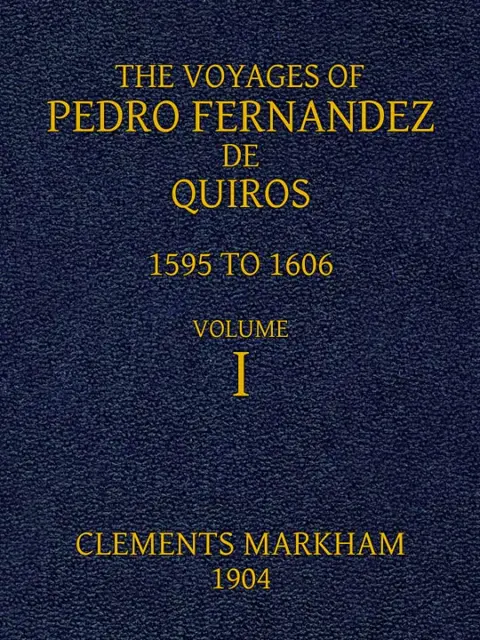
"The Voyages of Pedro Fernandez de Quiros, 1595 to 1606" by Queirós is a historical account written in the early 20th century. This work details the narratives of Pedro Fernandez de Quiros, a key figure in early exploration efforts in the Pacific. The book explores his voyages, focusing on his aspirations to discover the Southern continent and the various challenges and events he faced during his expeditions. The opening portion of this historical narrative introduces the background of Quiros and his association with the Adelantado Alvaro de Mendaña on a voyage to the Solomon Islands. It sets the stage for the conflicts and challenges encountered during the expedition, while highlighting Quiros as the Chief Pilot who brings skills and navigation experience into the mix. Notably, it emphasizes the tensions among the crew members, notably the confrontations between Quiros and the Master of the Camp that foreshadow the upcoming difficulties faced during their journey. The text paints a vivid picture of the atmosphere aboard the ships and hints at the unfolding drama that navigators like Quiros would face in their search for new lands.
Introduction adapted from the source catalogue; source summaries may be automatically generated.
Free to read · English · 123,569 words · No account needed
MAKE TIME FOR A GOOD BOOK
On by default. Untick to stop anonymous reading totals. Each page counts after 10 seconds in view. How this works.
Anonymous counting is on unless you have switched it off.
When the festivities were over, our Governess married a young cavalier named Don Fernando de Castro, a cousin of the Governor Marinas, who, as was just, took possession of the property of his wife as his own, and he was able to secure much in the city. With this help the ship was victualled and furnished with all that was necessary. On the day of St. Lawrence, we made sail to undertake the voyage to New Spain. But, having started so late, we had to go through incredible hardships and troubles. At last we arrived in the port of Acapulco on the 11th of December of the year 1597, where the ship was visited, and all received free leave to land. There I, Captain Pedro Fernandez de Quiros, took leave of the Governess, and of my other companions, and embarked on board a passenger ship for Peru.
NARRATIVE
OF
THE VOYAGE
OF THE
ADELANTADO
ALVARO DE MENDAÑA DE NEIRA
FOR THE
Discovery of the Islands of Solomon. [72]
WRITTEN BY
THE CHIEF PILOT,
PEDRO FERNANDEZ DE QUIROS,
FOR
DR. ANTONIO DE MORGA,
LIEUTENANT-GENERAL OF THE PHILIPPINES.
SECOND VOYAGE
OF THE
ADELANTADO ALVARO DE MENDAÑA,
BY
HIS CHIEF PILOT, PEDRO FERNANDEZ DE QUIROS.
On Friday, the 9th of April, of the year 1595, the Commander-in-Chief, Alvaro de Mendaña, set sail with his fleet to go and subject and people the western islands of the South Sea, from the port of the Callao of Lima, which is in 12 1/2° S. latitude; passing by the valleys of Santa, Truxillo and Saña, and collecting men and provisions, he went to Paita, where he took in water, and made a list of four hundred persons, more or less, with his four vessels, two large and two small. He left this port (which is 5° higher than the said port), steering W.S.W., making for the islands of his discovery: he took as Master of the Camp Pedro Merino Manrique, and as Admiral his brother-in-law, Lope de la Vega, and as Chief Pilot, Pedro Fernandez de Quiros; and he sailed on this course to the altitude of 9 1/2°, from which point he sailed W. and to the point S.W. to 14°, where he changed his course to W. and the point N.W.; and having reached, by this course, fully 10° of latitude, on Friday, 21st of July, we sighted an island, to which the General gave the name of Magdalena, and from a port in it there came forth about seventy canoes, in each of which came three men, in some more in others less. Others came swimming, and others on logs: they were more than four hundred natives, white, and of very agreeable appearance, tall and strong, large limbed, and so well made that they had greatly the advantage over us; with handsome teeth, eyes and mouth, hands and feet, and most beautiful flowing hair, and many of them very fair. Amongst them were most beautiful youths; they were entirely naked, without covering on any part, and all had their bodies, legs, and arms, and hands, and some of them their faces, marked after the manner of the Bisayas here: and indeed, for savage people, naked and of so little reason, at sight of them there was much cause to praise God who created them. Let this not be taken for exaggeration, for so it is. These people called us to go to their port, and we called to them from our flag-ship, and they went on board of her, a matter of forty of them; and we appeared to be men of less than the usual stature by the side of them; and amongst them there came one who was understood to be a palm taller than the tallest man of our fleet, although we had in the fleet men of more than regulation height. The General gave there to some of them shirts and other things, which they received with much pleasure, and danced after their fashion, and called to the others. The General was put out of temper at the liberties they took, because they were great thieves; and he ordered a cannon to be fired to frighten them; when they heard it they took to swimming, and all seized their arms, and sounding a conch, they threw a few stones, and threatened with their lances, for they had no other arms. From the ship they fired at them with arquebuses, and killed five or six, and they remained there. As our fleet sailed on we discovered three other islands. This island may be 6 leagues round; we passed by it on the S. side; this is high, precipitous towards the sea, with rocky ravines, in which the natives dwell. There seemed to be many inhabitants in it, for we saw them on the rocks and beach; so we went on making for the other three islands. The first, to which was given the name of San Pedro, will be 10 leagues from Magdalena, and runs with it northward and to the point N.W.: it will have 3 leagues circuit. It is an island beautiful to look at, with much wood and fair fields: we did not know whether it was inhabited, for we did not come close to it. To the S.E. of it, about 5 leagues off, is another, which the General named Dominica; it is very fair to look at, and seemed thickly inhabited: it may have about 15 leagues circumference; and to the S. of this, and a matter of little more than a league off, is another island, which may be 8 leagues round, which received the name of Santa Christina; and our fleet passed through the channel between this and the other island. For all that we saw of these islands is clear sailing; and on the W. side of Sta. Christina a good port was found, in which the fleet anchored. These natives did not come before me like the others, but some very beautiful women were seen. I did not see them, but persons who had an opinion in the matter affirmed to me that there were as beautiful women as in Lima, but white, and not so tall; and in Lima there are some very pretty. What was seen in the way of victuals in that port was pigs and hens, sweet canes, very good plantains, cocos, a fruit which grows on high trees; each is as large as a large fir cone; it is very good to eat; much of it was eaten--green, roasted and boiled, and when ripened it is indeed so sweet and good a fruit to my way of thinking, that I know no other which has the advantage of it; there is hardly anything in it to throw away, unless a little husk. There was another fruit, like chestnuts in savour, but much larger than six chestnuts together: a good deal of that was eaten, roast and boiled; and some nuts with a very hard shell, which were very oily, and many of them were eaten; some suspect that they brought on looseness. We also saw pumpkins of Castille sown in the ground. There is a pretty waterfall close to the beach of very good water; it comes out of a rock, at the height of two men; its volume may be of the thickness of four or five fingers; and then, close to it, a stream of water, and the vessels supplied themselves from it. The natives went off to the mountains and rocks, in which they fortified themselves, and tried to do mischief by rolling stones and hurling them; but they never wounded any one, for the Master of the Camp stopped their advance by placing outposts. The natives of this island, on seeing a negro of ours, made signs towards the S., to say that in that direction there were men like him, and that they went there to fight, and that the others had arrows, and that these went in large canoes, which they possess. As there was no interpreter, nor much curiosity to learn more, the matter remained thus; but in my opinion, this is not possible for natives so isolated, unless there is a chain (of islands), because their boats and customs in other matters do not show that these people had come there from any great distance.
Your reading position is saved on this browser. Take it to another device with a library code. Reading pages adapt to text, rather than matching a printed edition.
BEHIND THE BOOK
This eBook is for the use of anyone anywhere in the United States and most other parts of the world at no cost and with almost no restrictions whatsoever. You may copy it, give it away or re-use it under the terms of the Project Gutenberg License included with this eBook or online at www.gutenberg.org. If you are not located in the United States, you will have to check the laws of the country where you are located before using this eBook. Read the source licence.
The original source file, including credits and licence, is retained by this library. Request an original-format copy at no charge. Please include the book title and Project Gutenberg identifier #41200.
KEEP YOUR CURIOSITY GOING
Wilfrid Scawen Blunt
Wilfrid Scawen Blunt

E. W. (Edgar Watson) Howe
Cécile Tormay

Moritz Busch
John L. Ransom