THE CLASSIC COLLECTION✦Porridge poetryCLASSIC FREE BOOKS
Porridge poetry
Hugh Lofting
THE CLASSIC COLLECTION · 1922
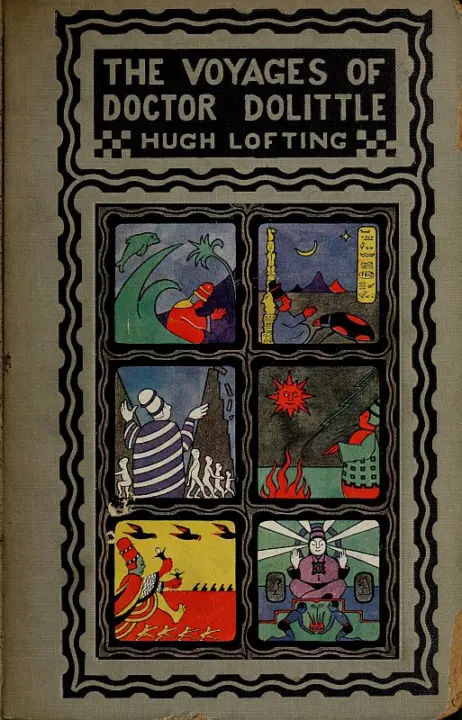
"The Voyages of Doctor Dolittle" by Hugh Lofting is a novel published in 1922. Young Tommy Stubbins discovers a remarkable doctor who can speak with animals and becomes his assistant on an extraordinary voyage. Their quest to find a missing naturalist leads them to Spider Monkey Island, where they encounter shipwrecks, rival tribes, and mysterious creatures. The doctor must use his unique abilities to help both humans and animals, ultimately facing unexpected responsibilities that will change everything.
Introduction adapted from the source catalogue; source summaries may be automatically generated.
Free to read · English · 75,532 words · No account needed
MAKE TIME FOR A GOOD BOOK
On by default. Untick to stop anonymous reading totals. Each page counts after 10 seconds in view. How this works.
Anonymous counting is on unless you have switched it off.
“Don’t mention it—don’t mention it,” said the Doctor. “We have had a very interesting chat.”
“Who might it be that I have the honor of addressing?” asked my mother staring at the gray parrot perched on the Doctor’s shoulder.
“Oh, I’m John Dolittle. I dare say your husband will remember me. He made me some very excellent boots about four years ago. They really are splendid,” added the Doctor, gazing down at his feet with great satisfaction.
“The Doctor has come to cure my squirrel, Mother,” said I. “He knows
all about animals.”
“Oh, no,” said the Doctor, “not all, Stubbins, not all about them by
any means.”
“It is very kind of you to come so far to look after his pet,” said my mother. “Tom is always bringing home strange creatures from the woods and the fields.”
“Is he?” said the Doctor. “Perhaps he will grow up to be a naturalist some day. Who knows?”
“Won’t you come in?” asked my mother. “The place is a little untidy because I haven’t finished the spring cleaning yet. But there’s a nice fire burning in the parlor.”
“Thank you!” said the Doctor. “What a charming home you have!”
And after wiping his enormous boots very, very carefully on the mat, the great man passed into the house.
INSIDE we found my father busy practising on the flute beside the fire. This he always did, every evening, after his work was over.
The Doctor immediately began talking to him about flutes and piccolos and bassoons; and presently my father said,
“Perhaps you perform upon the flute yourself, Sir. Won’t you play us a
tune?”
“Well,” said the Doctor, “it is a long time since I touched the instrument. But I would like to try. May I?”
Then the Doctor took the flute from my father and played and played and played. It was wonderful. My mother and father sat as still as statues, staring up at the ceiling as though they were in church; and even I, who didn’t bother much about music except on the mouth-organ—even I felt all sad and cold and creepy and wished I had been a better boy.
“Oh I think that was just beautiful!” sighed my mother when at length
the Doctor stopped.
“You are a great musician, Sir,” said my father, “a very great musician. Won’t you please play us something else?”
“Why certainly,” said the Doctor—“Oh, but look here, I’ve forgotten all about the squirrel.”
“I’ll show him to you,” I said. “He is upstairs in my room.”
Your reading position is saved on this browser. Take it to another device with a library code. Reading pages adapt to text, rather than matching a printed edition.
BEHIND THE BOOK
This eBook is for the use of anyone anywhere in the United States and most other parts of the world at no cost and with almost no restrictions whatsoever. You may copy it, give it away or re-use it under the terms of the Project Gutenberg License included with this eBook or online at www.gutenberg.org. If you are not located in the United States, you will have to check the laws of the country where you are located before using this eBook. Read the source licence.
The original source file, including credits and licence, is retained by this library. Request an original-format copy at no charge. Please include the book title and Project Gutenberg identifier #1154.
KEEP YOUR CURIOSITY GOING
Wilfrid Scawen Blunt
Wilfrid Scawen Blunt

E. W. (Edgar Watson) Howe
Coulson Kernahan

Maurice Baring
Frances Wright