
My study windows
James Russell Lowell
THE CLASSIC COLLECTION · 1848
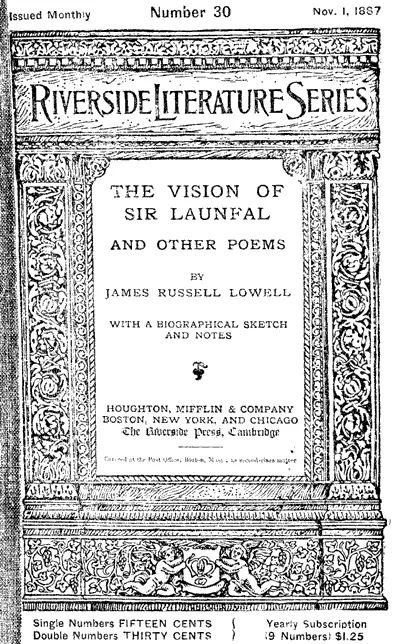
"The Vision of Sir Launfal" by James Russell Lowell is a poem written in the mid-19th century. It draws upon Arthurian legend to convey moral and social themes, focusing on the titular character, Sir Launfal, as he embarks on a quest for the Holy Grail. The poem explores topics such as charity, humanity, and the essence of true nobility, wherein the protagonist learns that true giving transcends material wealth. The opening of this work introduces us to Sir Launfal, a young knight eager to embark on his quest for the Holy Grail, a symbol of divine grace. As Launfal prepares for his journey, he encounters a leper who begs for alms, and upon recoiling in disgust, he gives a piece of gold but fails to recognize the human beneath the man’s suffering. The stark contrast between Launfal’s noble aspirations and his initial disdain for poverty sets the foundation for a life-altering revelation as the story unfolds. This initial encounter emphasizes the poem's central message that true honor lies in compassionate action toward those in need, setting the stage for Launfal's transformative quest.
Introduction adapted from the source catalogue; source summaries may be automatically generated.
Free to read · English · 24,954 words · No account needed
MAKE TIME FOR A GOOD BOOK
On by default. Untick to stop anonymous reading totals. Each page counts after 10 seconds in view. How this works.
Anonymous counting is on unless you have switched it off.
Come, while our country feels the lift
Of a gret instinct shoutin' forwards,
An' knows thet freedom ain't a gift
Thet tarries long in han's o' cowards!
Come, sech ez mothers prayed for, when 165
They kissed their cross with lips thet quivered,
An' bring fair wages for brave men,
A nation saved, a race delivered!
[The battles of Magenta and Solferino, in the early summer of 1859, had given promise of a complete emancipation of Italy from the Austrian supremacy, when Napoleon III., who was acting in alliance with Victor Emmanuel, king of Sardinia, held a meeting with the emperor Francis Joseph of Austria at Villa Franca, and agreed to terms which were very far from including the unification of Italy. There was a general distrust of Napoleon, and the war continued with the final result of a united Italy. In the poem which follows Mr. Lowell gives expression to his want of faith in the French emperor.]
Wait a little: do we not wait?
Louis Napoleon is not Fate,
Francis Joseph is not Time;
There's One hath swifter feet than Crime;
Cannon-parliaments settle naught; 5
Venice is Austria's,--whose is Thought?
Minie is good, but, spite of change,
Gutenberg's gun has the longest range.
Spin, spin, Clotho, spin![24]
Lachesis, twist! and, Atropos, sever! 10
In the shadow, year out, year in,
The silent headsman waits forever.
[Footnote 24: Clotho, Lachesis, and Atropos were the three Fates of the ancient mythology; Clotho spun the thread of human destiny, Lachesis twisted it, and Atropos with shears severed it.]
Wait, we say; our years are long;
Men are weak, but Man is strong;
Since the stars first curved their rings, 15
We have looked on many things;
Great wars come and great wars go,
Wolf-tracks light on polar snow;
We shall see him come and gone,
This second-hand Napoleon. 20
Spin, spin, Clotho, spin!
Lachesis, twist! and, Atropos, sever!
In the shadow, year out, year in,
The silent headsman waits forever.
We saw the elder Corsican, 25
And Clotho muttered as she span,
While crowned lackeys bore the train,
Of the pinchbeck Charlemagne:
"Sister, stint not length of thread!
Sister, stay the scissors dread! 30
On Saint Helen's granite bleak,
Hark, the vulture whets his beak!"
Spin, spin, Clotho, spin!
Lachesis, twist! and, Atropos, sever!
In the shadow, year out, year in, 35
The silent headsman waits forever.
Your reading position is saved on this browser. Take it to another device with a library code. Reading pages adapt to text, rather than matching a printed edition.
James Russell Lowell
James Russell Lowell
James Russell Lowell

James Russell Lowell
BEHIND THE BOOK
This eBook is for the use of anyone anywhere in the United States and most other parts of the world at no cost and with almost no restrictions whatsoever. You may copy it, give it away or re-use it under the terms of the Project Gutenberg License included with this eBook or online at www.gutenberg.org. If you are not located in the United States, you will have to check the laws of the country where you are located before using this eBook. Read the source licence.
The original source file, including credits and licence, is retained by this library. Request an original-format copy at no charge. Please include the book title and Project Gutenberg identifier #17119.
KEEP YOUR CURIOSITY GOING

Maurice Baring
Francis Greenleaf Allinson & Anne C. E. (Anne Crosby Emery) Allinson

Eric Mackay
Edmund Gosse
Sophia Margaretta Hensley
Stuart Dodgson Collingwood