
My study windows
James Russell Lowell
THE CLASSIC COLLECTION · 1848
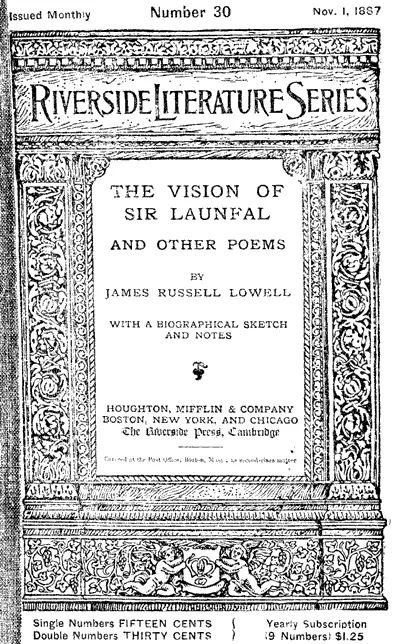
"The Vision of Sir Launfal" by James Russell Lowell is a poem written in the mid-19th century. It draws upon Arthurian legend to convey moral and social themes, focusing on the titular character, Sir Launfal, as he embarks on a quest for the Holy Grail. The poem explores topics such as charity, humanity, and the essence of true nobility, wherein the protagonist learns that true giving transcends material wealth. The opening of this work introduces us to Sir Launfal, a young knight eager to embark on his quest for the Holy Grail, a symbol of divine grace. As Launfal prepares for his journey, he encounters a leper who begs for alms, and upon recoiling in disgust, he gives a piece of gold but fails to recognize the human beneath the man’s suffering. The stark contrast between Launfal’s noble aspirations and his initial disdain for poverty sets the foundation for a life-altering revelation as the story unfolds. This initial encounter emphasizes the poem's central message that true honor lies in compassionate action toward those in need, setting the stage for Launfal's transformative quest.
Introduction adapted from the source catalogue; source summaries may be automatically generated.
Free to read · English · 24,954 words · No account needed
MAKE TIME FOR A GOOD BOOK
On by default. Untick to stop anonymous reading totals. Each page counts after 10 seconds in view. How this works.
Anonymous counting is on unless you have switched it off.
Yes, I am still Prometheus, wiser grown 95 By years of solitude,--that holds apart The past and future, giving the soul room To search into itself,--and long commune With this eternal silence;--more a god, In my long-suffering and strength to meet 100 With equal front the direst shafts of fate, Than thou in thy faint-hearted despotism, Girt with thy baby-toys of force and wrath. Yes, I am that Prometheus who brought down The light to man, which thou, in selfish fear, 105 Hadst to thyself usurped,--his by sole right, For Man hath right to all save Tyranny,-- And which shall free him yet from thy frail throne. Tyrants are but the spawn of Ignorance, Begotten by the slaves they trample on, 110 Who, could they win a glimmer of the light, And see that Tyranny is always weakness, Or Fear with its own bosom ill at ease, Would laugh away in scorn the sand-wove chain Which their own blindness feigned for adamant. 115 Wrong ever builds on quicksands, but the Right To the firm centre lays its moveless base. The tyrant trembles, if the air but stirs The innocent ringlets of a child's free hair, And crouches, when the thought of some great spirit, 120 With world-wide murmur, like a rising gale, Over men's hearts, as over standing corn, Rushes, and bends them to its own strong will. So shall some thought of mine yet circle earth, And puff away thy crumbling altars, Jove! 125
[Footnote 20: That is, Jove himself.]
And, wouldst thou know of my supreme revenge, Poor tyrant, even now dethroned in heart, Realmless in soul, as tyrants ever are, Listen! and tell me if this bitter peak, This never-glutted vulture, and these chains 130 Shrink not before it; for it shall befit A sorrow-taught, unconquered Titan-heart. Men, when their death is on them, seem to stand On a precipitous crag that overhangs The abyss of doom, and in that depth to see, 135 As in a glass, the features dim and vast Of things to come, the shadows, as it seems, Of what had been. Death ever fronts the wise; Not fearfully, but with clear promises Of larger life, on whose broad vans upborne, 140 Their outlook widens, and they see beyond The horizon of the present and the past, Even to the very source and end of things. Such am I now: immortal woe hath made My heart a seer, and my soul a judge 145 Between the substance and the shadow of Truth. The sure supremeness of the Beautiful, By all the martyrdoms made doubly sure Of such as I am, this is my revenge, Which of my wrongs builds a triumphal arch, 150 Through which I see a sceptre and a throne. The pipings of glad shepherds on the hills, Tending the flocks no more to bleed for thee,-- The songs of maidens pressing with white feet The vintage on thine altars poured no more,-- 155 The murmurous bliss of lovers, underneath Dim grapevine bowers, whose rosy bunches press Not half so closely their warm cheeks, unpaled By thoughts of thy brute lust,--the hive-like hum Of peaceful commonwealths, where sunburnt Toil 160 Reaps for itself the rich earth made its own By its own labor, lightened with glad hymns To an omnipotence which thy mad bolts Would cope with as a spark with the vast sea,-- Even the spirit of free love and peace, 165 Duty's sure recompense through life and death,-- These are such harvests as all master-spirits Reap, haply not on earth, but reap no less Because the sheaves are bound by hands not theirs; These are the bloodless daggers wherewithal 170 They stab fallen tyrants, this their high revenge: For their best part of life on earth is when, Long after death, prisoned and pent no more, Their thoughts, their wild dreams even, have become Part of the necessary air men breathe: 175 When, like the moon, herself behind a cloud, They shed down light before us on life's sea, That cheers us to steer onward still in hope. Earth with her twining memories ivies o'er Their holy sepulchres; the chainless sea, 180 In tempest or wide calm, repeats their thoughts; The lightning and the thunder, all free things, Have legends of them for the ears of men. All other glories are as falling stars, But universal Nature watches theirs: 185 Such strength is won by love of human-kind.
Your reading position is saved on this browser. Take it to another device with a library code. Reading pages adapt to text, rather than matching a printed edition.
James Russell Lowell
James Russell Lowell
James Russell Lowell

James Russell Lowell
BEHIND THE BOOK
This eBook is for the use of anyone anywhere in the United States and most other parts of the world at no cost and with almost no restrictions whatsoever. You may copy it, give it away or re-use it under the terms of the Project Gutenberg License included with this eBook or online at www.gutenberg.org. If you are not located in the United States, you will have to check the laws of the country where you are located before using this eBook. Read the source licence.
The original source file, including credits and licence, is retained by this library. Request an original-format copy at no charge. Please include the book title and Project Gutenberg identifier #17119.
KEEP YOUR CURIOSITY GOING

Maurice Baring
Francis Greenleaf Allinson & Anne C. E. (Anne Crosby Emery) Allinson

Eric Mackay
Edmund Gosse
Sophia Margaretta Hensley
Stuart Dodgson Collingwood