
My study windows
James Russell Lowell
THE CLASSIC COLLECTION · 1848
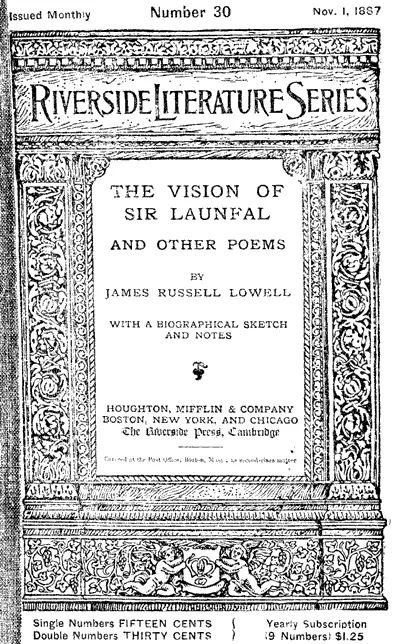
"The Vision of Sir Launfal" by James Russell Lowell is a poem written in the mid-19th century. It draws upon Arthurian legend to convey moral and social themes, focusing on the titular character, Sir Launfal, as he embarks on a quest for the Holy Grail. The poem explores topics such as charity, humanity, and the essence of true nobility, wherein the protagonist learns that true giving transcends material wealth. The opening of this work introduces us to Sir Launfal, a young knight eager to embark on his quest for the Holy Grail, a symbol of divine grace. As Launfal prepares for his journey, he encounters a leper who begs for alms, and upon recoiling in disgust, he gives a piece of gold but fails to recognize the human beneath the man’s suffering. The stark contrast between Launfal’s noble aspirations and his initial disdain for poverty sets the foundation for a life-altering revelation as the story unfolds. This initial encounter emphasizes the poem's central message that true honor lies in compassionate action toward those in need, setting the stage for Launfal's transformative quest.
Introduction adapted from the source catalogue; source summaries may be automatically generated.
Free to read · English · 24,954 words · No account needed
MAKE TIME FOR A GOOD BOOK
On by default. Untick to stop anonymous reading totals. Each page counts after 10 seconds in view. How this works.
Anonymous counting is on unless you have switched it off.
Dear marshes! vain to him the gift of sight Who cannot in their various incomes share, 100 From every season drawn, of shade and light, Who sees in them but levels brown and bare; Each change of storm or sunshine scatters free On them its largess of variety, 104 For Nature with cheap means still works her wonders rare.
In Spring they lie one broad expanse of green, O'er which the light winds run with glimmering feet: Here, yellower stripes track out the creek unseen, There, darker growths o'er hidden ditches meet; And purpler stains show where the blossoms crowd, 110 As if the silent shadow of a cloud Hung there becalmed, with the next breath to fleet.
All round, upon the river's slippery edge, Witching to deeper calm the drowsy tide, Whispers and leans the breeze-entangling sedge; 115 Through emerald glooms the lingering waters slide, Or, sometimes wavering, throw back the sun, And the stiff banks in eddies melt and run Of dimpling light, and with the current seem to glide.
In Summer 'tis a blithesome sight to see, 120 As, step by step, with measured swing, they pass, The wide-ranked mowers wading to the knee, Their sharp scythes panting through the thick-set grass; Then, stretched beneath a rick's shade in a ring, Their nooning take, while one begins to sing 125 A stave that droops and dies 'neath the close sky of brass.
Meanwhile that devil-may-care, the bobolink, Remembering duty, in mid-quaver stops Just ere he sweeps o'er rapture's tremulous brink, And 'twixt the winrows most demurely drops, 130 A decorous bird of business, who provides For his brown mate and fledglings six besides, And looks from right to left, a farmer 'mid his crops.
Another change subdues them in the Fall, But saddens not; they still show merrier tints, 135 Though sober russet seems to cover all; When the first sunshine through their dewdrops glints. Look how the yellow clearness, streamed across, Redeems with rarer hues the season's loss, 139 As Dawn's feet there had touched and left their rosy prints.
Or come when sunset gives its freshened zest, Lean o'er the bridge and let the ruddy thrill, While the shorn sun swells down the hazy west, Glow opposite;--the marshes drink their fill And swoon with purple veins, then slowly fade 145 Through pink to brown, as eastward moves the shade, Lengthening with stealthy creep, of Simond's darkening hill.
Later, and yet ere Winter wholly shuts, Ere through the first dry snow the runner grates, And the loath cart-wheel screams in slippery ruts, 150 While firmer ice the eager boy awaits, Trying each buckle and strap beside the fire, And until bedtime plays with his desire, Twenty times putting on and off his new-bought skates;--
Your reading position is saved on this browser. Take it to another device with a library code. Reading pages adapt to text, rather than matching a printed edition.
James Russell Lowell
James Russell Lowell
James Russell Lowell

James Russell Lowell
BEHIND THE BOOK
This eBook is for the use of anyone anywhere in the United States and most other parts of the world at no cost and with almost no restrictions whatsoever. You may copy it, give it away or re-use it under the terms of the Project Gutenberg License included with this eBook or online at www.gutenberg.org. If you are not located in the United States, you will have to check the laws of the country where you are located before using this eBook. Read the source licence.
The original source file, including credits and licence, is retained by this library. Request an original-format copy at no charge. Please include the book title and Project Gutenberg identifier #17119.
KEEP YOUR CURIOSITY GOING

Maurice Baring
Francis Greenleaf Allinson & Anne C. E. (Anne Crosby Emery) Allinson

Eric Mackay
Edmund Gosse
Sophia Margaretta Hensley
Stuart Dodgson Collingwood