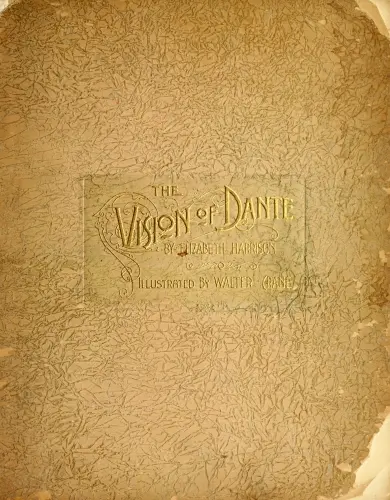
The Vision of Dante: A story for little children and a talk to their mothers (Second Edition)
Elizabeth Harrison & Dante Alighieri
THE CLASSIC COLLECTION · 1892
"The vision of hell." by Dante Alighieri is a narrative poem written in the 14th century. It follows a fictionalized Dante through Hell, guided by the Roman poet Virgil. Hell appears as nine concentric circles of torment within the Earth, where souls suffer punishments fitting their sins. The journey begins when Dante finds himself lost in a dark wood, blocked by three symbolic beasts. As an allegory, the poem represents the soul's journey toward God through recognition and rejection of sin.
Introduction adapted from the source catalogue; source summaries may be automatically generated.
Free to read · English · 38,413 words · No account needed
MAKE TIME FOR A GOOD BOOK
On by default. Untick to stop anonymous reading totals. Each page counts after 10 seconds in view. How this works.
Anonymous counting is on unless you have switched it off.
Now I had grasp’d his tresses, and stript off
More than one tuft, he barking, with his eyes
Drawn in and downward, when another cried,
“What ails thee, Bocca? Sound not loud enough
Thy chatt’ring teeth, but thou must bark outright?
“What devil wrings thee?”—“Now,” said I, “be dumb,
Accursed traitor! to thy shame of thee
True tidings will I bear.”—“Off,” he replied,
“Tell what thou list; but as thou escape from hence
To speak of him whose tongue hath been so glib,
Forget not: here he wails the Frenchman’s gold.
‘Him of Duera,’ thou canst say, ‘I mark’d,
Where the starv’d sinners pine.’ If thou be ask’d
What other shade was with them, at thy side
Is Beccaria, whose red gorge distain’d
The biting axe of Florence. Farther on,
If I misdeem not, Soldanieri bides,
With Ganellon, and Tribaldello, him
Who op’d Faenza when the people slept.”
We now had left him, passing on our way,
When I beheld two spirits by the ice
Pent in one hollow, that the head of one
Was cowl unto the other; and as bread
Is raven’d up through hunger, th’ uppermost
Did so apply his fangs to th’ other’s brain,
Where the spine joins it. Not more furiously
On Menalippus’ temples Tydeus gnaw’d,
Than on that skull and on its garbage he.
“O thou who show’st so beastly sign of hate
’Gainst him thou prey’st on, let me hear,” said I
“The cause, on such condition, that if right
Warrant thy grievance, knowing who ye are,
And what the colour of his sinning was,
I may repay thee in the world above,
If that wherewith I speak be moist so long.”
His jaws uplifting from their fell repast,
That sinner wip’d them on the hairs o’ th’ head,
Which he behind had mangled, then began:
“Thy will obeying, I call up afresh
Sorrow past cure, which but to think of wrings
My heart, or ere I tell on’t. But if words,
That I may utter, shall prove seed to bear
Fruit of eternal infamy to him,
The traitor whom I gnaw at, thou at once
Shalt see me speak and weep. Who thou mayst be
I know not, nor how here below art come:
But Florentine thou seemest of a truth,
When I do hear thee. Know I was on earth
Count Ugolino, and th’ Archbishop he
Ruggieri. Why I neighbour him so close,
Now list. That through effect of his ill thoughts
In him my trust reposing, I was ta’en
And after murder’d, need is not I tell.
What therefore thou canst not have heard, that is,
How cruel was the murder, shalt thou hear,
And know if he have wrong’d me. A small grate
Within that mew, which for my sake the name
Of famine bears, where others yet must pine,
Already through its opening sev’ral moons
Had shown me, when I slept the evil sleep,
That from the future tore the curtain off.
This one, methought, as master of the sport,
Rode forth to chase the gaunt wolf and his whelps
Unto the mountain, which forbids the sight
Of Lucca to the Pisan. With lean brachs
Inquisitive and keen, before him rang’d
Lanfranchi with Sismondi and Gualandi.
After short course the father and the sons
Seem’d tir’d and lagging, and methought I saw
The sharp tusks gore their sides. When I awoke
Before the dawn, amid their sleep I heard
My sons (for they were with me) weep and ask
For bread. Right cruel art thou, if no pang
Thou feel at thinking what my heart foretold;
And if not now, why use thy tears to flow?
Now had they waken’d; and the hour drew near
When they were wont to bring us food; the mind
Of each misgave him through his dream, and I
Heard, at its outlet underneath lock’d up
The horrible tower: whence uttering not a word
I look’d upon the visage of my sons.
I wept not: so all stone I felt within.
They wept: and one, my little Anslem, cried:
‘Thou lookest so! Father what ails thee?’ Yet
I shed no tear, nor answer’d all that day
Nor the next night, until another sun
Came out upon the world. When a faint beam
Had to our doleful prison made its way,
And in four countenances I descry’d
The image of my own, on either hand
Through agony I bit, and they who thought
I did it through desire of feeding, rose
O’ th’ sudden, and cried, ‘Father, we should grieve
Far less, if thou wouldst eat of us: thou gav’st
These weeds of miserable flesh we wear,
Your reading position is saved on this browser. Take it to another device with a library code. Reading pages adapt to text, rather than matching a printed edition.
Elizabeth Harrison & Dante Alighieri
BEHIND THE BOOK
This eBook is for the use of anyone anywhere in the United States and most other parts of the world at no cost and with almost no restrictions whatsoever. You may copy it, give it away or re-use it under the terms of the Project Gutenberg License included with this eBook or online at www.gutenberg.org. If you are not located in the United States, you will have to check the laws of the country where you are located before using this eBook. Read the source licence.
The original source file, including credits and licence, is retained by this library. Request an original-format copy at no charge. Please include the book title and Project Gutenberg identifier #8789.
KEEP YOUR CURIOSITY GOING

Eric Mackay
Edmund Gosse
Sophia Margaretta Hensley
Gilbert Parker
George MacDonald

Elizabeth Bibesco