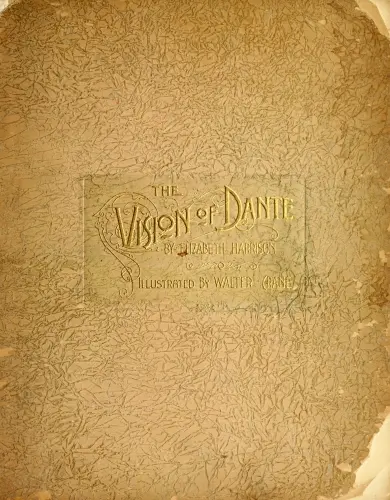
The Vision of Dante: A story for little children and a talk to their mothers (Second Edition)
Elizabeth Harrison & Dante Alighieri
THE CLASSIC COLLECTION · 1892
"The vision of hell." by Dante Alighieri is a narrative poem written in the 14th century. It follows a fictionalized Dante through Hell, guided by the Roman poet Virgil. Hell appears as nine concentric circles of torment within the Earth, where souls suffer punishments fitting their sins. The journey begins when Dante finds himself lost in a dark wood, blocked by three symbolic beasts. As an allegory, the poem represents the soul's journey toward God through recognition and rejection of sin.
Introduction adapted from the source catalogue; source summaries may be automatically generated.
Free to read · English · 38,413 words · No account needed
MAKE TIME FOR A GOOD BOOK
On by default. Untick to stop anonymous reading totals. Each page counts after 10 seconds in view. How this works.
Anonymous counting is on unless you have switched it off.
“Within these ardours are the spirits, each
Swath’d in confining fire.”—“Master, thy word,”
I answer’d, “hath assur’d me; yet I deem’d
Already of the truth, already wish’d
To ask thee, who is in yon fire, that comes
So parted at the summit, as it seem’d
Ascending from that funeral pile, where lay
The Theban brothers?” He replied: “Within
Ulysses there and Diomede endure
Their penal tortures, thus to vengeance now
Together hasting, as erewhile to wrath.
These in the flame with ceaseless groans deplore
The ambush of the horse, that open’d wide
A portal for that goodly seed to pass,
Which sow’d imperial Rome; nor less the guile
Lament they, whence of her Achilles ’reft
Deidamia yet in death complains.
And there is rued the stratagem, that Troy
Of her Palladium spoil’d.”—“If they have power
Of utt’rance from within these sparks,” said I,
“O master! think my prayer a thousand fold
In repetition urg’d, that thou vouchsafe
To pause, till here the horned flame arrive.
See, how toward it with desire I bend.”
He thus: “Thy prayer is worthy of much praise,
And I accept it therefore: but do thou
Thy tongue refrain: to question them be mine,
For I divine thy wish: and they perchance,
For they were Greeks, might shun discourse with thee.”
When there the flame had come, where time and place
Seem’d fitting to my guide, he thus began:
“O ye, who dwell two spirits in one fire!
If living I of you did merit aught,
Whate’er the measure were of that desert,
When in the world my lofty strain I pour’d,
Move ye not on, till one of you unfold
In what clime death o’ertook him self-destroy’d.”
Of the old flame forthwith the greater horn
Began to roll, murmuring, as a fire
That labours with the wind, then to and fro
Wagging the top, as a tongue uttering sounds,
Threw out its voice, and spake: “When I escap’d
From Circe, who beyond a circling year
Had held me near Caieta, by her charms,
Ere thus Aeneas yet had nam’d the shore,
Nor fondness for my son, nor reverence
Of my old father, nor return of love,
That should have crown’d Penelope with joy,
Could overcome in me the zeal I had
T’ explore the world, and search the ways of life,
Man’s evil and his virtue. Forth I sail’d
Into the deep illimitable main,
With but one bark, and the small faithful band
That yet cleav’d to me. As Iberia far,
Far as Morocco either shore I saw,
And the Sardinian and each isle beside
Which round that ocean bathes. Tardy with age
Were I and my companions, when we came
To the strait pass, where Hercules ordain’d
The bound’ries not to be o’erstepp’d by man.
The walls of Seville to my right I left,
On the other hand already Ceuta past.
“O brothers!” I began, “who to the west
Through perils without number now have reach’d,
To this the short remaining watch, that yet
Our senses have to wake, refuse not proof
Of the unpeopled world, following the track
Of Phoebus. Call to mind from whence we sprang:
Ye were not form’d to live the life of brutes
But virtue to pursue and knowledge high.”
With these few words I sharpen’d for the voyage
The mind of my associates, that I then
Could scarcely have withheld them. To the dawn
Our poop we turn’d, and for the witless flight
Made our oars wings, still gaining on the left.
Each star of the other pole night now beheld,
And ours so low, that from the ocean-floor
It rose not. Five times re-illum’d, as oft
Vanish’d the light from underneath the moon
Since the deep way we enter’d, when from far
Appear’d a mountain dim, loftiest methought
Of all I e’er beheld. Joy seiz’d us straight,
But soon to mourning changed. From the new land
A whirlwind sprung, and at her foremost side
Did strike the vessel. Thrice it whirl’d her round
With all the waves, the fourth time lifted up
The poop, and sank the prow: so fate decreed:
And over us the booming billow clos’d.”
Your reading position is saved on this browser. Take it to another device with a library code. Reading pages adapt to text, rather than matching a printed edition.
Elizabeth Harrison & Dante Alighieri
BEHIND THE BOOK
This eBook is for the use of anyone anywhere in the United States and most other parts of the world at no cost and with almost no restrictions whatsoever. You may copy it, give it away or re-use it under the terms of the Project Gutenberg License included with this eBook or online at www.gutenberg.org. If you are not located in the United States, you will have to check the laws of the country where you are located before using this eBook. Read the source licence.
The original source file, including credits and licence, is retained by this library. Request an original-format copy at no charge. Please include the book title and Project Gutenberg identifier #8789.
KEEP YOUR CURIOSITY GOING

Eric Mackay
Edmund Gosse
Sophia Margaretta Hensley
Gilbert Parker
George MacDonald

Elizabeth Bibesco