THE CLASSIC COLLECTION✦Wild life under the equatorCLASSIC FREE BOOKS
Wild life under the equator
Paul B. (Paul Belloni) Du Chaillu
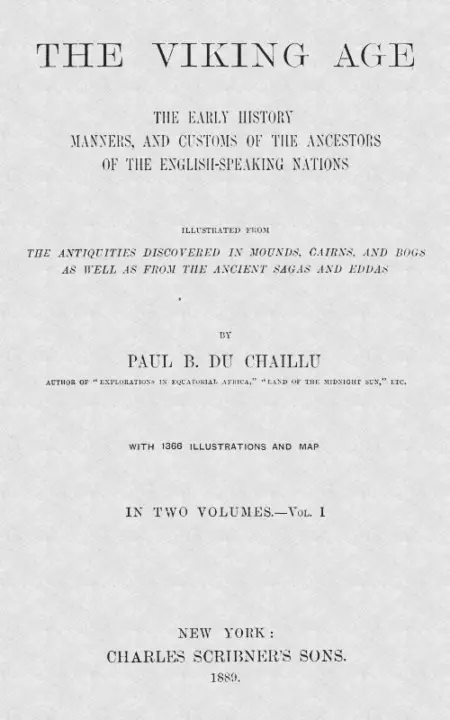
THE CLASSIC COLLECTION · 1889
"The Viking Age. Volume 1" by Paul B. Du Chaillu is a historical account written in the late 19th century. The book explores the early history, manners, and customs of the ancestors of the English-speaking nations, drawing from antiquities uncovered in various burial sites, as well as from ancient sagas and Eddas. It primarily focuses on the Viking civilization and its influence on the lands they settled, particularly in Britain. The opening of the volume sets the stage for an in-depth exploration of Norse civilization, emphasizing the wealth of archaeological evidence that paints a vivid picture of their social, political, and religious life. Du Chaillu discusses the motivations and characteristics of the Norse people, whom he describes as warlike, adventurous, and energetic, attributing their maritime prowess to their ancestry. He hints at the transformation of Britain through Viking influence, foreshadowing an extensive examination of their customs, literature, and mythology, which will be traced throughout the chapters.
Introduction adapted from the source catalogue; source summaries may be automatically generated.
Free to read · English · 172,836 words · No account needed
MAKE TIME FOR A GOOD BOOK
On by default. Untick to stop anonymous reading totals. Each page counts after 10 seconds in view. How this works.
Anonymous counting is on unless you have switched it off.
Footnote 260:
From this passage we see that it was the custom of Hakon Jarl to make sacrifices, but unfortunately the manner in which he made them is not told.
Footnote 261:
See p. 478.
Footnote 262:
Tíundaland = land of the tenth.
Footnote 263:
Hervarar Saga, 9, 10, 11, 12.
Footnote 264:
Kristnisaga, Fornmanna Sögur ii., 228.
Footnote 265:
I.e. Tun or open space.
Footnote 266:
Meaning, broke the backs of.
Footnote 267:
Not far from nearly every one of the (twenty) dom-rings of Nerike
there is a spring tending to confirm the Icelandic tradition of their
use.
Footnote 268:
King Olaf was on an expedition into France.
Footnote 269:
Odd evidently, like some other of his countrymen, as seen in this narrative, was not orthodox in the religion of his fathers, for he robbed the graves.
Footnote 270:
Cf. also Ragnar Lodbrók, 18; Norna Gest, 6; Olaf Tryggvason, 179; Sigurdar Kvida Fafnisbana ii., 26; Orkneyinga Saga, ch. 8.
Footnote 271:
Ynglinga Saga, 10.
Footnote 272:
Gisla Sursson mentions the same.
Footnote 273:
Olaf Tryggvason, Hkr., c. 76; Halfredar Saga, 6; Vatnsdæla, c. 10, 16.
Footnote 274:
See p. 411, sacrifice to the Disir.
Footnote 275:
I.e., draw the string so hard that the point of the arrow is inside
the curve.
Footnote 276:
Cf. also Sigrdrifumál, 17; Helgi Hundingsbani; Norna Gest; Flateyjarbók; Fornaldar Sögur, i. Later Edda; Orkneyinga; Egil’s Saga; Hávamál; Atlakvida.
Footnote 277:
Helgakvida Hundingsbana.
Footnote 278:
These three maidens came from Jötunheim, the home of the Jötnar; here they are no doubt meant to designate the three Nornir, who came and disturbed the peace of the golden age by establishing past, present, and future, i.e., change, fluctuation, development, and growth.
Footnote 279:
Idavöll, ida, movement; voll, plain. This stanza tells of the golden age when the Asars were happy and lacked nothing.
Footnote 280:
Grimnismál, gives a somewhat similar account.
Footnote 281:
Burn a spot on the skin as a cure.
Footnote 282:
Thjód nation, nation of the Goths.
Footnote 283:
Odin.
Footnote 284:
Warriors.
Footnote 285:
See pp. 31, 32.
Footnote 286:
Wealth.
Footnote 287:
Sun plains.
Footnote 288:
Fire-mountain. Here the text is corrupted, but I follow Bugge in the suggestion that this is a place-name, the battle taking place on the plain beneath the Logafjöll, from which the Valkyrias come down to take the slain.
Footnote 289:
The Valkyrias.
Footnote 290:
Valkyrias are here called disir, guardian spirits, and seem to come from the South, the ancient home of the Asar.
Footnote 291:
Chiefs. Helgi invited them to come home with him and his chiefs that night, and they would not.
Footnote 292:
We find that kings sometimes had meetings among themselves.
Footnote 293:
Probably she was betrothed by her father, not being present herself.
Footnote 294:
Your reading position is saved on this browser. Take it to another device with a library code. Reading pages adapt to text, rather than matching a printed edition.
Paul B. (Paul Belloni) Du Chaillu
Paul B. (Paul Belloni) Du Chaillu
Paul B. (Paul Belloni) Du Chaillu
BEHIND THE BOOK
This eBook is for the use of anyone anywhere in the United States and most other parts of the world at no cost and with almost no restrictions whatsoever. You may copy it, give it away or re-use it under the terms of the Project Gutenberg License included with this eBook or online at www.gutenberg.org. If you are not located in the United States, you will have to check the laws of the country where you are located before using this eBook. Read the source licence.
The original source file, including credits and licence, is retained by this library. Request an original-format copy at no charge. Please include the book title and Project Gutenberg identifier #56167.
KEEP YOUR CURIOSITY GOING
Cécile Tormay

Moritz Busch
John L. Ransom

Maurice Baring
Frances Wright
Cécile Tormay