THE CLASSIC COLLECTION✦Wild life under the equatorCLASSIC FREE BOOKS
Wild life under the equator
Paul B. (Paul Belloni) Du Chaillu
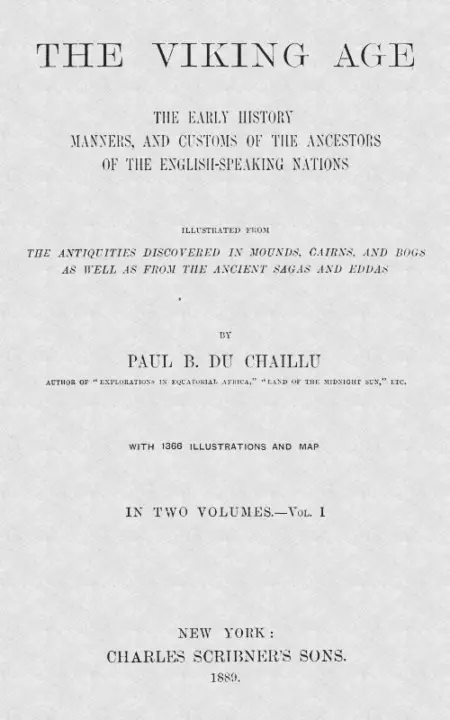
THE CLASSIC COLLECTION · 1889
"The Viking Age. Volume 1" by Paul B. Du Chaillu is a historical account written in the late 19th century. The book explores the early history, manners, and customs of the ancestors of the English-speaking nations, drawing from antiquities uncovered in various burial sites, as well as from ancient sagas and Eddas. It primarily focuses on the Viking civilization and its influence on the lands they settled, particularly in Britain. The opening of the volume sets the stage for an in-depth exploration of Norse civilization, emphasizing the wealth of archaeological evidence that paints a vivid picture of their social, political, and religious life. Du Chaillu discusses the motivations and characteristics of the Norse people, whom he describes as warlike, adventurous, and energetic, attributing their maritime prowess to their ancestry. He hints at the transformation of Britain through Viking influence, foreshadowing an extensive examination of their customs, literature, and mythology, which will be traced throughout the chapters.
Introduction adapted from the source catalogue; source summaries may be automatically generated.
Free to read · English · 172,836 words · No account needed
MAKE TIME FOR A GOOD BOOK
On by default. Untick to stop anonymous reading totals. Each page counts after 10 seconds in view. How this works.
Anonymous counting is on unless you have switched it off.
Men and women with the power of foreseeing and foretelling were thought to be born with the same gifts as the Volva;[317] by foretelling evil they had a great hold on the people, and received good rewards for their knowledge.[318]
“A woman, by name Oddbjörg, went about the herad. She was merry, wise and foreknowing. She made it a great point that the housewives should receive her well, and she told favourable things according to her entertainment. She came to Upsalir. Saldis received her well, and asked her to foretell something good about her boys. She said: ‘These boys look promising if they have luck, which I do not see.’ Saldis said: ‘I think thou wilt not find the entertainment very good for this taunt.’ She answered: ‘Thy entertainment will not depend on this, and thou needest not be so sensitive as to words.’ Saldis said: ‘Little shalt thou say of it if thy mind does not think it good.’ She answered: ‘I have not as yet said too much, but I do not think their love to each other will last long.’ Saldis replied, ‘I thought I deserved other words for the sake of good entertainment, and thou wilt be driven away if thou tellest evil foretellings.’ Oddbjörg said: ‘I think I need not spare thee as thou mayest this without reason; I will not visit thee again, and thou mayest bear this as well as thou wilt, but I can tell thee that they will carry spears of death against each other, and one thing after another, worse and worse, will be caused by this in the herad’” (Viga Glum, c. 12).
“When Hákon, Pal’s son, was in Sweden, he heard of a man who practised sorcery and foretelling, whether he used for it witchcraft or other things. He became very curious to see this man, and know what he could tell about his fate. He went to him, and at last found him in a district near the sea where he received feasts and foretold seasons and other things to the bondi. When he met him he asked how he would succeed in getting the realm or other luck. The wizard asked who he was, and he told his name and kin, that he was a son of the daughter of Hákon, Ivar’s son. The wizard said: ‘Why shouldst thou ask witchcraft or foretelling from me? Thou knowest that thy kinsmen little liked men of my kind. It may be needful for thee to ask thy kinsman, Olaf the Stout, in whom thou trustest fully, about thy fate, but I guess that he will not condescend to tell thee what thou art anxious to know, or is not so powerful as thou thinkest him.’ Hákon answered: ‘I will not blame him, for I think it is rather my unworthiness to learn wisdom from him than his incapability to teach it to me. I have come to thee because I think that neither of us need envy the other as to virtue or religion.’ The man answered: ‘I am pleased that thou trustest fully in me, and more than in the belief of thyself and thy kinsmen. It is strange with those who have this belief, they fast and have vigils, and think thus to be able to know the things they desire, and though they do such things they know less of the things they wish to know the more important they are. We undergo no afflictions, and yet always know the things our friends think important. Now it will be so that I will keep thee, because I see thou thinkest thou canst rather get truth from me than from the preachers of King Ingi whom he trusts fully. Thou shalt come after three nights, and then we shall see whether I am able to tell thee any of the things thou wishest to know.’ They parted, and Hákon passed three nights in the district, and then went to the wizard. He was alone in a house and sighed heavily when Hákon entered, stroked his forehead with his hand, and said it had taken him much trouble to know the things he wished to hear of; Hákon said he wanted to hear his fate. The wizard began: ‘If thou wishest to know thy fate it is long to tell, for it is great, and many great tidings will spring from thy life and doings—I see in my mind that thou wilt at last become sole chief over the Orkneys, but it may be thou thinkest the waiting time long. I also think that thy offspring will rule there, and thy next journey westward to the Orkneys will lead to great events when that which springs from it appears. Thou wilt also in thy days commit a crime which thou mayest redress or not to the god in whom thou believest. Thy steps go further out into the world than I can trace, though I think thou wilt rest thy bones in its northern half. Now I have told thee what I can tell thee this time, and thou mayest be satisfied or not with it.’ Hákon answered: ‘Much tellest thou if it is true, but I think it will turn out better than thou sayest, and maybe thou hast not seen the truth.’ The wizard said he might believe what he liked, but that this would take place” (Orkneyinga, c. xxvi. p. 100).
Your reading position is saved on this browser. Take it to another device with a library code. Reading pages adapt to text, rather than matching a printed edition.
Paul B. (Paul Belloni) Du Chaillu
Paul B. (Paul Belloni) Du Chaillu
Paul B. (Paul Belloni) Du Chaillu
BEHIND THE BOOK
This eBook is for the use of anyone anywhere in the United States and most other parts of the world at no cost and with almost no restrictions whatsoever. You may copy it, give it away or re-use it under the terms of the Project Gutenberg License included with this eBook or online at www.gutenberg.org. If you are not located in the United States, you will have to check the laws of the country where you are located before using this eBook. Read the source licence.
The original source file, including credits and licence, is retained by this library. Request an original-format copy at no charge. Please include the book title and Project Gutenberg identifier #56167.
KEEP YOUR CURIOSITY GOING
Cécile Tormay

Moritz Busch
John L. Ransom

Maurice Baring
Frances Wright
Cécile Tormay