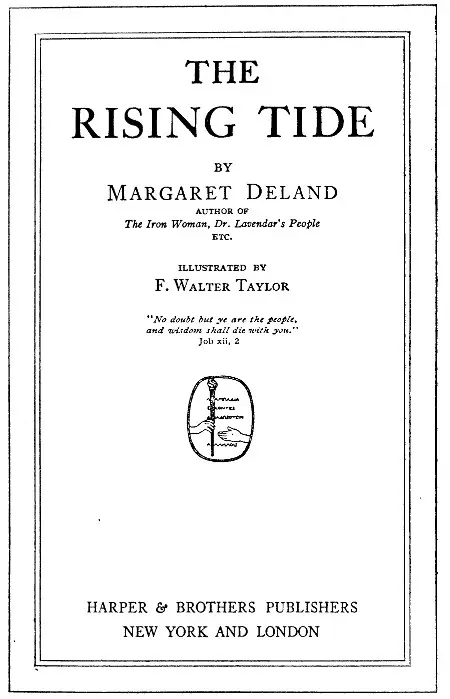
The Rising Tide
Margaret Wade Campbell Deland
THE CLASSIC COLLECTION · 1922
"The Vehement Flame" by Margaret Wade Campbell Deland is a novel written in the early 20th century. The story centers around the lives of Maurice Curtis, a nineteen-year-old, and his older wife, Eleanor Newbolt, who marry impulsively after a whirlwind romance fraught with societal implications. The novel explores themes of love, passion, and the complexities of their age difference in a society that has strict notions of propriety. The opening of "The Vehement Flame" introduces the newlywed couple in a picturesque setting, filled with joy and the lightness of love as they savor the early moments of their marriage. Maurice expresses exuberance and playful confidence about their future together, despite the doubts that Eleanor quietly harbors due to the significant age gap and societal expectations. As they navigate their feelings for each other, the narrative hints at external pressures from Eleanor's aunt and the expectations of the world around them, setting a stage for both tender moments and the challenges they will confront as a couple.
Introduction adapted from the source catalogue; source summaries may be automatically generated.
Free to read · English · 123,789 words · No account needed
MAKE TIME FOR A GOOD BOOK
On by default. Untick to stop anonymous reading totals. Each page counts after 10 seconds in view. How this works.
Anonymous counting is on unless you have switched it off.
"You'll get your skirts wringing wet, Edith. And--I thought we were to
sit here and sing?"
"Oh, you can sing any old time," Edith said, lifting the lid of the coffee pot and stirring the brown froth with a convenient stick.
"And I'm just to look on?" Eleanor said.
"Why, wade, if you want to," her husband said; "It's safe enough to
leave Edith's things here."
After that he was too much absorbed in shooing ants off the marmalade to give any thought to his wife. The luncheon (except to her) was the usual delightful discomfort of balancing coffee cups on uncertain knees, and waving off wasps, and upsetting glasses of water. Maurice talked about the ball game, and Edith gossiped darkly of her teachers, and Johnny Bennett ate enormously and looked at Edith.
Eleanor neither ate nor gossiped; but she, too, watched Edith--and listened. Bingo, in his mistress's lap, had snarled at Johnny when he took Eleanor's empty cup away, which led Edith to say that he was jealous.
"I don't call it 'jealous,'" Eleanor said, "to be fond of a person."
"You can't really be fond of anybody, and be jealous," Edith announced; "or if you are, it is just Bingoism."
This brought a quick protest from Eleanor, which was followed by the inevitable discussion; Edith began it by quoting, "'Love forgets self, and jealousy remembers self.'"
Maurice grinned and said nothing--it was enough for him to see Eleanor hit, hard! But Johnny protested:
"If your girl monkeys round with another fellow," he said, "you have a
right to be jealous."
"Of course," said Eleanor.
"No, sir!" said Edith. "You have a right to be unhappy. If the other fellow's nicer than you--I mean if he has something that attracts her that you haven't, of course you'd be unhappy! (though you could get busy and be nice yourself.) Or, if he's not as nice as you, you'd be unhappy, because you'd be so awfully disappointed in her. But there's no jealousy about that kind of thing! Jealousy is hogging all the love for yourself. Like Bingo! And I call it plain garden selfishness--and no sense, either, because you don't gain anything by it. Do you think you do, Maurice? ... For Heaven's sake, hand me the sandwiches!"
Maurice didn't express his thoughts; he just roared with laughter. Eleanor reddened; Johnny, handing the sandwiches, said that, though Edith generally could reason pretty well--for a woman--in this particular matter she was 'way off.
"You are long on logic, Edith," Maurice agreed; "but short on human nature; (she hasn't an idea how the shoe fits!)."
Your reading position is saved on this browser. Take it to another device with a library code. Reading pages adapt to text, rather than matching a printed edition.
Margaret Wade Campbell Deland
Margaret Wade Campbell Deland
Margaret Wade Campbell Deland
Margaret Wade Campbell Deland
BEHIND THE BOOK
This eBook is for the use of anyone anywhere in the United States and most other parts of the world at no cost and with almost no restrictions whatsoever. You may copy it, give it away or re-use it under the terms of the Project Gutenberg License included with this eBook or online at www.gutenberg.org. If you are not located in the United States, you will have to check the laws of the country where you are located before using this eBook. Read the source licence.
The original source file, including credits and licence, is retained by this library. Request an original-format copy at no charge. Please include the book title and Project Gutenberg identifier #15927.
KEEP YOUR CURIOSITY GOING
Coulson Kernahan

Maurice Baring
Frances Wright
Cécile Tormay

Frederic Jesup Stimson

W. H. P. (William Henry Pope) Jarvis