THE CLASSIC COLLECTION✦An outlaw’s diary: the CommuneCLASSIC FREE BOOKS
An outlaw’s diary: the Commune
Cécile Tormay
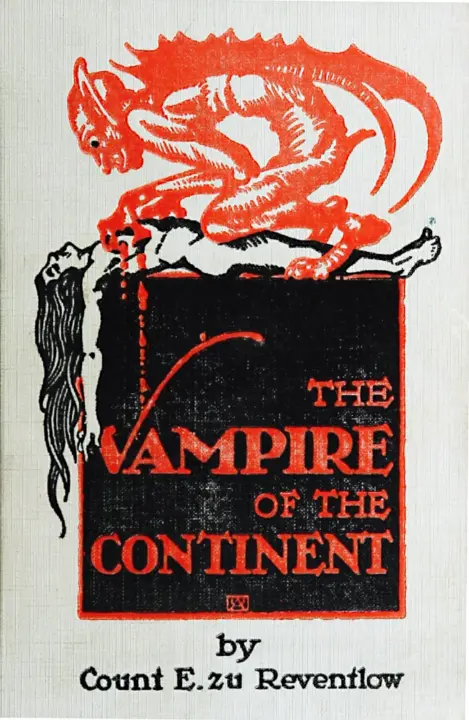
THE CLASSIC COLLECTION · 1916
"The Vampire of the Continent" by Count Ernst zu Reventlow is a historical treatise written in the early 20th century. The work systematically critiques and analyzes the role of England in shaping modern European history since the late 16th century, portraying it as a nation driven by greed and imperial ambitions. The author emphasizes England's influence on conflicts and power dynamics, presenting it as a "vampire" that feeds off the resources and prosperity of other nations, particularly during periods of war and upheaval. At the start of the work, the translator’s preface sets the stage for Reventlow’s provocative examination of England’s historical actions. It alludes to the myths surrounding England’s role as a liberator, emphasizing instead the destructive impact its imperial pursuits had on Europe and the world. The opening chapters delve into the narratives surrounding key historical events, such as the defeat of the Spanish Armada, notably reinterpreting them through a lens critical of English statecraft. The author's overarching argument is that England, often viewed as a benefactor in historical accounts, has acted primarily out of self-interest and avarice, undermining the stability and prosperity of its continental neighbors in the process.
Introduction adapted from the source catalogue; source summaries may be automatically generated.
Free to read · English · 54,831 words · No account needed
MAKE TIME FOR A GOOD BOOK
On by default. Untick to stop anonymous reading totals. Each page counts after 10 seconds in view. How this works.
Anonymous counting is on unless you have switched it off.
King Edward and his Ministers continued energetically and perseveringly their propaganda in the Balkans, whereby they defended especially the “Programme of Macedonian Reform.” King Edward’s celebrated visit to Reval, his meeting with Czar Nicholas, the toasts exchanged, and the semi-official comments in the press (July 19th, 1908), brought the Anglo-Russian negotiations to a conclusion, and constituted so to speak the apogée of the English sovereign’s diplomatic triumph. The usual diplomatic assurances to the effect that nothing had been discussed at Reval which was in any way contrary to German interests, could not do away with the impression that King Edward’s coalition against the German Empire was now complete. The “Macedonian Question” was considered its best instrument; for the carrying out of the programme of Macedonian Reform would have implied a violation of the Turkish Empire absolutely incompatible with the latter’s sovereignty and integrity. The German Empire must, in this way, have been placed before the question as to whether it would abandon Turkey to her fate or not; this question, as the English intended, necessarily led up to the further one: shall we give way or shall we go to war? Austria-Hungary was in the same manner to be placed before a similar dilemma: should she, under such circumstances, still remain by the side of Germany, or should she, in exchange perhaps for compensations, go over to the other side? As we see, quite a lot of prospects and possibilities were opened up to British statesmen; and these possibilities, if cleverly made use of, might lead to the weakening—or, who knows, the destruction—of Germany.
But now something unexpected happened: the Revolution in Turkey. The “Macedonian Reform Scheme” of England, Russia, France, and Italy, had terribly frightened the Turks. Up till now Russia and England had, owing to the divergency of their aims, held each other in check; and it was to this rivalry that Turkey owed the continuation of her existence. The Reval meeting drove home the fact that the two ancient adversaries had come to an understanding in Oriental questions; and this understanding signified the doom of the Turkish Empire. The Young Turks took the European Powers at their word; Abdul Hamid having as yet failed to take “Macedonian Reform” seriously in hand, was deposed; the new rulers drew up a constitution, and inscribed on their banner the maintenance of the territorial integrity of the Empire, and also the equality of all nations and religious bodies therein. In this way was the bottom taken out of the Reval programme. Sir Edward Grey declared himself “satisfied with the turn that matters had taken,” and it was decided to give the Young Turks time. England expected the deposition of Abdul Hamid to entail the collapse of the friendship between Germany and Turkey, and at once changed her outward attitude towards the latter. The change, as usual, was very skilfully explained as being a “matter of principle”: liberty-loving England, it was said, could not possibly be a friend of the tyrannical and reactionary government of Abdul Hamid; but all the more sincere, therefore, was her joy on witnessing the birth of the new liberal and progressive and humanitarian Ottoman Empire, to which she extended a cordial and hearty welcome. In this way did the British Government think to be able to lift Germany from out of the saddle in Constantinople. It is, unfortunately, not possible to analyse here in detail the policy of England in the Near East since the accession to the throne of Edward VII. But that policy offers, on a small scale, truly typical examples of the skill with which British statesmanship is able to make use even of totally contradictory events in the pursuit of one fundamental aim, which is never lost sight of for a minute. England’s calculations after the Young Turk Revolution appeared at first to be successful; and, for a time, she was in fact more popular in Constantinople than Germany. This was only natural, since the Young Turks were continually told that Germany was Abdul Hamid’s friend and Young Turkey’s enemy—and that she had never really helped Turkey, but had only acted from a purely egotistical standpoint. Only little by little did German diplomacy succeed in again consolidating Germany’s position; and some time elapsed before the Young Turk politicians understood that Germany was the only Power whose Oriental policy was compatible with the interests of the Turkish Empire.
Your reading position is saved on this browser. Take it to another device with a library code. Reading pages adapt to text, rather than matching a printed edition.
BEHIND THE BOOK
This eBook is for the use of anyone anywhere in the United States and most other parts of the world at no cost and with almost no restrictions whatsoever. You may copy it, give it away or re-use it under the terms of the Project Gutenberg License included with this eBook or online at www.gutenberg.org. If you are not located in the United States, you will have to check the laws of the country where you are located before using this eBook. Read the source licence.
The original source file, including credits and licence, is retained by this library. Request an original-format copy at no charge. Please include the book title and Project Gutenberg identifier #66468.
KEEP YOUR CURIOSITY GOING
Cécile Tormay

Moritz Busch
John L. Ransom
Frances Wright
Cécile Tormay

Mabel Potter Daggett