THE CLASSIC COLLECTION✦An outlaw’s diary: the CommuneCLASSIC FREE BOOKS
An outlaw’s diary: the Commune
Cécile Tormay
THE CLASSIC COLLECTION · 1916
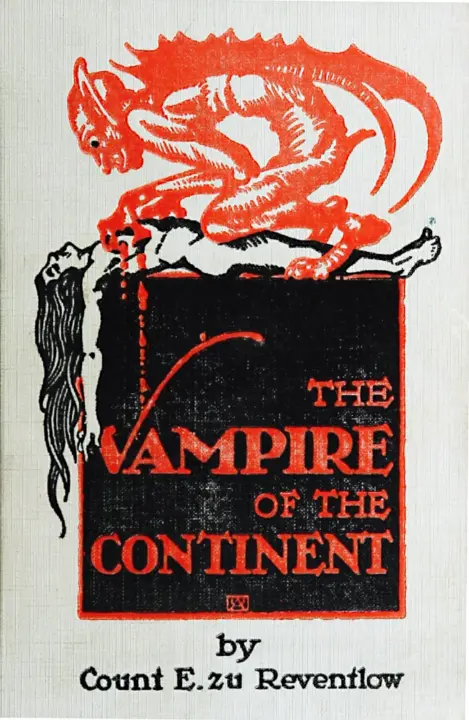
"The Vampire of the Continent" by Count Ernst zu Reventlow is a historical treatise written in the early 20th century. The work systematically critiques and analyzes the role of England in shaping modern European history since the late 16th century, portraying it as a nation driven by greed and imperial ambitions. The author emphasizes England's influence on conflicts and power dynamics, presenting it as a "vampire" that feeds off the resources and prosperity of other nations, particularly during periods of war and upheaval. At the start of the work, the translator’s preface sets the stage for Reventlow’s provocative examination of England’s historical actions. It alludes to the myths surrounding England’s role as a liberator, emphasizing instead the destructive impact its imperial pursuits had on Europe and the world. The opening chapters delve into the narratives surrounding key historical events, such as the defeat of the Spanish Armada, notably reinterpreting them through a lens critical of English statecraft. The author's overarching argument is that England, often viewed as a benefactor in historical accounts, has acted primarily out of self-interest and avarice, undermining the stability and prosperity of its continental neighbors in the process.
Introduction adapted from the source catalogue; source summaries may be automatically generated.
Free to read · English · 54,831 words · No account needed
MAKE TIME FOR A GOOD BOOK
On by default. Untick to stop anonymous reading totals. Each page counts after 10 seconds in view. How this works.
Anonymous counting is on unless you have switched it off.
CHAPTER XI
EDWARD VII PREPARES THE HUMILIATION AND DESTRUCTION OF GERMANY
1905–1908
The first European crisis engendered by the new British policy broke out in 1905. On account of her geographical situation on the shores of the Atlantic and the Mediterranean, with her Northern coast bordering the Straits of Gibraltar, Morocco is a country of much importance; England wished her now obedient vassal France to take possession of it. Spain, it is true, was to receive a strip of territory as hinterland to Ceuta, while Tangier was to remain “international.” It was forbidden, in the interests of England, to fortify the coast near the Straits of Gibraltar. With these reservations Morocco was handed over by Great Britain to France. Germany was intentionally ignored, and the convention of 1904 was not even brought officially to the knowledge of the German Government. The latter waited a whole year, but when the French Government commenced taking steps with a view to placing Morocco under its protectorate, Germany protested; the final result of her protest was the resignation of M. Delcassé. The policy of this statesman had been to refuse systematically all German demands, even at the risk of war. He was convinced that Germany would retreat the moment she knew that Great Britain had decided to stand by France and to back up the latter energetically. The attitude of the Premier, M. Maurice Rouvier, and the declaration made by the Ministers of War and Marine to the effect that France was unprepared for war, brought about the departure of M. Delcassé quicker than England had expected it. The “inner” history of the crisis of 1905 is not yet fully known; but the course taken by events shows sufficiently clearly that the London Cabinet subsequently took the reins into its own hands. The attitude of the French Government, which had at first been conciliatory, changed within a very short time, and became either dilatory or hostile; and when the German Government made the great mistake of proposing an international conference to settle the Moroccan question, Germany found herself alone in front of an overwhelming hostile majority. Here is not the place to discuss the aims which our Moroccan policy set itself in those days. The basis of Prince Bülow’s policy was invariably the open door, the principles of which he and his successors always consistently upheld. The German Government was further of opinion that war should not be waged on account of Morocco, unless a question of national honor were involved. Prince Bülow believed this to be no longer the case after the departure of M. Delcassé. On the other hand, the public and secret agreements between France and England aimed at creating a condition of affairs, the inevitable result of which could not but be the destruction alike of the open door, of the integrity of Morocco, and of the sovereignty of the Sultan. To speak, under these circumstances, of the open door, was to maintain a fiction in which no one could believe. The fact that the German Government consistently kept up this fiction, necessarily awakened in England and France the impression that Germany only wished to “save her face” in the eyes of the world, and that she would on no account wage war. This was certainly the weakest spot in the armor of German diplomacy, at a moment when the latter was face to face with very resolute adversaries. For Great Britain was resolved to prove to the world that she and her new ally France were in absolute opposition to the German Empire; she wished further to prove that a war could only be prevented by a German retreat. All the demands of the German representatives at the Algeciras Conference were rejected, and not a single Power was to be found to back up Germany energetically. German’s isolation was so complete, that she was thankful to Austria-Hungary when the latter’s representatives declared themselves ready, in one particularly knotty question, to build a bridge over which the Germans could effect an honorable retreat. The Algeciras Act, a very voluminous document, was from beginning to end a complete farce. Those who knew the conditions did not for a moment doubt that it could never be put into practice. The secret agreements between France and England were alone sufficient to deprive the Act of all value. As a matter of fact it was never enforced, and France never allowed herself for one minute to be influenced—much less bound—by it. To a certain extent did the Conference keep up appearances, as far as Germany was concerned; but in reality the whole thing was a failure from beginning to end. The new European policy of England had stood its first test. In 1905 it was clear to all the nations of Europe, with the exception of the Germans, that henceforth international politics would be dominated by the Anglo-German rivalry.
Your reading position is saved on this browser. Take it to another device with a library code. Reading pages adapt to text, rather than matching a printed edition.
BEHIND THE BOOK
This eBook is for the use of anyone anywhere in the United States and most other parts of the world at no cost and with almost no restrictions whatsoever. You may copy it, give it away or re-use it under the terms of the Project Gutenberg License included with this eBook or online at www.gutenberg.org. If you are not located in the United States, you will have to check the laws of the country where you are located before using this eBook. Read the source licence.
The original source file, including credits and licence, is retained by this library. Request an original-format copy at no charge. Please include the book title and Project Gutenberg identifier #66468.
KEEP YOUR CURIOSITY GOING
Cécile Tormay

Moritz Busch
John L. Ransom
Frances Wright
Cécile Tormay

Mabel Potter Daggett