THE CLASSIC COLLECTION✦An outlaw’s diary: the CommuneCLASSIC FREE BOOKS
An outlaw’s diary: the Commune
Cécile Tormay
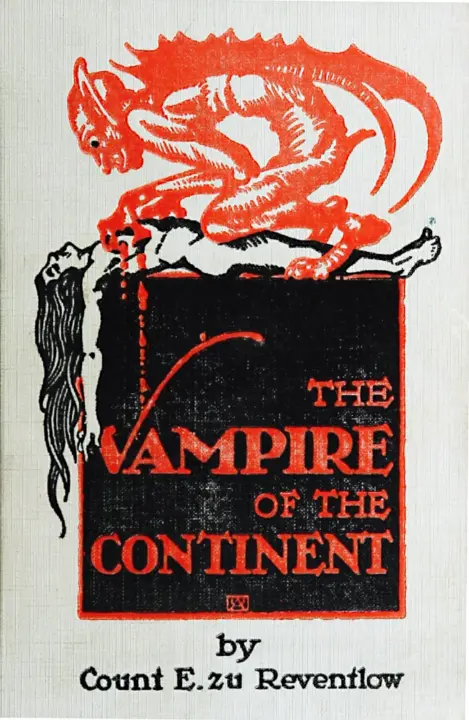
THE CLASSIC COLLECTION · 1916
"The Vampire of the Continent" by Count Ernst zu Reventlow is a historical treatise written in the early 20th century. The work systematically critiques and analyzes the role of England in shaping modern European history since the late 16th century, portraying it as a nation driven by greed and imperial ambitions. The author emphasizes England's influence on conflicts and power dynamics, presenting it as a "vampire" that feeds off the resources and prosperity of other nations, particularly during periods of war and upheaval. At the start of the work, the translator’s preface sets the stage for Reventlow’s provocative examination of England’s historical actions. It alludes to the myths surrounding England’s role as a liberator, emphasizing instead the destructive impact its imperial pursuits had on Europe and the world. The opening chapters delve into the narratives surrounding key historical events, such as the defeat of the Spanish Armada, notably reinterpreting them through a lens critical of English statecraft. The author's overarching argument is that England, often viewed as a benefactor in historical accounts, has acted primarily out of self-interest and avarice, undermining the stability and prosperity of its continental neighbors in the process.
Introduction adapted from the source catalogue; source summaries may be automatically generated.
Free to read · English · 54,831 words · No account needed
MAKE TIME FOR A GOOD BOOK
On by default. Untick to stop anonymous reading totals. Each page counts after 10 seconds in view. How this works.
Anonymous counting is on unless you have switched it off.
The Anglo-Japanese Alliance was but the logical consequence of the situation which had been created in the Far East by the war between China and Japan, by the intervention of the European Continental Powers in 1895, and by the expansion of Russia. There can be no doubt that the British statesmen had long been at work. They had for a long time intended drawing Japan, as the strongest adversary of Russia, over to their side. On the other hand, the hope of avenging “the disgrace of Shimonoseki” had operated powerfully among the Japanese nation. England, with the one definite aim of checking Russian expansion before her, had assisted the Japanese Government in every way—with money, credit, political and naval advice. With the help of the Chinese war indemnity and of British loans, Japan, between 1895 and 1904, built up a small but excellent fleet, and organized her army according to the German pattern—whereby she was actively seconded by German officers, who were engaged as instructors. These officers laid, during years of peace, the basis of the Japanese victories, which were due first and foremost to German military science. The German army manœuvres also played their part, for they were frequently visited by studious and energetic Japanese officers. Thus did German diplomacy, on the one hand, and the German army, on the other, take diametrically opposite sides: namely, for Russia, and against her. Truly a deplorable spectacle!
The way in which the Russo-Japanese War was prepared, begun, and carried out, furnishes another typical example of British methods. England did not need to have recourse, in the case of Japan, to arguments—for Japan was already convinced. England only needed to pour oil on the fire, to add to her ally’s strength where this was necessary, to take the political and diplomatic reins into her own hands—and then, when war had broken out, to point with unmistakable clearness to her all-powerful fleet which ruled the seas. Under these circumstances, who else could venture to say a word? Japan fought England’s battles on sea and on land. The Russian fleet was annihilated at Tsushima and in the harbor of Port Arthur; the Russian armies were driven with terrible loss from Liaotung and Manchuria. Port Arthur fell into the hands of the Japanese. The satisfaction in London would certainly have been greater if the Japanese triumph had not been so overwhelming. England wished the Russian fleet to be entirely destroyed, but she would also liked to have seen three-quarters of the Japanese fleet at the bottom of the sea. Instead of that Japan became, thanks to her navy, the predominant Power in the Far East. This solution was not, from the English point of view, an ideal one; but it was not an unprofitable one either—or at any rate any disadvantages it might have, did not seem likely to manifest themselves for a very long time to come. It was England who, cleverly screened behind the United States, prevented Japan from obtaining a war indemnity in Portsmouth. In this way did the two Anglo-Saxon nations inflict far greater damage on Japan, than was ever inflicted by the intervention of the Continental Powers in 1895. Japan’s army and navy have thereby suffered considerably in their development up till the present day; the Japanese finances have ever since been in a critical condition; and the population as a whole has been reduced to a state of poverty resulting from overtaxation, such as no country has ever witnessed after a victorious war. About the same time, England caused the Alliance between herself and her impoverished friend to be consolidated, and the duties resulting from it for either Power to be extended. On the whole, the danger in the Far East had been suppressed; Japan had been bound to Great Britain and rendered economically dependent on the latter. Japan’s resources were exhausted, and she had been placed in the impossibility of recovering her strength for many years to come. England sought, at the same time, to widen as much as possible the gulf, already then perceptible, between America and Japan. It was in England’s interest that the gulf in question should not be bridged over—but, on the other hand, the quarrel must not be allowed to lead to war. The London Cabinet has had, nevertheless, considerable difficulty at times in preventing war from breaking out.
Your reading position is saved on this browser. Take it to another device with a library code. Reading pages adapt to text, rather than matching a printed edition.
BEHIND THE BOOK
This eBook is for the use of anyone anywhere in the United States and most other parts of the world at no cost and with almost no restrictions whatsoever. You may copy it, give it away or re-use it under the terms of the Project Gutenberg License included with this eBook or online at www.gutenberg.org. If you are not located in the United States, you will have to check the laws of the country where you are located before using this eBook. Read the source licence.
The original source file, including credits and licence, is retained by this library. Request an original-format copy at no charge. Please include the book title and Project Gutenberg identifier #66468.
KEEP YOUR CURIOSITY GOING
Cécile Tormay

Moritz Busch
John L. Ransom
Frances Wright
Cécile Tormay

Mabel Potter Daggett