THE CLASSIC COLLECTION✦An outlaw’s diary: the CommuneCLASSIC FREE BOOKS
An outlaw’s diary: the Commune
Cécile Tormay
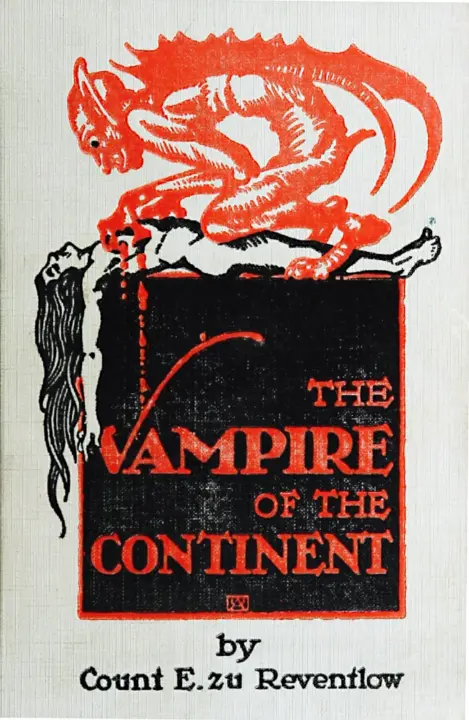
THE CLASSIC COLLECTION · 1916
"The Vampire of the Continent" by Count Ernst zu Reventlow is a historical treatise written in the early 20th century. The work systematically critiques and analyzes the role of England in shaping modern European history since the late 16th century, portraying it as a nation driven by greed and imperial ambitions. The author emphasizes England's influence on conflicts and power dynamics, presenting it as a "vampire" that feeds off the resources and prosperity of other nations, particularly during periods of war and upheaval. At the start of the work, the translator’s preface sets the stage for Reventlow’s provocative examination of England’s historical actions. It alludes to the myths surrounding England’s role as a liberator, emphasizing instead the destructive impact its imperial pursuits had on Europe and the world. The opening chapters delve into the narratives surrounding key historical events, such as the defeat of the Spanish Armada, notably reinterpreting them through a lens critical of English statecraft. The author's overarching argument is that England, often viewed as a benefactor in historical accounts, has acted primarily out of self-interest and avarice, undermining the stability and prosperity of its continental neighbors in the process.
Introduction adapted from the source catalogue; source summaries may be automatically generated.
Free to read · English · 54,831 words · No account needed
MAKE TIME FOR A GOOD BOOK
On by default. Untick to stop anonymous reading totals. Each page counts after 10 seconds in view. How this works.
Anonymous counting is on unless you have switched it off.
The English were not yet uneasy. The tremendous start which it had, enabled British industry to dominate its rival in all markets. The immense difference between the means of production and distribution, and especially between the capital, at the disposal of either country, was well known. This fact alone was sufficient to prevent any uneasiness cropping up. Lack of German capital, and an extreme and lasting tension of German credit, on the one hand; immense English capital on the other: such was the position of affairs towards the close of the last century.
But England is in the habit of carefully observing even the first rudimentary beginnings of everything calculated to damage the monopoly, which Providence has granted her in the markets of this world. In 1896 the former Prime Minister, Lord Rosebery, declared in a public meeting that he attributed the disturbance of the friendly relations between England and Germany not only to the Transvaal question, but above all to the fact that Germany was beginning to catch up England in the economic race. He himself was quite surprised by the technical and commercial progress achieved by the Germans; German competition in these spheres was a danger of the future. Germany possessed the most complete system of technical education, and was therefore the most dangerous rival of England; in fact, she even menaced British trade in India and Egypt. The same politician said later: “We are threatened by a terrible adversary, who wears us out as surely as the sea wears out the unprotected parts of a coast. I refer to Germany.”
Lord Rosebery was quite right. What he termed a disturbance of the friendly relations between Germany and England—namely, the outburst of mob fury in the latter country after the German Emperor’s telegram to President Krüger—was due only in part to the South African complications. In fact, these certainly furnished the lesser motive, for Great Britain, being all-powerful at sea, had nothing to fear in the future from Germany in South Africa. The South African question was settled. But German commercial competition, and the development of German industry, were quite different matters. They could be suppressed neither by a quod non of the British Government, nor by a clatter of swords. The principal motive of English unrest resided in the feeling, partly conscious and partly unconscious, that German trade had risen from humble origins to an astonishing height of prosperity by its own unaided efforts, and in spite of the most difficult conditions. In the course of our pilgrimage through the centuries which tell of the development of British piracy, we have seen that it is by no means the superior capacity or the originality of the English people which have permitted them to obtain possession of the markets of the world. An exceptionally favorable geographical position; the ability to inflict in the most cunning and unscrupulous manner damage on other nations, which were either exploited if possible by their best forces being drawn by England into her own service, or which, if this was impossible, were paralysed in such a way that they destroyed themselves: such have been the factors of the development of British wealth and power. The incurable madness of the Continental Powers, which perpetually tore each other to pieces and exhausted their resources for the greater glory of the British grocer, did the rest. But never did the superior productivity, the superior intelligence, and the honest work, of the English, have a share in the building up of England’s monopoly. Germany before the Thirty Years’ War stood, in respect of such qualities, on a far higher level than England, as did also Italy at the time of the Renaissance, Holland in the seventeenth century, and France in the days of Colbert and of Napoleon I. And now, after the long interval that had elapsed since the War of Liberation, during which the monopoly of industry and trade had appeared to the English as if it were given them by Providence—after all these years, there suddenly arose the new German Empire. The latter was, it is true, as yet without many resources; but it proved itself a hard-working and talented competitor. Was it not inevitable that the noble British blood should boil? How could the German nation, which up till then had been poor and despised, dare to compete with British industry, not only in the German but even in the English market—nay, even in the world market?
Your reading position is saved on this browser. Take it to another device with a library code. Reading pages adapt to text, rather than matching a printed edition.
BEHIND THE BOOK
This eBook is for the use of anyone anywhere in the United States and most other parts of the world at no cost and with almost no restrictions whatsoever. You may copy it, give it away or re-use it under the terms of the Project Gutenberg License included with this eBook or online at www.gutenberg.org. If you are not located in the United States, you will have to check the laws of the country where you are located before using this eBook. Read the source licence.
The original source file, including credits and licence, is retained by this library. Request an original-format copy at no charge. Please include the book title and Project Gutenberg identifier #66468.
KEEP YOUR CURIOSITY GOING
Cécile Tormay

Moritz Busch
John L. Ransom
Frances Wright
Cécile Tormay

Mabel Potter Daggett