THE CLASSIC COLLECTION✦An outlaw’s diary: the CommuneCLASSIC FREE BOOKS
An outlaw’s diary: the Commune
Cécile Tormay
THE CLASSIC COLLECTION · 1916
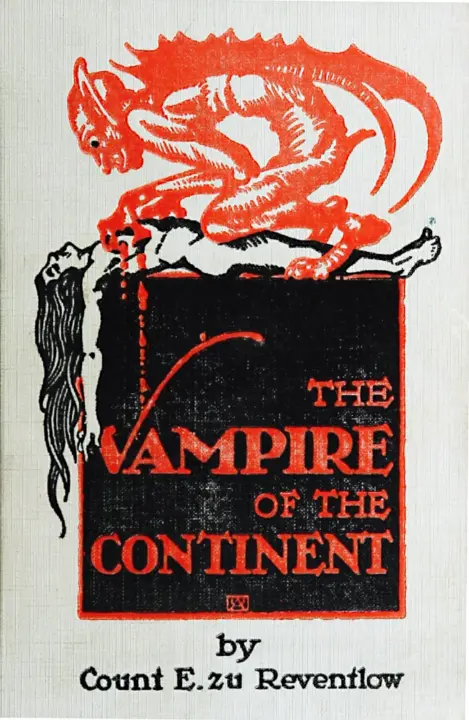
"The Vampire of the Continent" by Count Ernst zu Reventlow is a historical treatise written in the early 20th century. The work systematically critiques and analyzes the role of England in shaping modern European history since the late 16th century, portraying it as a nation driven by greed and imperial ambitions. The author emphasizes England's influence on conflicts and power dynamics, presenting it as a "vampire" that feeds off the resources and prosperity of other nations, particularly during periods of war and upheaval. At the start of the work, the translator’s preface sets the stage for Reventlow’s provocative examination of England’s historical actions. It alludes to the myths surrounding England’s role as a liberator, emphasizing instead the destructive impact its imperial pursuits had on Europe and the world. The opening chapters delve into the narratives surrounding key historical events, such as the defeat of the Spanish Armada, notably reinterpreting them through a lens critical of English statecraft. The author's overarching argument is that England, often viewed as a benefactor in historical accounts, has acted primarily out of self-interest and avarice, undermining the stability and prosperity of its continental neighbors in the process.
Introduction adapted from the source catalogue; source summaries may be automatically generated.
Free to read · English · 54,831 words · No account needed
MAKE TIME FOR A GOOD BOOK
On by default. Untick to stop anonymous reading totals. Each page counts after 10 seconds in view. How this works.
Anonymous counting is on unless you have switched it off.
Great Britain’s world-position was greater, stronger, and more influential, than ever, after the Napoleonic wars. Her warships ruled the seas, and no other nation could even think of challenging British maritime supremacy. The British fleet was regarded as not only invincible, but as irresistible. Europe had been persuaded that her “liberation” was due to that fleet. For the first time for many centuries, England had no “enemy” on the Continent, for the simple reason that she needed none. The weakened and exhausted Continent lay at the mercy of John Bull, and the latter did not hesitate to exploit it. Especially was this the case with the German States, which were separated from each other by a wall of prohibitive tariffs, but whose markets were unreservedly open to foreign countries. France was clever and experienced enough to continue protecting her industry even after the fall of Napoleon. In this way did the break-up of the Continental Blockade have a destructive effect on the industry of several German States, during many years; all the more so as the English Government and English merchants alike had recourse, with their usual absence of scruples, to corruption and other dishonorable means for crushing German industrial competition ab ovo. The superstitious veneration which was entertained in Germany up till a comparatively recent date for all “genuinely English” products, dates back, for the main part, to that time.
The era of great battles on the plains of Europe was over. But a time of political unrest in the interior of the various European States set in; this unrest reached its culminating point in the explosions of 1848. Such unrest was a source of particular satisfaction to England, for it weakened and disorganised all her Continental rivals.
Down to the time of the Crimean war (1855), the Eastern question remained veiled in considerable obscurity; England, Russia, Turkey, France, and Austria-Hungary played a curious and very complicated game of political and diplomatic chess. This game was still further complicated when Mehmed Ali appeared on the scene, and marched on Constantinople. It is impossible, within the limits of the present work, to dwell on those events. We must content ourselves with describing, in general terms, the part played by England. The latter did not wish to see any of the Continental Powers in possession of Constantinople; and she also wished to prevent by all means an alliance between the Porte and any of the Powers. It was from these two considerations that English policy derived its principle of the “maintenance and independence” of Turkey. That policy, on the other hand, aimed at drawing Turkey as much as possible into the meshes of Great Britain’s net; in this way Turkey could be conveniently played off against France or Russia, as the occasion required it. Being herself an insular Power, England needed the services of a Continental Power in all Eastern matters. According as time or circumstances dictated, Austria-Hungary or France was selected for this honor; but Russia was not disdained either if the occasion required it. During the period of Mehmed All’s insurrection, English policy had three distinct aims in view: firstly, to prevent Mehmed Ali from capturing Constantinople; secondly, to prevent the development—desired by France—of intimate relations between him and the French Government; thirdly, to prevent him concluding an alliance with the Sultan, and thus strengthening the Porte. Great Britain’s anxiety concerning France was not unfounded; for the French had turned their eyes towards Egypt. In all these lengthy quarrels, the decisive word was spoken by the all-powerful British navy. The old English principle, according to which every opportunity should be seized upon in order to destroy all foreign fleets—whether the latter were peaceful or hostile at the moment of destruction did not matter: this principle proved extremely valuable. Its utility (from the English point of view) had been manifested in 1807, at the moment of the theft of the Danish fleet. Thus did it come about that, at the instigation of Great Britain, the Turkish fleet was destroyed “by mistake” at Navarino. An allied Anglo-Franco-Russian fleet sailed in 1824 to Navarino, where the Turkish fleet lay. An agreement had been made whereby negotiations should take place with the Turks, and it had further been resolved by the allied commanders not to open fire unless the Turks did so. Suddenly a shot was fired, and it has never yet been ascertained on which side; but the English declared that it was the Turks who had fired it. The result was the destruction, or rather the massacre, of the wholly unprepared Turkish fleet. The English Admiral had already received his instructions from London, but in the British Parliament all this was, of course, denied. The English Prime Minister even gave utterance to the memorable words: “The destruction of the Turkish fleet was an untoward event.” But “unfortunately” could things not be changed! Mehmed Ali’s future fleet had been partly annihilated, partly captured by the English, whose ships, in turn, occupied with success the ports and harbors of Syria.
Your reading position is saved on this browser. Take it to another device with a library code. Reading pages adapt to text, rather than matching a printed edition.
BEHIND THE BOOK
This eBook is for the use of anyone anywhere in the United States and most other parts of the world at no cost and with almost no restrictions whatsoever. You may copy it, give it away or re-use it under the terms of the Project Gutenberg License included with this eBook or online at www.gutenberg.org. If you are not located in the United States, you will have to check the laws of the country where you are located before using this eBook. Read the source licence.
The original source file, including credits and licence, is retained by this library. Request an original-format copy at no charge. Please include the book title and Project Gutenberg identifier #66468.
KEEP YOUR CURIOSITY GOING
Cécile Tormay

Moritz Busch
John L. Ransom
Frances Wright
Cécile Tormay

Mabel Potter Daggett