THE CLASSIC COLLECTION✦An outlaw’s diary: the CommuneCLASSIC FREE BOOKS
An outlaw’s diary: the Commune
Cécile Tormay
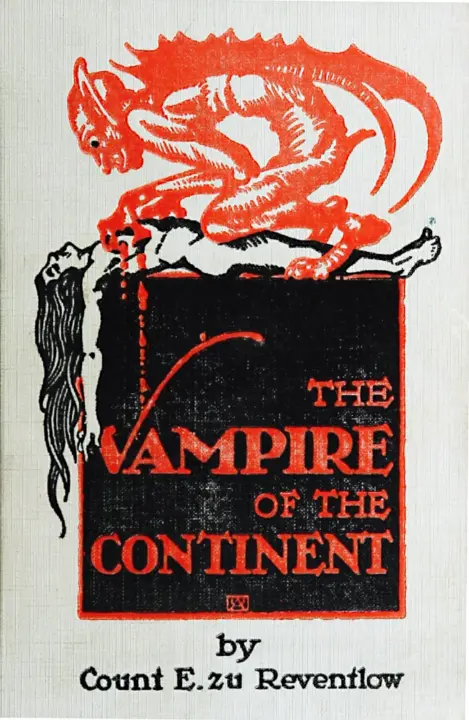
THE CLASSIC COLLECTION · 1916
"The Vampire of the Continent" by Count Ernst zu Reventlow is a historical treatise written in the early 20th century. The work systematically critiques and analyzes the role of England in shaping modern European history since the late 16th century, portraying it as a nation driven by greed and imperial ambitions. The author emphasizes England's influence on conflicts and power dynamics, presenting it as a "vampire" that feeds off the resources and prosperity of other nations, particularly during periods of war and upheaval. At the start of the work, the translator’s preface sets the stage for Reventlow’s provocative examination of England’s historical actions. It alludes to the myths surrounding England’s role as a liberator, emphasizing instead the destructive impact its imperial pursuits had on Europe and the world. The opening chapters delve into the narratives surrounding key historical events, such as the defeat of the Spanish Armada, notably reinterpreting them through a lens critical of English statecraft. The author's overarching argument is that England, often viewed as a benefactor in historical accounts, has acted primarily out of self-interest and avarice, undermining the stability and prosperity of its continental neighbors in the process.
Introduction adapted from the source catalogue; source summaries may be automatically generated.
Free to read · English · 54,831 words · No account needed
MAKE TIME FOR A GOOD BOOK
On by default. Untick to stop anonymous reading totals. Each page counts after 10 seconds in view. How this works.
Anonymous counting is on unless you have switched it off.
Napoleon had not, from the outset, menaced the existence of England as an independent Power and as a seafaring nation. His attempts to effect a landing in the island, and subsequently to exhaust the resources of the English by means of the Continental Blockade, were purely defensive measures. England it was who began the attack on France, for reasons which—as is always the case with such English attacks—were based on trading interests. It was in order to consolidate and develop her empire of the seas that England continually fanned the flames of war in Europe during twenty years—and at the end of that time she came proudly forward as the “liberator of Europe”! The simple-minded Germans believed it; and there are some who still believe it to-day. Innumerable historical works prove this, and endeavor to make out that we owe an incalculable debt of thanks to England for having safeguarded the liberty of the nations. There is, in fact, a legend circulated in Germany, to the effect that the English of those days were entirely different to their descendants to-day. Other people, again, are of opinion that the “golden age” of liberty-loving Britain came to an end with the wars of the Revolution; but they are firmly convinced that such an age existed prior to that date. The one view is as erroneous as the other. The methods and aims of the English nation have remained exactly the same, from the day when England, as an “island,” was definitely differentiated from the “Continent”—when, in consequence, the egotistical interests of the former entered into conflict with the interests of Europe.
CHAPTER VII
ENGLAND DIGESTS HER BOOTY—THE CONTINENT GRADUALLY BECOMES UNRULY
1815–1890
England did not wish to leave the Continent any time to organise resistance to her commercial policy. Once Napoleon had been rendered harmless—in fact from the very moment when the battle of Waterloo developed into a great Prussian victory—we find her alongside of France. England restored to France the latter’s King, who had resided on English soil; she concluded the long-foreseen agreement with Talleyrand; and thus, in conjunction with Russia, did she re-arrange the map of Europe. It was customary in Prussia in those days, and it is still customary to-day, to criticise the incapacity of the Prussian representatives at the Congress of Vienna, and to repeat the words of Blücher: “the pen has gone and lost everything which the sword had won.” In itself, the criticism is perfectly justified; but the responsibility for what took place at the Congress of Vienna cannot be ascribed solely to the Prussian diplomatists. The fact of the matter was that the Great Powers wished neither a strong Prussia nor a strong Germany to arise. The letter written, before the War of Liberation, by Baron Stein to the Earl of Munster (the British statesman), appears to us to-day almost touching in its simplicity: “My desire is to see Germany great and strong, so that she may regain her nationality and her independence, and maintain them in her position between France and Russia.” But that was just what no single European Power desired, least of all England. For the latter knew that a strong, united Germany would constitute an important factor in the world’s industry, and would no longer be at the mercy of English manufacturers and merchants. It must be noted, further, that the spectacle of another nation growing in strength and prosperity has always been extremely distasteful to the Englishman. At first the English diplomatists let the Sovereigns of Europe amuse themselves with discussions concerning Legitimacy; for in this way could the nations be deceived as to their real interests. “Legitimacy” proved itself to be something excellently adapted to the interests of France—and of France only; thanks to the wonderfully skilful use made of this new rallying-cry by Talleyrand, the land of Napoleon was able, despite its defeat, to take up a relatively strong position. England, whilst pretending to be wholly disinterested, kept Malta and Gibraltar; but she gave back a few colonies to France. All the more energetically did England insist upon the territories which border the North Sea and the Channel being distributed in the manner most agreeable to her. Prussia was compelled to hand over her ancient province East Frisia to Hanover, the latter being, we must remember, a sort of English fief on the Continent. Prussia was thus without a single port on the North Sea. England further succeeded in persuading the Congress of Vienna, through the agency of the Duke of Wellington, to unite Holland and Belgium—under the pretext that Belgium, left to herself, would be crushed by France. The British Prince Regent hoped in this way to bring both countries entirely under England’s influence. The fact that the Belgian provinces had formerly belonged to the German Empire was, of course, wholly ignored; and much less still did it occur to anyone to revise the Treaty of Westphalia. Under England’s influence—which remained, however, as unobtrusive as possible—the Congress succeeded in shutting Prussia off completely from the North Sea, albeit without Prussia Napoleon would never have been crushed. Prussia was placed, as a result of the decisions of the Congress, in so unfavorable a geographical position, that she was nearly rent asunder into two separate parts; the task of defending her frontiers in West and East was thus rendered as difficult as could be. Denmark kept Schleswig-Holstein, and basked once more in the sun of England’s favor; for she henceforth held Prussia in check, seeing that she commanded the entry to the straits. Each of the States forming the German Staatenbund was granted the widest possible autonomy, in the well-founded belief that this was the most efficacious way of preventing the formation of a United Germany.
Your reading position is saved on this browser. Take it to another device with a library code. Reading pages adapt to text, rather than matching a printed edition.
BEHIND THE BOOK
This eBook is for the use of anyone anywhere in the United States and most other parts of the world at no cost and with almost no restrictions whatsoever. You may copy it, give it away or re-use it under the terms of the Project Gutenberg License included with this eBook or online at www.gutenberg.org. If you are not located in the United States, you will have to check the laws of the country where you are located before using this eBook. Read the source licence.
The original source file, including credits and licence, is retained by this library. Request an original-format copy at no charge. Please include the book title and Project Gutenberg identifier #66468.
KEEP YOUR CURIOSITY GOING
Cécile Tormay

Moritz Busch
John L. Ransom
Frances Wright
Cécile Tormay

Mabel Potter Daggett