THE CLASSIC COLLECTION✦An outlaw’s diary: the CommuneCLASSIC FREE BOOKS
An outlaw’s diary: the Commune
Cécile Tormay
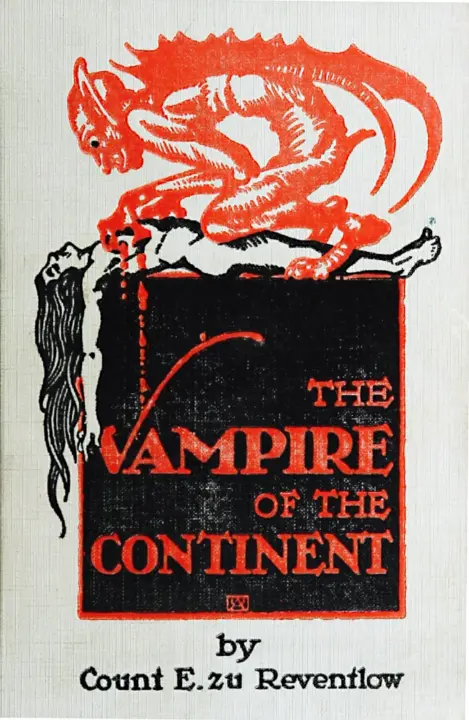
THE CLASSIC COLLECTION · 1916
"The Vampire of the Continent" by Count Ernst zu Reventlow is a historical treatise written in the early 20th century. The work systematically critiques and analyzes the role of England in shaping modern European history since the late 16th century, portraying it as a nation driven by greed and imperial ambitions. The author emphasizes England's influence on conflicts and power dynamics, presenting it as a "vampire" that feeds off the resources and prosperity of other nations, particularly during periods of war and upheaval. At the start of the work, the translator’s preface sets the stage for Reventlow’s provocative examination of England’s historical actions. It alludes to the myths surrounding England’s role as a liberator, emphasizing instead the destructive impact its imperial pursuits had on Europe and the world. The opening chapters delve into the narratives surrounding key historical events, such as the defeat of the Spanish Armada, notably reinterpreting them through a lens critical of English statecraft. The author's overarching argument is that England, often viewed as a benefactor in historical accounts, has acted primarily out of self-interest and avarice, undermining the stability and prosperity of its continental neighbors in the process.
Introduction adapted from the source catalogue; source summaries may be automatically generated.
Free to read · English · 54,831 words · No account needed
MAKE TIME FOR A GOOD BOOK
On by default. Untick to stop anonymous reading totals. Each page counts after 10 seconds in view. How this works.
Anonymous counting is on unless you have switched it off.
England could, in general, be more satisfied with the European situation resulting from the Bosnian crisis, than is generally supposed. Of course, King Edward’s plan to destroy the Austro-German alliance, to humiliate these two Powers, and to excite France and Russia against them, had failed. Why? Because neither France nor Russia were ready, seeing that both had been taken by surprise. Neither was England ready. The London Cabinet had reckoned with a slower development of affairs in the Balkans, and it had not foreseen either the Turkish Revolution or the annexation of Bosnia-Herzegovina. Despite their unpreparedness, the British statesmen had put all the wheels of their diplomatic machinery into movement against the German Empire and her ally.
France and Russia had been compelled to admit that they were not ready. This admission, coupled with their diplomatic defeat, was bound to wound both Powers severely in their national pride and in their prestige. This is what Great Britain secretly desired. The British calculation, that henceforth France and Russia would proceed to apply themselves steadily and systematically to the task of developing their military strength, was correct. British policy had also succeeded in making Russia more anxious than ever to rehabilitate herself in the eyes of the Balkan people; it had succeeded in inspiring Servia with the desire of vengeance, not only against Austria-Hungary, but also against Turkey; and the work of exciting Italy against Austria had progressed satisfactorily.
CHAPTER XIV
THE CATASTROPHE IS MORE CAREFULLY PREPARED
1909–1914
The good Germans breathed more freely, and rejoiced at the political détente. Their astonishment was all the greater when, at the end of 1908 and the beginning of 1909, a terrible cry arose at the other side of the North Sea about an appalling “German peril.” It was stated that the fleet of German Dreadnoughts was in a fair way to out-rivalling that of Great Britain. The cunning tricks of the German Government, and especially of Admiral von Tirpitz, had succeeded in secretly hastening the construction of the German navy. We have already mentioned, in a previous chapter, how skilfully the British Government made use of these lies for the purpose of hoodwinking the Colonies and the United States. The whole story was a falsehood from beginning to end, for there could be no question of the construction of the German fleet being “secretly hastened”; and the British Government knew this perfectly well. The German Government furnished, through its diplomatic representatives and also publicly through the press, more than enough explanations showing that the pretended English reckonings about the number of German battleships were wholly wrong. In the same “year of panic,” 1908–09, a conference of the leading maritime nations was held in London, at the invitation of the British Government. The result of this Conference was the publication of the “London Declaration concerning Maritime Law,” which was subsequently so much commented upon. Its origin was as follows: During the Conference at The Hague in 1907, the leading maritime nations had declared themselves in agreement with the German proposal to institute a permanent international Court of Prizes. It was intended to convert the latter, in future maritime wars, into a Court of Appeal which should be above all the national Prize Courts. But there was no international law corresponding to the proposed international institution. It was the task of the London Conference to create this international law, and it did so in the form of the London Declaration above mentioned. The avowed object of the latter was to draw up provisions for the protection of neutral shipping in time of war. And, as a matter of fact, the contents of the Declaration were such as to furnish, if not a perfect, at all events a very acceptable basis on which the safety and the rights of neutral shipping could be guaranteed. The British Government instructed its delegates to sign the Declaration, just as in 1907 they had signed the Hague Convention concerning the International Prize Court. But no ratification of either agreement ever took place. The British Government, albeit pretending that it was in favor of the ratification, engineered behind the scenes a violent agitation against the London Declaration, and against the establishment of an International Court of Prizes. This agitation lasted several years. The agitators told the credulous and trembling islanders that the whole thing was just simply a base German intrigue. The German Government had succeeded, according to them, in outwitting harmless British statesmen and naval officers in The Hague and in London. The International Court of Prizes and the London Declaration signified nothing else but “Sea Law made in Germany”; it was intended, in the case of an Anglo-German war, to deprive England of all the means which she possessed for defending her own maritime trade, and to prevent her applying in future those time-honored methods which, in the wars of former centuries, had produced such brilliant results. The British nation was naturally most indignant at this unheard-of German infamy; and the consequence was that the House of Lords, by rejecting a Bill which provided that the existing British Prize Law should be modified, frustrated the ratification of the Hague Convention and also of the London Declaration. When war broke out in 1914 the Declaration did not, therefore, possess international validity; but simple-minded persons in Germany and in the neutral countries firmly believed that England would act according to the provisions of the Declaration, since the latter was the fruit of an unanimous agreement among all the maritime nations which took part in the Conference.
Your reading position is saved on this browser. Take it to another device with a library code. Reading pages adapt to text, rather than matching a printed edition.
BEHIND THE BOOK
This eBook is for the use of anyone anywhere in the United States and most other parts of the world at no cost and with almost no restrictions whatsoever. You may copy it, give it away or re-use it under the terms of the Project Gutenberg License included with this eBook or online at www.gutenberg.org. If you are not located in the United States, you will have to check the laws of the country where you are located before using this eBook. Read the source licence.
The original source file, including credits and licence, is retained by this library. Request an original-format copy at no charge. Please include the book title and Project Gutenberg identifier #66468.
KEEP YOUR CURIOSITY GOING
Cécile Tormay

Moritz Busch
John L. Ransom
Frances Wright
Cécile Tormay

Mabel Potter Daggett