THE CLASSIC COLLECTION✦An outlaw’s diary: the CommuneCLASSIC FREE BOOKS
An outlaw’s diary: the Commune
Cécile Tormay
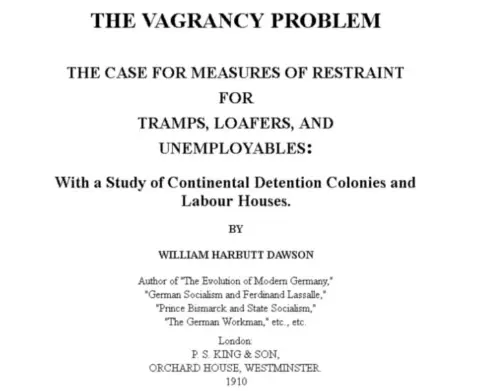
THE CLASSIC COLLECTION · 1910
"The Vagrancy Problem" by William Harbutt Dawson is a sociological treatise written in the early 20th century. The book addresses the increase of vagrancy and the societal challenges posed by tramps, loafers, and unemployables, arguing for the need for legislative measures to manage these social issues more effectively. Dawson draws comparisons with continental approaches to managing similar problems, suggesting a systematic, disciplinary treatment for idlers rather than merely tolerating their existence. The opening of the work establishes the context of England's handling of vagrancy and outlines Dawson's arguments against the current state of the Poor Law system. He discusses the historical treatment of vagrants in England, highlighting the societal indulgence towards idleness, which he contends fosters a culture of dependency. He categorizes various types of loafers, from the nomadic beggar to the settled urban loafer, and critiques the inadequacies of existing policies in deterring vagrancy. Drawing on his extensive experience as a Poor Law Guardian, Dawson emphasizes the need for stricter regulations and harsher treatments of habitual loafers to protect society and uphold the integrity of work and contribution to the community.
Introduction adapted from the source catalogue; source summaries may be automatically generated.
Free to read · English · 67,633 words · No account needed
MAKE TIME FOR A GOOD BOOK
On by default. Untick to stop anonymous reading totals. Each page counts after 10 seconds in view. How this works.
Anonymous counting is on unless you have switched it off.
The work-day is thus about twelve hours in summer. But while, as a rule, the hours are the same for all, work is not altogether measured by time, but according to the capacity of the individual inmate, and where the tasks imposed are unfulfilled at the close of the day, owing to evident sloth or insubordination, some sort of punishment follows.
The dietary on ordinary work-days is as follows:--
Morning.--Coffee with milk and bread.
Noon.--Peas, beans, or lentils with potatoes; vegetable soup with potatoes; cabbage or turnips, with potatoes (the portion of potatoes allowed is 750 grammes for men and 660 grammes for women); or fresh fish and potatoes.
Evening.--Soup, made with rye or wheaten flour, bread, oats, buckwheat, rice or potatoes. (Of bread 550 grammes are allowed to each man and 400 grammes to each woman daily). At Easter, Whitsuntide, Christmas, and on the Emperor's birthday, beef or pork, with beer, is given. Twice a week 100 grammes of meat may be served to men, and 80 grammes to women, instead of the fat which enters into the noon meal. Once a week cheese (100 grammes) is served to men and women, and once also a salted herring.
The whole of the prisoners are kept to work of a kind suited to their strength, capacity and sex, their employment being determined by the Director and the resident doctor together. The principal methods of employment are the following:--
(1) Farm work on the provincial estate at Eichelborn, for which purpose men are farmed out as required.
(2) Building and earth works in connection with provincial institutions
and undertakings.
(3) A series of industries carried on within the walls of the house.
(4) Works on the buildings, both within and without.
(5) Domestic and culinary work such as baking, washing, cleaning,
sewing, etc.
The baking alone is a very serious task, for a thousand mouths have to be fed every day, since the two large ovens provide, not only for the Labour House itself, but for two other large public institutions situated not far away. In the weaving shop there are fourteen hand-looms for linen, the yarn for which is bought. The work done by the carpenters is various and thoroughly creditable. Furniture in request for provincial institutions is chiefly made, such as tables, benches, chests, chairs, toilette tables, and the like, and some of the work I saw would compare with the best products of free labour. "We have just sent out an account for £2,000 worth of goods," said the labour master with pride. The business of cigar making is not, like the other departments, carried on by the Labour House on its own account. The plan adopted is for labour to be farmed to tobacco manufacturers, who send the raw material with a skilled overseer to direct the various processes of preparation. The administration undertakes no responsibility for the quality of the work done, or for the material spoiled, though, on the other hand, the wages charged to the manufacturer are very low, viz., 75 pfennige or 9d. per day. The various employments detailed in a recent official report included locksmithry, joinery and carpentry, basket and chair making, tinning, mason's work, roofing, painting and plastering, weaving and spooling, tailoring, boot and shoe making, saddlery, hair sorting, book-binding, cigar making, machine turning, repairs to tools and implements, copying, manifolding, baking, butchery, knitting, sewing, laundry work, farm and field work, and road making. The weaving department produced 45,547 metres of stuff, the tailoring department produced 158 complete suits and 2,890 single garments, the sewing department 5,099 bed coverlets, towels, shirts, aprons, handkerchiefs, neckerchiefs, etc.; the shoe making department 748 pairs of shoes, the carpentry department 1,319 articles of furniture, and so forth. The total value of the goods produced and of the labour farmed during the year was £6,164, which more than covered the cost of food and clothing.
Your reading position is saved on this browser. Take it to another device with a library code. Reading pages adapt to text, rather than matching a printed edition.
BEHIND THE BOOK
This eBook is for the use of anyone anywhere in the United States and most other parts of the world at no cost and with almost no restrictions whatsoever. You may copy it, give it away or re-use it under the terms of the Project Gutenberg License included with this eBook or online at www.gutenberg.org. If you are not located in the United States, you will have to check the laws of the country where you are located before using this eBook. Read the source licence.
The original source file, including credits and licence, is retained by this library. Request an original-format copy at no charge. Please include the book title and Project Gutenberg identifier #46904.
KEEP YOUR CURIOSITY GOING
Cécile Tormay

Moritz Busch
John L. Ransom
Frances Wright
Cécile Tormay

Mabel Potter Daggett