THE CLASSIC COLLECTION✦An outlaw’s diary: the CommuneCLASSIC FREE BOOKS
An outlaw’s diary: the Commune
Cécile Tormay
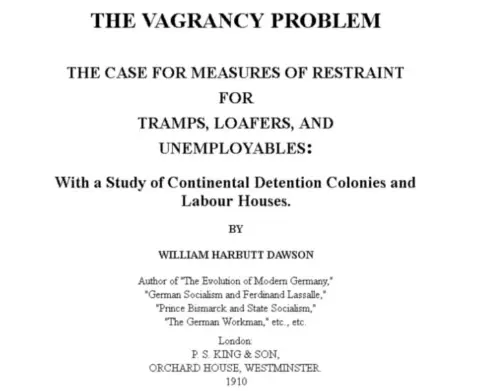
THE CLASSIC COLLECTION · 1910
"The Vagrancy Problem" by William Harbutt Dawson is a sociological treatise written in the early 20th century. The book addresses the increase of vagrancy and the societal challenges posed by tramps, loafers, and unemployables, arguing for the need for legislative measures to manage these social issues more effectively. Dawson draws comparisons with continental approaches to managing similar problems, suggesting a systematic, disciplinary treatment for idlers rather than merely tolerating their existence. The opening of the work establishes the context of England's handling of vagrancy and outlines Dawson's arguments against the current state of the Poor Law system. He discusses the historical treatment of vagrants in England, highlighting the societal indulgence towards idleness, which he contends fosters a culture of dependency. He categorizes various types of loafers, from the nomadic beggar to the settled urban loafer, and critiques the inadequacies of existing policies in deterring vagrancy. Drawing on his extensive experience as a Poor Law Guardian, Dawson emphasizes the need for stricter regulations and harsher treatments of habitual loafers to protect society and uphold the integrity of work and contribution to the community.
Introduction adapted from the source catalogue; source summaries may be automatically generated.
Free to read · English · 67,633 words · No account needed
MAKE TIME FOR A GOOD BOOK
On by default. Untick to stop anonymous reading totals. Each page counts after 10 seconds in view. How this works.
Anonymous counting is on unless you have switched it off.
The rule is to pay the inmates, at first, the minimum rates which apply to their class of work. Small bonuses and gratuities are given in special cases. Extra duties, such as reading aloud fiction in the dormitories (to prevent conversation), singing in church, and service in the bugle squad, are paid for. Non-able-bodied men receive "canteen money" of 3 centimes per day.
The men are paid monthly one half of their earnings to spend as they wish, and the balance goes to their leaving fund, and is paid only on discharge. As a rule, the instalments paid go in the purchase of supplementary food and luxuries, but many frugal workers deposit the whole of their earnings in the leaving fund. The result is that some men, who have been detained a long time, have been known to take away as much as £8 in cash, clothes, and tools.
The Colony's chief sources of revenue are; (1) The maintenance charges of 66 centimes (6-1/2d.) per head per day for able-bodied colonists, and 1 franc 50 centimes (1s. 3d.) for non-able-bodied colonists needing special food, paid in equal shares by the State, the Provinces, and the Communes; (2) the proceeds of the colonists' labour, both on the farm and in the workshops; and (3) the profits of the canteen.
An estimate of revenue and expenditure for the year 1905, prepared by the Director of Merxplas for the Departmental Vagrancy Committee, contained the following principal items:--
Revenue. £ Maintenance grants (3,500 able-bodied inmates at 66 centimes per day, and 1,000 not able-bodied inmates at 1 franc 50 centimes per day) 55,626 Sale of farm produce (milk, vegetables, butter, sheep, pigs, etc.) to private persons 800 Produce of workshops (sold to private persons, prisons, charitable institutions, and discharged inmates) 15,000 Canteen 3,800 Miscellaneous 399 ------- Total £75,625
Expenditure. £
Salaries and allowances, permanent staff, etc. 9,329 Office, library, and school 220 Buildings and furniture 2,400 Maintenance and clothing 23,254 Colonists' earnings 11,720 Canteen (goods purchased) 1,960 Workshops (tools, raw materials, etc.) 14,181 Farm and estate (plants, seeds, manures, live stock, straw and fodder, etc.) 2,047 Miscellaneous 1,020 ------- Total £66,131
It will be seen that a credit balance of £9,494 is shown, but this is obviously a paper balance, inasmuch as no allowance is made for rent, interest on capital, or depreciation. On the other hand, in any full balance sheet a large accretion of capital value through improvements would be shown.
On this subject Monsieur Stroobant writes to me:--
Your reading position is saved on this browser. Take it to another device with a library code. Reading pages adapt to text, rather than matching a printed edition.
BEHIND THE BOOK
This eBook is for the use of anyone anywhere in the United States and most other parts of the world at no cost and with almost no restrictions whatsoever. You may copy it, give it away or re-use it under the terms of the Project Gutenberg License included with this eBook or online at www.gutenberg.org. If you are not located in the United States, you will have to check the laws of the country where you are located before using this eBook. Read the source licence.
The original source file, including credits and licence, is retained by this library. Request an original-format copy at no charge. Please include the book title and Project Gutenberg identifier #46904.
KEEP YOUR CURIOSITY GOING
Cécile Tormay

Moritz Busch
John L. Ransom
Frances Wright
Cécile Tormay

Mabel Potter Daggett