THE CLASSIC COLLECTION✦An outlaw’s diary: the CommuneCLASSIC FREE BOOKS
An outlaw’s diary: the Commune
Cécile Tormay
THE CLASSIC COLLECTION · 1910
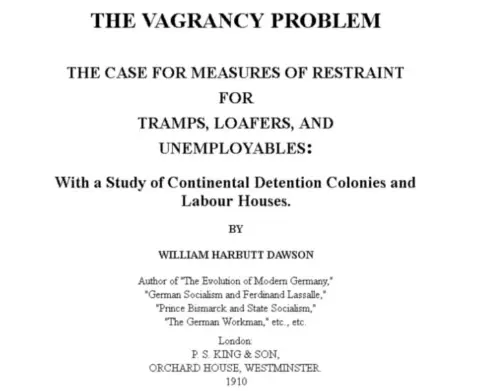
"The Vagrancy Problem" by William Harbutt Dawson is a sociological treatise written in the early 20th century. The book addresses the increase of vagrancy and the societal challenges posed by tramps, loafers, and unemployables, arguing for the need for legislative measures to manage these social issues more effectively. Dawson draws comparisons with continental approaches to managing similar problems, suggesting a systematic, disciplinary treatment for idlers rather than merely tolerating their existence. The opening of the work establishes the context of England's handling of vagrancy and outlines Dawson's arguments against the current state of the Poor Law system. He discusses the historical treatment of vagrants in England, highlighting the societal indulgence towards idleness, which he contends fosters a culture of dependency. He categorizes various types of loafers, from the nomadic beggar to the settled urban loafer, and critiques the inadequacies of existing policies in deterring vagrancy. Drawing on his extensive experience as a Poor Law Guardian, Dawson emphasizes the need for stricter regulations and harsher treatments of habitual loafers to protect society and uphold the integrity of work and contribution to the community.
Introduction adapted from the source catalogue; source summaries may be automatically generated.
Free to read · English · 67,633 words · No account needed
MAKE TIME FOR A GOOD BOOK
On by default. Untick to stop anonymous reading totals. Each page counts after 10 seconds in view. How this works.
Anonymous counting is on unless you have switched it off.
The admissions shown above included the reinstatements (of inmates escaped) after capture, and the admissions by transfer from other institutions. The direct admissions, the admissions by transfer, and the reinstatements after escape are here shown separately for the years 1901 to 1908:--
---------------------------------+-------+-------+-------+-------+-------+------- | 1901. | 1902. | 1903. | 1904. | 1905. | 1906. +-------+-------+-------+-------+-------+------- Admitted direct | 3,280 | 3,390 | 3,460 | 3,316 | 3,186 | 3,071 discharged owing to expiration | | | | | | of sentence and Ministerial | | | | | | decision, conducted to the | | | | | | frontier, and deceased | 2,463 | 2,972 | 3,030 | 2,939 | 2,760 | 3,071 +-------+-------+-------+-------+-------+------- Admitted by transfer | 391 | 353 | 305 | 366 | 341 | 431 Discharged by transfer | 530 | 501 | 452 | 514 | 439 | 504 +-------+-------+-------+-------+-------+------- Reinstated after escape | 677 | 771 | 884 | 933 | 1,097 | 924 Escaped | 769 | 879 | 1,004 | 1,066 | 1,243 | 1,031 ---------------------------------+-------+-------+-------+-------+-------+-------
Those "placed at the disposition of the Government" (for commitment to the Merxplas Depot) under the law of November 27, 1891, during the years 1901 to 1906 belonged to the following classes:--
-----------------------------------+-------+-------+-------+-------+-------+------- | 1901. | 1902. | 1903. | 1904. | 1905. | 1906. +-------+-------+-------+-------+-------+------- Able-bodied beggars and vagrants | | | | | | (Article 13) | 4,314 | 4,509 | 4,637 | 4,614 | 4,618 | 4,419 Able-bodied beggars and vagrants | | | | | | for detention supplementary to | | | | | | imprisonment (Article 14) | 14 | 5 | 12 | 1 | 6 | 7 +-------+-------+-------+-------+-------+------- | 4,348 | 4,514 | 4,649 | 4,615 | 4,624 | 4,426 Deduct reinstatements after escape | 677 | 771 | 884 | 933 | 1,097 | 924 -----------------------------------+-------+-------+-------+-------+-------+-------
The following further table shows the frequency of commitment during a
series of years:--
------------------------------+-------+-------+-------+-------+-------+-------+------- Number of Times | | | | | | | Committed. | 1902. | 1903. | 1904. | 1905. | 1906. | 1907. | 1908. ------------------------------+-------+-------+-------+-------+-------+-------+------- For the first time | 674 | 668 | 558 | 517 | 547 | 519 | 720 For the second time | 546 | 585 | 552 | 595 | 522 | 442 | 561 For the third time | 493 | 472 | 582 | 516 | 488 | 433 | 465 For the fourth time | 446 | 470 | 455 | 406 | 420 | 406 | 425 For the fifth time or oftener | 2,355 | 2,454 | 2,468 | 2,590 | 2,449 | 2,412 | 2,260 +-------+-------+-------+-------+-------+-------+------- Total number of | | | | | | | admissions | 4,514 | 4,649 | 4,615 | 4,624 | 4,426 | 4,212 | 4,431 ------------------------------+-------+-------+-------+-------+-------+-------+-------
The whole of the men capable of working, either much or little, are employed according to their aptitudes and physical capacity, either in farm and land work, in the workshops, in domestic work in and around the establishment, or in the service of outside employers. On a given day in 1907, 1,279 men were engaged on the farm and land, 1,970 in industrial work for the profit of the Colony, 811 in domestic work, and 525 were lent to other institutions.
The men engaged in the fields work in gangs of between fifty and sixty, each under a single overseer. Shelters exist for their accommodation in wet weather, and when it is impossible to do outside work they are employed in the workshops.
The trades and occupations are very numerous, but the principal are brick, pipe and tile making, iron founding, button making, wood-working, mat, boot, and shoe making, weaving, tanning, tailoring, carpentering, and printing.
Several years ago, a Committee appointed by the Lindsey (Lincoln) Quarter Sessions visited Merxplas and reported as follows upon what they saw of the workshops:--[55]
[Footnote 55: Report of the Vagrancy Committee adopted by the Court of Quarter Sessions (Lincolnshire, Parts of Lindsey) on Friday, October 23, 1903.]
Your reading position is saved on this browser. Take it to another device with a library code. Reading pages adapt to text, rather than matching a printed edition.
BEHIND THE BOOK
This eBook is for the use of anyone anywhere in the United States and most other parts of the world at no cost and with almost no restrictions whatsoever. You may copy it, give it away or re-use it under the terms of the Project Gutenberg License included with this eBook or online at www.gutenberg.org. If you are not located in the United States, you will have to check the laws of the country where you are located before using this eBook. Read the source licence.
The original source file, including credits and licence, is retained by this library. Request an original-format copy at no charge. Please include the book title and Project Gutenberg identifier #46904.
KEEP YOUR CURIOSITY GOING
Cécile Tormay

Moritz Busch
John L. Ransom
Frances Wright
Cécile Tormay

Mabel Potter Daggett