THE CLASSIC COLLECTION✦An outlaw’s diary: the CommuneCLASSIC FREE BOOKS
An outlaw’s diary: the Commune
Cécile Tormay
THE CLASSIC COLLECTION · 1910
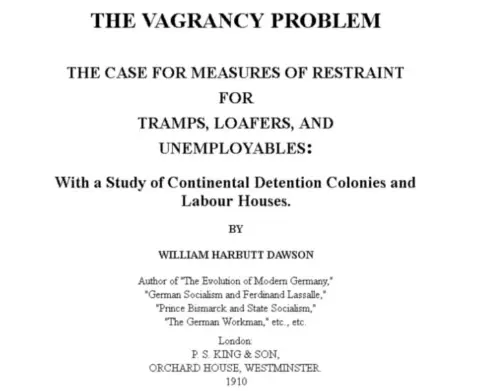
"The Vagrancy Problem" by William Harbutt Dawson is a sociological treatise written in the early 20th century. The book addresses the increase of vagrancy and the societal challenges posed by tramps, loafers, and unemployables, arguing for the need for legislative measures to manage these social issues more effectively. Dawson draws comparisons with continental approaches to managing similar problems, suggesting a systematic, disciplinary treatment for idlers rather than merely tolerating their existence. The opening of the work establishes the context of England's handling of vagrancy and outlines Dawson's arguments against the current state of the Poor Law system. He discusses the historical treatment of vagrants in England, highlighting the societal indulgence towards idleness, which he contends fosters a culture of dependency. He categorizes various types of loafers, from the nomadic beggar to the settled urban loafer, and critiques the inadequacies of existing policies in deterring vagrancy. Drawing on his extensive experience as a Poor Law Guardian, Dawson emphasizes the need for stricter regulations and harsher treatments of habitual loafers to protect society and uphold the integrity of work and contribution to the community.
Introduction adapted from the source catalogue; source summaries may be automatically generated.
Free to read · English · 67,633 words · No account needed
MAKE TIME FOR A GOOD BOOK
On by default. Untick to stop anonymous reading totals. Each page counts after 10 seconds in view. How this works.
Anonymous counting is on unless you have switched it off.
[Footnote 14: Mr. G. A. F. Hervey, writing of Norfolk and Suffolk.
Report for 1902-3, p. 67.]
[Footnote 15: Mr, G. Walsh, reporting on Leicestershire, Lincolnshire, etc. Report for 1907, p. 332.]
[Footnote 16: Mr. R. J. Dansey, writing of the Midland Counties. Report
for 1908, p. 71.]
[Footnote 17: Mr. G. Walsh, writing of the counties of Leicester, Lincoln, Nottingham, etc. Report for 1908, pp. 77, 78.]
As the Departmental Committee on Vagrancy say:--
"It is much easier for a workhouse master, or the superintendent of the casual ward, to allow vagrants to discharge themselves on the morning after admission without labour, than to detain them, and insist upon their doing the regulation task of work, and the discretion which is left to the officers with respect to the discharge of certain classes of vagrants results in a complete variety of practice."[18]
[Footnote 18: Report, Vol. I., pp. 32, 33.]
Again:--
"Where a union carries out the regulations as to detention and task of work there is always a reduction in the number of admissions to their casual wards, but the evidence before us shows that severity of discipline in one union may merely cause the vagrants to frequent other unions."[19]
[Footnote 19: Ibid., Vol. I., p. 28.]
In London, according to the evidence given before that Committee:--
"Some guardians do not detain, some give one task, some another, and some practically none at all.... Some Boards of Guardians say the casuals are working-men honestly looking for work, and there is no doubt they are, but they know where they are going to get it. When they leave, they know to what casual ward they are going, and whether they are going to break stones or pick oakum. The consequence is, that the London vagrants flock to Poplar, Thavies Inn, and the other wards where detention and work are not enforced, or where only a light task is given."[20]
[Footnote 20: Report, Vol. I., p. 30.]
All experience shows that the frequency with which vagrants visit given parts of the country is in exact proportion to the comfort or otherwise of the casual wards, and a change either way means a difference in the number of loafers entertained. "If a tramp likes the ward he is there again within the month, and perhaps in a fortnight," was the verdict of a witness before the Poor Law Commission.
"The slightest relaxation with reference to the quantity or quality of food given in workhouses leads immediately to an increase of vagrants," writes a Poor Law Inspector.[21]
[Footnote 21: Mr. J. S. Davy. Report of the Local Government Board for
1902-3, p. 57.]
Another Inspector, explaining decreases in the numbers of vagrants in some of his districts, says:--
Your reading position is saved on this browser. Take it to another device with a library code. Reading pages adapt to text, rather than matching a printed edition.
BEHIND THE BOOK
This eBook is for the use of anyone anywhere in the United States and most other parts of the world at no cost and with almost no restrictions whatsoever. You may copy it, give it away or re-use it under the terms of the Project Gutenberg License included with this eBook or online at www.gutenberg.org. If you are not located in the United States, you will have to check the laws of the country where you are located before using this eBook. Read the source licence.
The original source file, including credits and licence, is retained by this library. Request an original-format copy at no charge. Please include the book title and Project Gutenberg identifier #46904.
KEEP YOUR CURIOSITY GOING
Cécile Tormay

Moritz Busch
John L. Ransom
Frances Wright
Cécile Tormay

Mabel Potter Daggett