THE CLASSIC COLLECTION✦An outlaw’s diary: the CommuneCLASSIC FREE BOOKS
An outlaw’s diary: the Commune
Cécile Tormay
THE CLASSIC COLLECTION · 1910
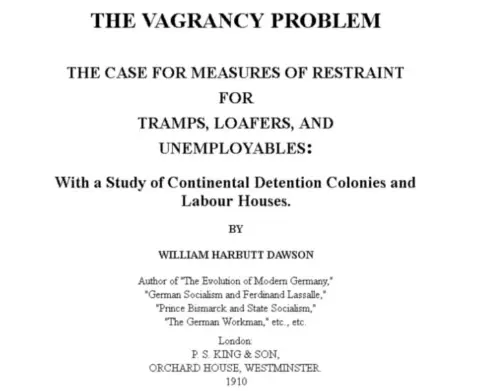
"The Vagrancy Problem" by William Harbutt Dawson is a sociological treatise written in the early 20th century. The book addresses the increase of vagrancy and the societal challenges posed by tramps, loafers, and unemployables, arguing for the need for legislative measures to manage these social issues more effectively. Dawson draws comparisons with continental approaches to managing similar problems, suggesting a systematic, disciplinary treatment for idlers rather than merely tolerating their existence. The opening of the work establishes the context of England's handling of vagrancy and outlines Dawson's arguments against the current state of the Poor Law system. He discusses the historical treatment of vagrants in England, highlighting the societal indulgence towards idleness, which he contends fosters a culture of dependency. He categorizes various types of loafers, from the nomadic beggar to the settled urban loafer, and critiques the inadequacies of existing policies in deterring vagrancy. Drawing on his extensive experience as a Poor Law Guardian, Dawson emphasizes the need for stricter regulations and harsher treatments of habitual loafers to protect society and uphold the integrity of work and contribution to the community.
Introduction adapted from the source catalogue; source summaries may be automatically generated.
Free to read · English · 67,633 words · No account needed
MAKE TIME FOR A GOOD BOOK
On by default. Untick to stop anonymous reading totals. Each page counts after 10 seconds in view. How this works.
Anonymous counting is on unless you have switched it off.
(3) An enumeration made on March 17, 1905, by the chief constable of Northumberland, by means of police officers placed at the most important points, of vagrants on the roads between the hours of 7.0 a.m. and 7 p.m. gave a total of 300 (exclusive of Newcastle and Tynemouth), equal to about 1 per 1,000 of the population of the area covered. On this basis he placed the number of vagrants in England and Wales at 36,000. Here the omission of two important towns largely invalidates computation; their inclusion would unquestionably give a much higher ratio.
[Footnote 8: "In point of distribution through the country vagrancy is found to cling to the Metropolis and its neighbourhood, and to the manufacturing and coal and iron mining districts; it follows also the track of the navvy when any new works of importance are in progress." Report of Poor Law Commission, Vol. II., pp. 161, 162.]
(4) A careful census of vagrants, beggars, migratory poor, etc., is taken by the police for each county, city, and burgh police district in Scotland on two nights in the year, in June and December, showing the number of these persons in (1) prisons or police cells, (2) homes and refuges, hospitals and poorhouses, (3) common lodging-houses or other houses, (4) public parks, gardens or streets, outhouses, sheds, barns, or about pits, brick and other works. The two counts of 1908 gave the following result:--
Men. Women. Children. Total.
June 21 6,815 1,843 1,541 10,199
December 27 6,129 1,391 986 8,506
This was equal to 2.1 and 1.8 per 1,000 of the population respectively, and if these ratios were applied to England and Wales they would represent aggregates of 76,000 and 63,000.
(5) An enumeration of homeless persons in the administrative County of London, made by the London County Council on the night of January 15, 1909, showed a total of 2,088. On that night there were also 1,188 persons in the casual wards of London, and 21,864 in the common lodging-houses and shelters, of whom 10 per cent. were supposed to belong to the vagrant class. This would give a total of 5,462 vagrants as follows:--homeless (sleeping out and walking the streets), 2,088; in casual wards, 1,188; in common lodging-houses and shelters, 2,186; total, 5,462. As the population of the administrative County of London at the date named was estimated at 4,795,757, this total is equal to a ratio of 1.14 per 1,000 of the population. The same ratio for England and Wales would give a vagrant population of about 41,000.
(6) Dr. J. R. Kaye, Medical Officer of Health for the West Riding of Yorkshire, in a report upon the influence of vagrancy in the dissemination of disease, published in 1904, estimated the roving population at 36,000. He has, at my request, explained the basis of his calculation as follows:--
Your reading position is saved on this browser. Take it to another device with a library code. Reading pages adapt to text, rather than matching a printed edition.
BEHIND THE BOOK
This eBook is for the use of anyone anywhere in the United States and most other parts of the world at no cost and with almost no restrictions whatsoever. You may copy it, give it away or re-use it under the terms of the Project Gutenberg License included with this eBook or online at www.gutenberg.org. If you are not located in the United States, you will have to check the laws of the country where you are located before using this eBook. Read the source licence.
The original source file, including credits and licence, is retained by this library. Request an original-format copy at no charge. Please include the book title and Project Gutenberg identifier #46904.
KEEP YOUR CURIOSITY GOING
Cécile Tormay

Moritz Busch
John L. Ransom
Frances Wright
Cécile Tormay

Mabel Potter Daggett