THE CLASSIC COLLECTION✦An outlaw’s diary: the CommuneCLASSIC FREE BOOKS
An outlaw’s diary: the Commune
Cécile Tormay
THE CLASSIC COLLECTION · 1910
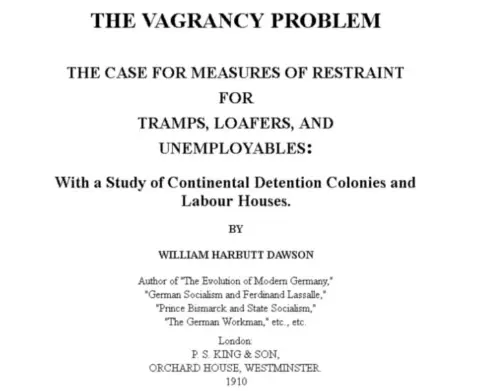
"The Vagrancy Problem" by William Harbutt Dawson is a sociological treatise written in the early 20th century. The book addresses the increase of vagrancy and the societal challenges posed by tramps, loafers, and unemployables, arguing for the need for legislative measures to manage these social issues more effectively. Dawson draws comparisons with continental approaches to managing similar problems, suggesting a systematic, disciplinary treatment for idlers rather than merely tolerating their existence. The opening of the work establishes the context of England's handling of vagrancy and outlines Dawson's arguments against the current state of the Poor Law system. He discusses the historical treatment of vagrants in England, highlighting the societal indulgence towards idleness, which he contends fosters a culture of dependency. He categorizes various types of loafers, from the nomadic beggar to the settled urban loafer, and critiques the inadequacies of existing policies in deterring vagrancy. Drawing on his extensive experience as a Poor Law Guardian, Dawson emphasizes the need for stricter regulations and harsher treatments of habitual loafers to protect society and uphold the integrity of work and contribution to the community.
Introduction adapted from the source catalogue; source summaries may be automatically generated.
Free to read · English · 67,633 words · No account needed
MAKE TIME FOR A GOOD BOOK
On by default. Untick to stop anonymous reading totals. Each page counts after 10 seconds in view. How this works.
Anonymous counting is on unless you have switched it off.
"These are the total numbers of casual paupers entered in the returns as relieved on January 1, 1909. The total number relieved on the night of January 1, was 9,747. To what extent the former totals include twice over persons who received relief in more than one union on the same day is not ascertainable, and it is possible that the total of the paupers relieved on the night of January 1, although omitting many casual paupers who, after their discharge from the workhouse in the morning, did not again have recourse to the Poor Law on the same day, is the more reliable."[4]
That the vagrant population, even enumerated in this partial manner, is increasing is shown by the following table, showing for a period of ten years the number of casuals relieved during day and night on January 1:--
---------+--------------------------
| Casual Paupers Relieved.
+-------------+------------
Year. | At any time | On the
| during | night of
| January 1. | January 1.
---------+-------------+------------
1899 | 13,366 | 7,499
1900 | 9,841 | 5,579
1901 | 11,658 | 6,795
1902 | 13,178 | 7,840
1903 | 14,475 | 8,266
1904 | 15,634 | 8,519
1905 | 17,524 | 9,768
1906 | 16,823 | 9,708
1907 | 14,957 | 8,346
1908 | 17,083 | 10,436
---------+-------------+------------
It would appear from these figures that a certain relationship exists between vagrancy and trade cycles. Of the years of maximum vagrancy, 1904, 1905, and 1908 were years of more or less acute unemployment, while those of minimum vagrancy, 1900, 1901, and 1902, were years of good or fairly good trade. That the fact of an inter-relationship between vagrancy and the state of trade cannot be pressed unduly, however, is proved by the comparatively narrow limits within which, allowing for increase of population, the figures move. Certainly the figures afford no prima facie justification for supposing that trade depression causes any considerable number of genuine workmen to join the highway population.
[Footnote 4: "Annual Report" for 1908, p. 10.]
Poor Law statistics, however, fail entirely to do justice to the extent of the vagrancy problem. They show the number of vagrants relieved at one time and in one way only; but all vagrants do not receive public help at the same time, and the total number on the road is far larger than the number who call at the workhouses. As to this the testimony of Poor Law Inspectors and all who have studied the vagrancy question at close quarters is unanimous. "A very large number, probably the majority, of vagrants seldom come to the vagrant wards," wrote Mr. J. S. Davy, as Poor Law Inspector for Sussex, Kent, and part of Surrey.[5] "It ought to be remembered," says another Inspector, "that the vagrants admitted to the vagrant wards represent only a very small percentage of the vagrants of the country."[6]
[Footnote 5: Annual Report of the Local Government Board, 1902-3, p.
57.]
[Footnote 6: Ibid., Report of Mr. P. H. Bagenal, p. 147.]
The Departmental Committee on Vagrancy of 1904 endorse this view:--
Your reading position is saved on this browser. Take it to another device with a library code. Reading pages adapt to text, rather than matching a printed edition.
BEHIND THE BOOK
This eBook is for the use of anyone anywhere in the United States and most other parts of the world at no cost and with almost no restrictions whatsoever. You may copy it, give it away or re-use it under the terms of the Project Gutenberg License included with this eBook or online at www.gutenberg.org. If you are not located in the United States, you will have to check the laws of the country where you are located before using this eBook. Read the source licence.
The original source file, including credits and licence, is retained by this library. Request an original-format copy at no charge. Please include the book title and Project Gutenberg identifier #46904.
KEEP YOUR CURIOSITY GOING
Cécile Tormay

Moritz Busch
John L. Ransom
Frances Wright
Cécile Tormay

Mabel Potter Daggett