THE CLASSIC COLLECTION✦An outlaw’s diary: the CommuneCLASSIC FREE BOOKS
An outlaw’s diary: the Commune
Cécile Tormay
THE CLASSIC COLLECTION · 1910
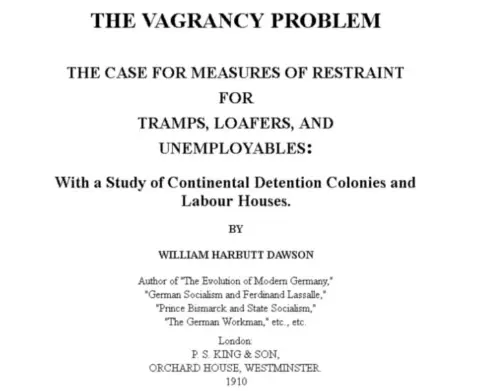
"The Vagrancy Problem" by William Harbutt Dawson is a sociological treatise written in the early 20th century. The book addresses the increase of vagrancy and the societal challenges posed by tramps, loafers, and unemployables, arguing for the need for legislative measures to manage these social issues more effectively. Dawson draws comparisons with continental approaches to managing similar problems, suggesting a systematic, disciplinary treatment for idlers rather than merely tolerating their existence. The opening of the work establishes the context of England's handling of vagrancy and outlines Dawson's arguments against the current state of the Poor Law system. He discusses the historical treatment of vagrants in England, highlighting the societal indulgence towards idleness, which he contends fosters a culture of dependency. He categorizes various types of loafers, from the nomadic beggar to the settled urban loafer, and critiques the inadequacies of existing policies in deterring vagrancy. Drawing on his extensive experience as a Poor Law Guardian, Dawson emphasizes the need for stricter regulations and harsher treatments of habitual loafers to protect society and uphold the integrity of work and contribution to the community.
Introduction adapted from the source catalogue; source summaries may be automatically generated.
Free to read · English · 67,633 words · No account needed
MAKE TIME FOR A GOOD BOOK
On by default. Untick to stop anonymous reading totals. Each page counts after 10 seconds in view. How this works.
Anonymous counting is on unless you have switched it off.
Although no claim to payment is recognised a certain sum, not exceeding 2 francs (1s. 6d.) per month, is credited to every man's account, and the aggregate is paid out to him on discharge; his clothes are then thoroughly repaired or new ones are given to him, and his railway fare is paid, as far as the Swiss frontier, if necessary; in case of need relief is also given to a prisoner's dependents during his incarceration.
The dietary is as follows:--Morning, coffee with milk, potatoes and bread; noon, soup, with vegetables or flour, with meat and salad twice a week; evening, soup and fresh fruit (the latter being occasionally given with Sunday dinner as well). The daily ration of bread is from 22 to 27 ounces, while soup, coffee and vegetables are served to every man ad libitum.
The moral interests of the prisoners are not overlooked. There is a school for the benefit of such young men as choose to attend; every Saturday books and magazines of an edifying and entertaining character are distributed for use the following day; concerts and lectures are given from time to time; and the religious needs of the Colony are ministered to by two visiting chaplains. Letter-writing and visits of friends are allowed once a month.
The number of prisoners on January 1, 1908, was 156, 279 were admitted and 237 were discharged (including 2 deaths and 2 escapes) during the year, and there remained on December 31, 198. The maximum number detained was 198, and the minimum 154. Of the 279 new prisoners 204 were detained for the first time. Further, 172 were single men, 76 were married, 15 were widowers, and 16 were separated from their wives. As to occupations 107 were agricultural labourers, factory operatives, and general labourers, and the remainder represented more than thirty trades. There were 31 foreigners amongst the new prisoners (13 per cent. of the whole), 13 being Italians, 9 Germans, and 6 French. Of the sentences, 148 were for less than six months, 68 were for six and under twelve months, 51 were for one year and under two years, and 12 were for two years and over.
The total number of days worked during the year was 50,531, divided as
follows:--
Small earnings 1,525
Domestic service and cooking 1,660
Washing 612
Baking 332
Tailoring 1,332
Shoemaking and saddlery 1,084
Wood working 1,177
Iron working 1,614
Basket-plaiting 279
Turf cutting 782
Building works 3,723
General labour 535
Improvement works 2,587
Agriculture 33,309
------
Total 50,551
To look after and direct the work of this body of men 48 officers and employees of all kinds were necessary, comprising 3 general overseers, 1 machinist, 28 foremen and chief stockmen in the agricultural departments, 1 saddler, 1 tailor, 1 shoemaker, 1 wheelwright, 1 carpenter, 1 smith, 1 mason (the last seven being skilled men), 3 office employees, and 6 domestic servants.
Your reading position is saved on this browser. Take it to another device with a library code. Reading pages adapt to text, rather than matching a printed edition.
BEHIND THE BOOK
This eBook is for the use of anyone anywhere in the United States and most other parts of the world at no cost and with almost no restrictions whatsoever. You may copy it, give it away or re-use it under the terms of the Project Gutenberg License included with this eBook or online at www.gutenberg.org. If you are not located in the United States, you will have to check the laws of the country where you are located before using this eBook. Read the source licence.
The original source file, including credits and licence, is retained by this library. Request an original-format copy at no charge. Please include the book title and Project Gutenberg identifier #46904.
KEEP YOUR CURIOSITY GOING
Cécile Tormay

Moritz Busch
John L. Ransom
Frances Wright
Cécile Tormay

Mabel Potter Daggett